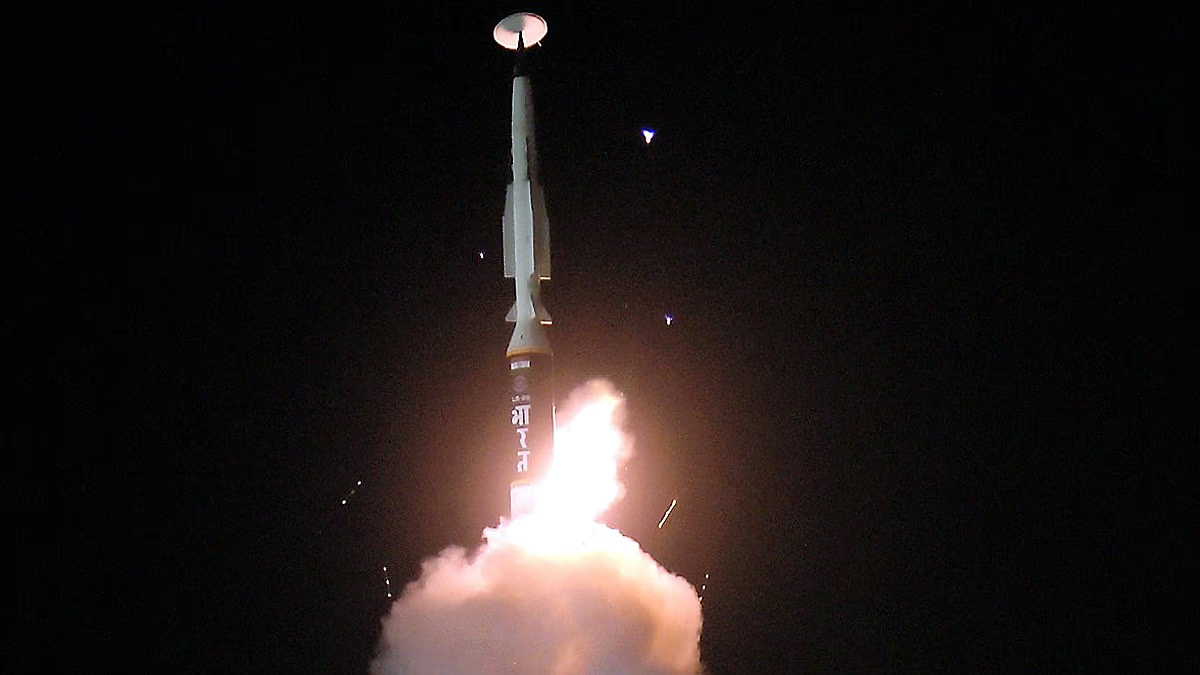
A groundbreaking marvel in Indian defense technology has taken place. The Defence Research and Development Organization (DRDO), through its Hyderabad lab DRDL, has successfully performed a full-scale actively cooled scramjet combustor test lasting over 12 minutes. This achievement solidifies the foundation of India's future hypersonic cruise missile (HCM) endeavors.
While global tests often conclude in under 100 seconds, India has shattered records with a remarkable 720-second (12-minute) demonstration. This isn't just a test—it's a bold stride forward in India's pursuit of hypersonic weaponry superiority.
Hypersonic Speed: Surpassing the speed of sound by fivefold, reaching speeds of 6,100 km/h or more. At such velocities, air friction is capable of melting metals.
Scramjet Engine: An air-breathing engine utilizing atmospheric oxygen to ignite fuel, distinguishing it from conventional jet engines, operational at supersonic speeds. 'Scramjet' signifies Supersonic Combustion Ramjet.
Active Cooling: At Mach 6-7, temperatures soar to thousands of degrees. This system cools the engine by passing fuel or coolant along its walls, preventing melting.
The test was conducted at Hyderabad's state-of-the-art SCPT (Scramjet Connect Pipe Test) facility, where the engine sustained combustion for over 12 minutes.
Ballistic vs. Hypersonic: Ballistic missiles soar to great heights, making them easily trackable. Hypersonic cruise missiles fly at lower altitudes, taking swift, unpredictable paths to elude radar detection.
Impact on Defense Systems: Advanced systems like the S-400 or Patriot struggle to track these swift missiles.
Self-Reliant India: With 100% indigenous technology, partnered with Indian industries, allowing no foreign restrictions to impede progress.
Global Race: While China and the USA participate in this race, India's rapid advancements are now setting a new pace.
LRAShM (Long Range Anti-Ship Missile or Hypersonic Glide Missile): Possesses a range of 1500 km, transitioning from solid booster to cruise and glide mode, effectively targeting moving ships.
ET-LDHCM (Extended Trajectory-Long Duration Hypersonic Cruise Missile): Ground-launched, hyper-glides via booster, before transitioning to a scramjet-driven long cruise, culminating in supersonic target engagement at Mach 6-8 speeds.
AL-HCM (Air-Launched Hypersonic Cruise Missile): Airborne, utilizing Dual Combustion Ramjet (DCR) for reduced weight and enhanced air-breathing efficiency, potentially integrating into the ET-LDHCM.
HSTDV (Hypersonic Technology Demonstrator Vehicle): Initially a scramjet demonstration, evolving through modifications, now developing within LDHCM scope.
BrahMos-II (or BrahMos-K): A BrahMos Aerospace initiative, combining solid boosters and LFDSR (Liquid Fuel Dual Stage Ramjet) for hypersonic capability.
Agni-1P: A two-stage missile with solid propellant, featuring a re-entry vehicle comparable to C-HGB, supporting boost-glide maneuvering with a 1500 km range.
BM-04: A three-stage platform, based on Agni-P, employing advanced C-HGB and 4-control fins, designed for 1500 km reach.
CB-HGB (Common Boost Glide Hypersonic Glide Body): Under Project Dhvani, testing maneuverability in hypersonic stages.
DWB-HGB (Dual Warhead Boost Glide): Tailored for long-range strikes, skirting enemy BMD (Ballistic Missile Defense).
BB-HGB (Boost Bomb Hypersonic Glide Body): Incorporates boost glide, skip glide, and skip re-entry strategies, part of Project Dhvani.
AD-AH (Advanced Defence Against Hypersonics): A potent ally to AD-AM in the next-gen BMD project, fortifying against enemy hypersonics and MIRVs (Multiple Independent Re-entry Vehicles) akin to GPI (Glide Phase Interceptor).
Other Projects: Shrouded in confidentiality, DRDO's 12 projects span aggressive and defensive strategies. Project Vishnu supports ET-LDHCM.
This test fortifies India's standing in the hypersonic domain, reducing reliance on foreign weaponry. As these missiles integrate into India's defense arsenal, they will fortify national invincibility in the years ahead.