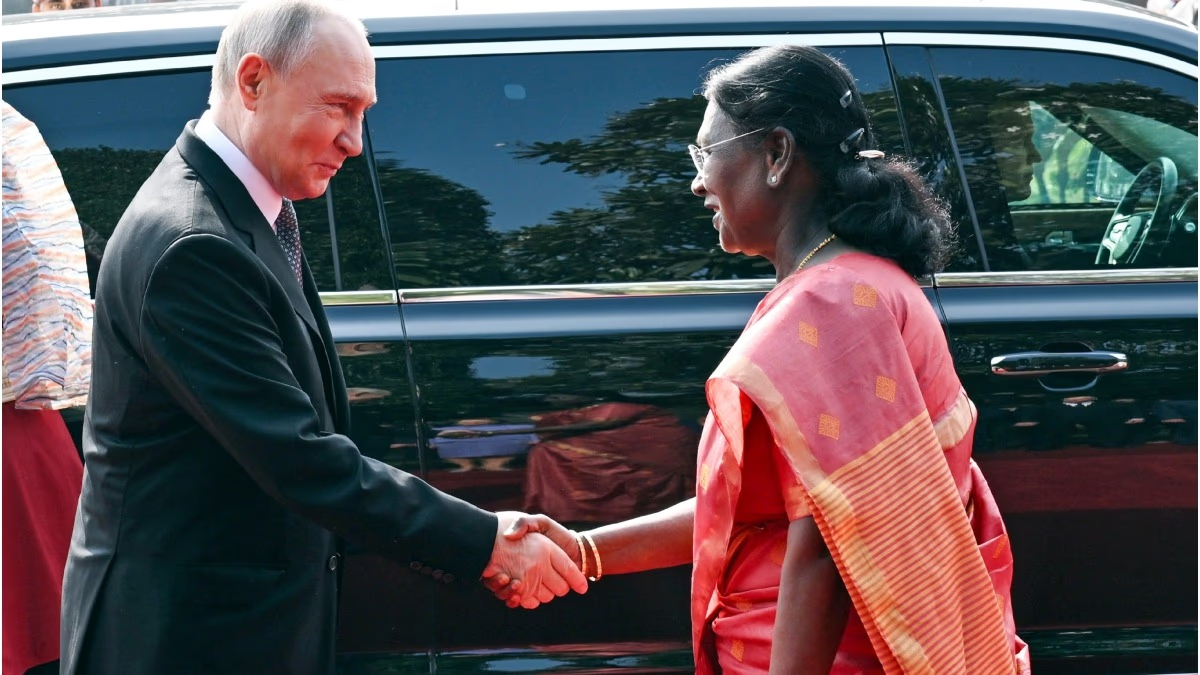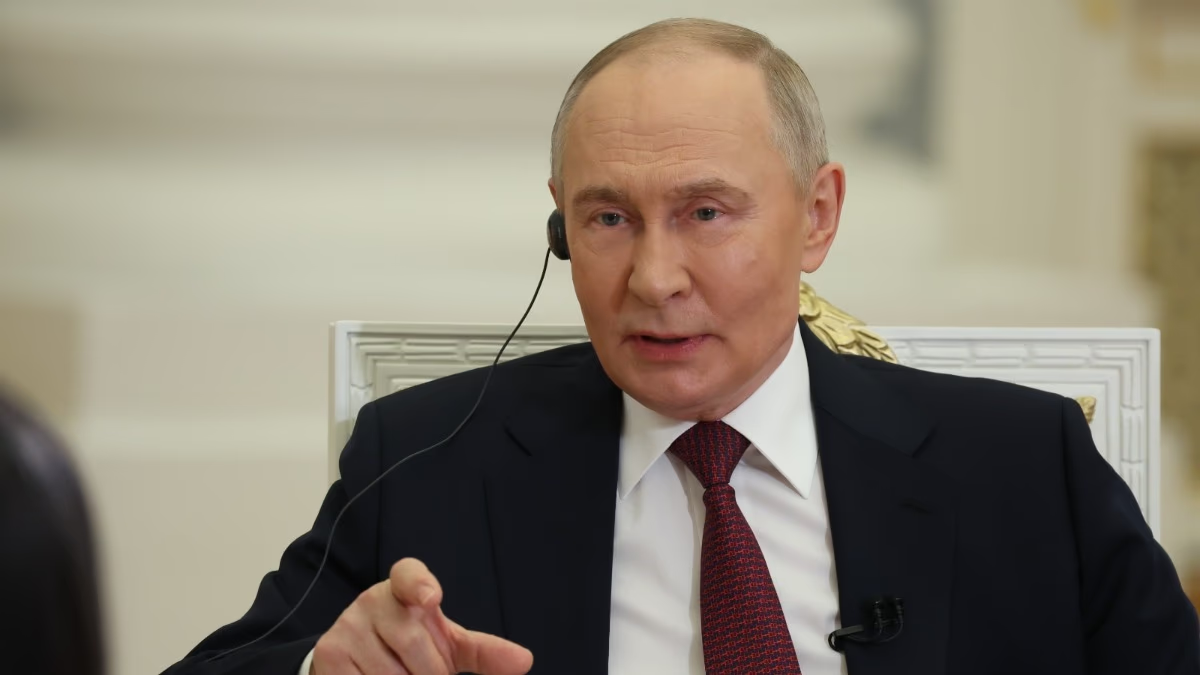
Russian President Vladimir Putin is on a visit to India. During his approximately 30-hour visit, Putin will engage in discussions on several important topics with Prime Minister Narendra Modi. Before that, 'Aaj Tak' conducted an exclusive interview with Russian President Putin. In a world-exclusive interview given to 'Aaj Tak' Managing Editor Anjana Om Kashyap and India Today's Foreign Affairs Editor Geeta Mohan at the Kremlin in Moscow, Putin answered all questions candidly.
Read every question asked in this comprehensive interview and President Putin's answers to them:
Anjana Om Kashyap:
Without a doubt, Vladimir Putin is one of the most influential politicians globally, whose decisions impact not just Russia but numerous countries worldwide. He is an exceptionally influential and enigmatic figure on the global stage, and frankly, nothing could be more fascinating.
Geeta Mohan:
Today, we have among us one of the world's longest-serving leaders. A person who has witnessed everything from wars to global economic recessions, the dissolution of nations to the evolution of world order. From Boris Yeltsin to Donald Trump and from Atal Bihari Vajpayee, Manmohan Singh to Narendra Modi.
He has seen the world change before his eyes. He steered Russia through incredibly challenging and tumultuous times and yet, through his leadership, has built a global reputation that cannot be ignored.
Vladimir Putin:
I am most delighted by the prospect of meeting my friend, Prime Minister Modi. We agreed to this meeting in India long ago. We have a lot to discuss because our cooperation with India is extensive. I won't even touch on the historical aspect of our relationship, as our ties have always been unique.
The path India has taken since independence has been remarkable. Seventy-seven years have passed—a short period historically. Yet, India has achieved significant progress. I will elaborate on this, but when we look at ourselves now, the change isn't apparent. In retrospect, the progress seems nothing short of a miracle.
Perhaps few know that average life expectancy in India has more than doubled in the past seventy-seven years. We will discuss this, but it is fair to say that our relations with India are now reaching new heights. I am thrilled to have the opportunity to meet with Prime Minister Modi, it's not just about business; this meeting holds immense personal significance.
Anjana Om Kashyap:
You just mentioned India-Russia relations, a friendship over seven decades old. In Hindi, it's 'Dosti,' and in Russian, it's 'Druzba.' My question is: how strong do you see this relationship in contemporary times, and what would you like to say about your friend Prime Minister Modi?
Vladimir Putin:
Regarding Prime Minister Modi, truly, the world is changing rapidly, and its pace is only accelerating. Everyone knows this. New equations and new power centers are emerging. The forces influencing these equations are also evolving over time. In such circumstances, stability among the great nations of the world is crucial for the world, and it is the cornerstone of global development.
Whether it's a matter between two countries or concerning the entire world, in this context, my relationship with Prime Minister Modi plays a vital role. It is significant not only for our bilateral relations but also for fulfilling our mutual goals. Our mutual cooperation ensures the realization of our objectives. Prime Minister Modi has set numerous goals for the government and the country. The 'Make in India' project is an exemplary initiative in this direction. Whenever we meet, he always talks about something new, and his approach towards work is greatly practical.
Anjana Om Kashyap:
During the SCO meeting, you and PM Modi were in the car together. Was there prior discussion about this, and what did you both talk about while in the car?
Putin:
We discussed timely topics, with no prior preparation. We both stepped out, and when I saw my car ahead, I asked him to join me. Just like friends do — there was nothing more to it. On the way, we chatted like common friends. We always have something to discuss. We got so engrossed in the conversation that later we realized others might be waiting for us. It wasn't a significant incident, but it reflects our rich discussions and the importance we place on them.
Geeta Mohan:
What announcements can we expect during your visit to India? We've heard about technology transfer and business deals. What else can we anticipate? The world is keenly observing your visit.
Vladimir Putin:
The whole world is watching... I don't think there's anything special about that. India is a vast country — a nation of 1.5 billion people and a burgeoning economy with a 7.7% growth rate. This is a significant achievement of Prime Minister Modi, a matter of pride for Indian citizens. While critics may argue that more could have been done better, the results speak for themselves. We are ready to collaborate in several key areas for the future, and one of them is high technology.
India and Russia are cooperating in critical sectors such as space technology, nuclear technology, shipbuilding, aircraft construction, and future-oriented fields like artificial intelligence. We will discuss this further, as it is a technology that will shape the future. It can drive our progress but also carries challenges. We will work with Prime Minister Modi on these issues to choose the best path forward for us today.
Geeta Mohan:
Would you like to disclose any specific agreements?
Vladimir Putin:
Perhaps I should not say anything about that just yet. As these agreements will be formally signed and announced jointly during my visit to India.
Geeta Mohan:
Speaking of trade, India and Russia face significant international pressure, especially concerning oil. India has suffered considerable damages due to Western pressure. How do India and Russia plan to tackle this pressure together?
Putin:
The pressure you mention is actually an attempt to use politics for economic interests. In other words, our energy cooperation with India remains unaffected by such short-term political pressures. Our energy agreement with India is longstanding and based on trust. It has no connection to the events in Ukraine. In fact, one of our major oil companies has acquired an oil refinery in India, which represents one of the largest foreign investments in the Indian economy to date, with more than 20 billion US dollars invested.
Our company, along with its partners, is successfully operating this refinery. At present, India can supply oil to European markets on a large scale as they purchase oil from us at cheaper rates. But behind this lies decades of our relations. Many at the international level are displeased about this, as India has emerged as a leading supplier of oil to the market, aided by Russia. Consequently, they are trying new political tactics to trouble India and create hurdles in its developmental path.
Anjana Om Kashyap:
India is the biggest buyer of weapons produced in Russia, with Russia accounting for almost 38% of India's arms procurement. In such a scenario, with India facing sanctions from the US, how will Russia support India under changed circumstances?
Vladimir Putin:
I understand that no country in the world can talk to India the same way as 77 years ago. Today, India is a powerful country and is no longer under British rule, and everyone needs to understand this. Especially under Prime Minister Modi's leadership, India will not bow to foreign pressure. Indians should be proud that their Prime Minister doesn't work under anyone's influence. He also avoids confrontations with others.
In reality, we do not wish to enter conflicts with anyone. We only seek to protect our legitimate interests. Over 90% of our transactions are in our national currency. There are minor issues with intermediaries, but we can establish a joint system where Russian and Indian banks handle transactions seamlessly. We are continuously working on this. Once this system is implemented, all problems related to external pressures on trade will be resolved.
Anjana Om Kashyap:
During Operation Sindhur, India achieved tremendous success in the war with Russia-provided weapons. When will Russia deliver the five S-400 air defense systems to India? When is the S-500 expected, and when can India receive the fifth-generation SU-57 fighter jets?
Vladimir Putin:
India is one of our most reliable partners. We do not just sell our weapons to India, nor does India merely purchase them. Our relationship transcends these transactions. We cherish this mutual cooperation as much as India does. Not only do we sell weapons, but we also share technology. Such collaborations are rare in the defense sector as they demand unbreakable trust, but our cooperation goes beyond this. We are jointly involved in constructing ships, missiles, and aircraft.
You mentioned the SU-57, but India uses several Russian warships. Alongside T-90 tanks manufactured by India, they are excellent, as is the Brahmos missile, crafted under the Make in India mission with Russian collaboration. This includes Kalashnikov rifles. Here, we focus on advanced technology, so with modern weaponry used in warfare, their significance increases immensely. Now, India's defense experts, with Russian assistance, precisely understand how to utilize technology and weapons under various circumstances.
Geeta Mohan:
You mentioned strategic autonomy concerning India. It is highly essential for India's interests. Has India reduced oil procurement from Russia under Western pressure?
Putin:
It is true that India's trade with Russia slightly declined in the last nine months compared to the beginning of the year. However, this should be seen as an adjustment. Overall, trade between India and Russia in hydrocarbons and oil remains stable. I am well aware of the opinions of Russian oil companies and stakeholders; they believe their Indian partners are entirely reliable.
Geeta Mohan:
Another key issue between India and Russia is nuclear cooperation. India has received maximum assistance from Russia in this sector so far. Are we expecting any major nuclear deal this time?
Vladimir Putin:
Yes, we will certainly make an announcement about this. This is true: we are among the largest stakeholders in this sector — but not stakeholders, rather we are the largest manufacturer of modern and reliable nuclear power plant equipment worldwide. One Russian company is a global leader in this field. This company has built 22 nuclear reactors abroad, all of which have proven immensely useful. No doubt, Russia excels in small nuclear plant construction worldwide. Many are already in use in Russia. We provide options to use them on land, sea, or water surfaces. They can be employed in areas where building large power plants isn't feasible or in regions that are hard to reach.
Geeta Mohan:
You discussed Indo-Russian cooperation, Made in India, and Make in Russia. How do you think President Trump's consideration of this would be?
Vladimir Putin:
Look, neither I nor Prime Minister Modi gets influenced by pressure. However, I must clarify that we never undertake joint ventures against anyone. President Trump has his own policies and concerns, and we have ours. We bear no animosity. Russia and India only pursue mutual interests. We do not intend to harm anyone. I believe countries should appreciate our policy.
Anjana Om Kashyap:
Recently, Donald Trump told India that buying oil from Russia financially aids the continuation of the Russia-Ukraine war. In this context, how would you evaluate US President Donald Trump's behavior?
Putin:
I never characterize my colleagues — not those I've worked with, and certainly not heads of state. In my view, citizens who voted them into power should appraise them. Regarding India's purchase of energy resources from Russia, let me clarify that the US still purchases nuclear energy resources from us for its nuclear plants, including uranium for American nuclear power plants. If the US fulfils its energy requirements via Russia, why should they object to India's purchases? This topic requires in-depth study, and we are prepared to discuss this with President Trump.
Geeta Mohan:
Donald Trump often comments on you. He initiated using tariffs as a weapon, implemented it against India too. How should India and Russia counter Trump's policy?
Putin:
It's his own policy. I think his advisers believe applying tariffs will benefit the American economy. However, our economic experts consider such a policy hazardous. But ultimately, decisions on these policies are made by any country and its supreme leader. We have never done this nor wish to. We believe in an open economy. We merely hope the World Trade Organization's rules, alleged to be violated, will be revised.
Geeta Mohan:
There has been a shift in US-Russian relations lately. The US now extends an offer for dialogue with Russia. Recently, you met with Jared Kushner and Steve Witkoff — a significant meeting. What was discussed between you and them? Did Russia refuse to back down on certain issues? What happened in that meeting?
Putin:
It is too early to draw conclusions from these discussions. I don't think even if you attended the discussion, you would have understood much. The meeting lasted five hours. I was bored by such a long meeting myself. But it was an essential meeting. Imagine sitting through the entire meeting with just Witkoff and Kushner alongside me. To be honest, it was a crucial meeting, and we discussed specific aspects leading up to the final meeting with President Trump in Alaska. Before, we went point by point, which was overall quite constructive.
Anjana Om Kashyap:
Was there any issue in the meeting where no progress was made?
Vladimir Putin:
Yes, there were many contradictory issues. It's a very complex topic that President Trump has taken upon himself. I'm not being sarcastic, but bringing both sides together on the same page is a difficult task. I believe President Trump genuinely wants to resolve this, and hence, we discussed every point extensively, be it an agreement or disagreement. Presently, making any judgment on this matter would be premature. Drawing any conclusion could hinder diplomacy, which is under President Trump's supervision. His diplomatic efforts are ongoing — he spoke with Ukrainian representatives, then went to Europe, later came to us, and will speak again with European stakeholders and Ukrainian representatives.
Geeta Mohan:
So, was there talk about the peace proposal with 28 points?
Vladimir Putin:
Yes, we discussed that. Although later he changed those 28 points into 27, then converted them into four packages for discussion. However, they were entirely based on the initial 28 points.
Anjana Om Kashyap:
What happened in Alaska? You met President Trump, and it was all about the peace agreement. How did that go? Did you genuinely see any sincere intent?
Vladimir Putin:
Yes, it was absolutely so. We had a sense and more. I had no doubt that it was President Trump's genuine wish. Well, let's not discuss why it's happening or what prompted this genuine wish, but the fact remains it exists. President Trump genuinely understands why it should end and as soon as possible. In particular, when it comes to humanitarian issues, I'm fully convinced this is one of the reasons behind President Trump's behavior. He always said — and I'm sure it's true — that they want to minimize harm. And I'm sure he has humane factors in mind as well, alongside political and economic considerations. And I'm sure the US is trying to find a solution.
Geeta Mohan:
Trump claims to have resolved wars. He claims to have mediated between India and Pakistan, leading to a ceasefire, and now he is addressing Russia-Ukraine and the Israel war. Do you believe Trump is indeed a peacemaker?
Vladimir Putin:
When it comes to Ukraine, certainly. I can reiterate that I feel positively about this. I have no doubt that he sincerely seeks a peaceful resolution. And I can reiterate that the US may have different reasons: humanitarian and President Trump's personal humanistic thoughts. They truly want to end hostilities and human casualties. But, they may also have political interests — the end of the stalemate between Russia and Ukraine — and economic reasons, like the energy sector and other areas. Indeed, there are a plethora of aspects where the resumption of economic ties between the US and Russia could be beneficial for both Russia and America.
He showed me some letters from some leading American companies written to us. Yes, letters from American companies stating they are prepared to return when disputes settle and they wish not to be forgotten. Many people want to return to Russia. But, for Trump to advocate on their behalf and present letters from companies, that is another matter altogether.
Geeta Mohan:
Advocating on behalf of companies, bringing letters from companies. Trying to support, it's quite a novel approach.
Vladimir Putin:
No, no. You misunderstood me. We have letters from American companies. We indeed have letters from American companies.
Anjana Om Kashyap:
Now we'll address a very serious issue, which is the Russia-Ukraine war. In your view, what would be considered a victory for Russia in this war? What are the red lines? Because you've stated that Russia would only lay down arms if Kyiv's forces withdrew from the claimed territories by Russia. What territories are those?
Vladimir Putin:
It's not about victory. It's about Russia defending itself. Protecting our interests and the people living there. It's about protecting our traditional values, the Russian language, and culture. Also, it's about protecting religion and faith existing in those regions for centuries. The Russian Orthodox Church in Ukraine is nearly banned. Churches were forcibly occupied, and people evicted. I'm not even talking about the ban on the Russian language. It's a complex and expansive set of issues. I would like to remind you that we weren't the ones who began war. The West colluded with Ukraine and executed a coup there, leading to consequent events, especially in Southeastern Ukraine, and then in Donbas. This is seldom discussed.
For eight years, we attempted to resolve the matter peacefully. In the Minsk agreements, we recorded a peaceful settlement, hoping to achieve a resolution peacefully. Later, we discovered that Western leaders, who publicly spoke about it, never intended to fulfill the Minsk agreements. They signed it just to arm Ukraine and carry on armed conflicts against us. After eight years of our people in Donbas being killed — which the West conveniently disregards — we had to recognize those republics, then support them. Currently, this special military operation isn't the start of war. It's an attempt to end the war, initiated by the West through Ukrainian nationalists against us. That's the reality. That's the crux of the dispute. We'll conclude this war when we decide we've reached the objectives set at the start of the special military operation — liberating those areas.
Anjana Om Kashyap:
What is Vladimir Putin's ultimate goal in Ukraine?
Putin:
For eight years, we didn't recognize republics declaring independence. They announced their independence for eight years, and we persevered, trying to establish any relations between the remaining Ukraine parts and these republics. When we realized it was impossible, as they were being obliterated, we had to recognize them. Not just parts, but their administrative boundaries unchanged since the Soviet era and later as independent Ukraine. Residents went to vote in the referendum, advocating troop withdrawal. But they chose war. Now it's evident, the crux is either commit military action to liberate those regions, or Ukraine withdraw troops and cease killing those residents.
Anjana Om Kashyap:
You said earlier, on March 8, in your address that Kyiv is the mother of all Russian cities.
Vladimir Putin:
This isn't an invented statement; it's what history records. In the formation of Russia, Novgorod was the first capital, later Veliky, then Kyiv. Since then, Kyiv became part of Old Russia and is regarded as the mother of all Russian cities. Later, events in history resulted in parts of Old Russia dividing, with a part going to Moscow, another to Latvia. Kyiv once connected to Poland, then reunited with Russia in the 18th century.
Geeta Mohan:
While military actions were ongoing, I met people from Donetsk, Luhansk, Zaporizhzhia, and Kherson — they were furious with Kyiv. Nevertheless, they expressed shock, asking why Putin left us orphaned since their own people were around, crossing borders daily.
Vladimir Putin:
I'm unclear about their shock?
Geeta Mohan:
In eastern Ukraine, where people's homes were destroyed.
Putin:
It's quite simple — those areas were under Kyiv's control, and those areas not controlled by Kyiv were decimated by them, compelling us to stand with those regions wrecked by them. Openly advocating for a referendum, those seeking freedom moved here, while those who didn't could head elsewhere — we won't stop them; certainly, they can leave.
Geeta Mohan:
What are your views on President Zelensky? He had promises from NATO and the European Union. Do you think NATO would have ever included him?
Vladimir Putin:
When Zelensky came to power, he stated intentions to strive for peace, even at the cost of his career. Now everything appears different. Currently, it's a resolution with the help of a small group of National Radical Fascists. The government, in its core beliefs, is neo-Nazi. This is what led to a war environment and constant failure. They must understand the peaceful dialogue is the only potential solution. That's what we've been trying to express since 2022. Whatever he aims to achieve, only he can explain.
Anjana Om Kashyap:
You've always asserted that NATO's eastward expansion is concerning, yet Ukraine isn't a NATO member — is it an excuse for regaining territories?
Vladimir Putin:
NATO is a separate issue. The Russian language, culture, and religion — we're not demanding anything outside these frames. The fundamental concept applicable to all: any country's security cannot jeopardize another's security. Every nation can secure itself in its way. Are we preventing Ukraine from doing so? Absolutely not. But it doesn't mean jeopardizing Russia's security. Ukraine planned to secure itself via NATO at the expense of Russia, and this is harmful. We didn't make any illicit demands or demands that felt like a mountain's burden. We just want what's agreed — something not freshly conceived. It was determined during the Soviet era. In the 90s, it posed a threat, evidence being the initial agreements. It was clearly outlined, and upon Ukraine's separation, they declared themselves as a neutral state.
Geeta Mohan:
Is this why you took over the Crimean port, crucial to Russia's only access? Is this why you left the G8, leading some to believe Russia became isolated?
Putin:
There's no need to seize the Crimean port; it's ours by default. Our navy was already there under an agreement with Ukraine — stationed since the Soviet Union's annexation. That's a fact. We took no action to seize the Crimean port. We simply stepped up to support those who handed their future over to them. They felt unheard during the Soviet Union's dissolution, and after following a democratic process, couldn't agree. If anyone thinks Russia will do otherwise, they are mistaken. Russia will always protect its interests.
Anjana Om Kashyap:
Would you like to return to the G8? What do you think about this?
Vladimir Putin:
No.
Anjana Om Kashyap:
Your answer is intriguing. Your clarity is commendable.
Vladimir Putin:
There's no need to delve deep into this, but I stopped considering this much earlier. Another thing, I can't comprehend why those in the G8 consider themselves superior — what's so great? For instance, economically, India ranks third, where does the UK stand? Perhaps tenth. Ukraine is a strong country, but its economy keeps shrinking. Germany is in recession. Nonetheless, they gather, they communicate, tackle each other's problems, greet each other. Everything seems fine, but I stopped attending long ago, not related to the Ukraine incident. I'd refrain from explaining why — that isn't necessary. However, I informed the US about this earlier.
Geeta Mohan:
Did you provide them this information in this meeting?
Vladimir Putin:
Yes, previously and this time too.
Anjana Om Kashyap:
This is crucial.
Vladimir Putin:
You think so? I don't find it significant.
Anjana Om Kashyap:
You're telling us that during your recent meeting with Steve Witkoff, you were offered a proposition to return to the G8 and you clearly denied any interest.
Vladimir Putin:
No, the subject merely arose. Look, I explained to Steve Witkoff why I initially stopped attending G8 meetings. Frankly, there wasn't any proposal. When the topic came up, it reminded me of when I stopped going. That was in 2012, post-presidential election in Russia. Went once for a short period, then didn't go after. Yes, it's an existing platform — let it operate. Other significant organizations are emerging like BRICS, SCO, and G20 remain active. We actively participate in all these platforms, having no objection to it. Now, look at another aspect — what is the current state of affairs between Russia and the European Union? It's not normal. Hence, think, if attending G8, how do I converse with G8 members if they aren't ready for dialogue? What would I achieve there? Maybe we'll discuss this further at another time.
Anjana Om Kashyap:
Is a new world order emerging? Because you're not attending G7, but have visited China and will visit India. Russia, India, China — RIC, BRICS, SCO, Global South. How do you perceive this new center of power in a multipolar world?
Vladimir Putin:
The reality is that the world is in constant flux. Everything changes. But nowadays, change is happening rapidly, and we can feel it, observe it. I've mentioned this before. At its core, we are witnessing global economic disruption and changes. It's unrelated to Ukraine or other conflict zones. We could discuss it for another hour, and I'd be delighted, but perhaps your viewers might tire from our discourse. Fundamentally, new growth centers are emerging, rapid development, robust growth. This change is particularly prominent in the Global South.
I am referring to South Asia. And not just India but Indonesia is also emerging rapidly. Around 300 million reside there. Not as vast as India's 1.5 billion, but still a rising country on the growth path. Likewise, Africa is witnessing rapid growth, and such growth will accelerate because of the young population with a future and aspirations for higher living standards. Overall, this transition cannot be hindered. The pace towards change in the global economy will continue to accelerate. We often hear that Russia is adjusting its relations anew with the Global South and Asia, but the truth is we've been doing this for a long time.
Anjana Om Kashyap:
A picture recently stirred much discussion worldwide: Putin, Xi Jinping, and Narendra Modi — three leaders together. This image received immense attention on social media and in America. The question is, how can alternative alliances grow, become real forces when fundamental issues within such crucial member countries remain unresolved?
Putin:
Look, conflicts have always existed. There's never been a period without conflicts globally. Examine the history of the world's major territories and power centers; every era bore issues, disputes, conflicts. The significant aspect is how you resolve these conflicts. What's the most effective way to address these challenges? Let's take BRICS and the Shanghai Cooperation Organization — large entities where we have a common understanding uniting us: our values. Our traditional values on which our civilizations have been built for thousands, if not hundreds of years.
Inheriting these values from previous generations, we strive to advance by synergizing our efforts. Instead of suppressing these opportunities, we collaborate for outcomes driven by synergy, yielding impactful results. We prioritize these attributes within these organizations. We've never met with the purpose of deceiving or hampering any nation's growth. Our agenda has always been positive.
Geeta Mohan:
How do you make this economic aspect viable? Are you creating an alternative transaction system? Considering any currency adjustments or payment in national currencies? Isn't this initiative leaning towards reducing reliance on the US dollar?
Vladimir Putin:
Haste often leads to major errors. Look at Europe — there's an American system, many countries unready for a single currency structure face issues. We're addressing this. As you know, it's not easy to transact in our currency due to a single currency arrangement. Our goal isn't developing single currency systems. We must tread cautiously, understandingly. We need to employ our currency and invest more broadly with the BRICS New Development Bank.
For instance, create an investment platform with electronic payments supporting economic development for the Global South, initially with a $100 billion capacity. I'm convinced this will be quite remarkable. Beneficiary countries will benefit, and so will we. Offering high-quality goods at affordable prices, the Global South countries will develop, and we'll benefit too. Indeed, electronic payment systems are rapidly advancing today, not to eliminate anyone — we must collaborate in harmony.
Geeta Mohan:
On the topic of Rupee and Ruble transactions?
Vladimir Putin:
No obstacle here; it's an economic matter. I understand there's imbalanced trading between us. For instance, India imposed no hindrance against us. They require oil and oil-derived products. The Indian government needs Russian-made fertilizers for its farmers. PM Modi consistently voices this issue with me. It's not about Rupee payment. I always say to correct this imbalance, not to restrict it. Our trade should benefit both nations — not a single one. During our visit to India, we aim to initiate an exhibition highlighting India-Russia imports and exports. I have instructed my officials to assess additional products we can buy from India.
Anjana Om Kashyap:
How do you balance India and China, knowing your relationships with both countries are favourable?
Vladimir Putin:
India and China are our closest friends. I don't see why we should engage in their bilateral matters. I know that Prime Minister Modi and President Jinping will surely reach conclusions on complex and contentious issues. Both leaders share concerns over the tension between their countries. They desire to solve these issues, working actively towards solutions. I'm happy for both of them. I don't see the need for intervention — these are bilateral affairs.
Anjana Om Kashyap:
India suffered two major terrorist attacks, one in Pahalgam and the other in Delhi. Do you see a double standard on terrorism worldwide? Russia has been a victim of terrorism too. Regarding the notion that what's a terrorist for some, for others, is a freedom fighter — how do you view this?
Vladimir Putin:
It's quite straightforward. Fight for freedom through legal means. Our stand is clear: terror support cannot be justified. As you've mentioned, Russia has been a terrorism victim, and in combating terrorism, Russia stands with India.
Geeta Mohan:
Russia is among the few nations to recognize the Taliban government in Afghanistan. The global community states discrimination exists there regarding gender and human rights abuses — what's your interest? On what basis was the recognition given?
Vladimir Putin:
Every country has issues, including Afghanistan. It's correct that a nation enduring decades of civil war, what a dreadful scenario, and now — the Taliban controlling Afghanistan marks progress, this is today's reality. Secondly, Afghanistan's government has made notable efforts to identify terrorists and organizations. For instance, Afghanistan sidelined organizations like the Islamic State. Moreover, the Afghan leadership has taken steps against drug networks, aiming to enforce stricter measures. The most vital aspect is that what happens there has consequences. We should be aware of occurrences and stay connected and work together. That's what we've done.
Geeta Mohan:
During the Afghani Foreign Minister's visit to India, women were not allowed at the press conference. Faced with much opposition, another conference ensued where women gained entry.
Vladimir Putin:
If their minister hadn't visited India, would your women have had the chance to speak? They arrived from Afghanistan, and only upon witnessing discrimination with your eyes — could women speak up. While it may not be a significant change, it will influence circumstances there. Say you maintain no contact with Afghanistan — what happens? They remain unchanged, and your influence on them diminishes. Maintaining contact with the Taliban exceeds creating distance.
Anjana Om Kashyap:
What is Vladimir Putin's Gaza peace plan?
Putin:
I have no separate peace plan. I believe resolving the Palestinian issue requires implementing UN's (two-state solution) peace plan entirely. The most crucial point is establishing an independent Palestinian state — that's the solution to the problems.
Geeta Mohan:
You believe Arab nations didn't perform as well as Iran regarding Gaza. It was unthinkable that Iran would retaliate. Does this shift world order, and how do you see it?
Vladimir Putin:
You know, all these countries share concerns for Palestine, desiring a Palestinian nation. Some countries openly stepped forward to assist, while others behaved from the shadows. To state anyone did nothing would be incorrect. This is a complex, decades-long tangled issue. Solutions can't manifest overnight — we desire an independent Palestinian nation. The recent release of prisoners and President Trump's actions contribute significantly to Gaza's rehabilitation. Frankly, uniting Gaza and restoring Israel's full power to Palestine are among several options to consider. This needs discussion at the UN. As a UN member, we always participate in these discussions with our allies.
Geeta Mohan:
You have a long history with the KGB. How do you rate today's intelligence agencies globally? Which agency do you regard as superior?
Vladimir Putin:
Numerous powerful intelligence agencies exist worldwide: CIA, KGB, during the Soviet era, Israel's Mossad. Many countries worldwide — it wouldn't be appropriate for me to evaluate agencies' capabilities. Still, I am satisfied with KGB's work.
Anjana Om Kashyap:
How was your career as an intelligence agent? Working in Germany, Pittsburgh, Moscow—who made the person here today?
Putin:
My family — the family I was born into and grew up with. I believe they've collectively shaped me into who I am today. Regarding my intelligence agent career, there was strict discipline. You are to protect your homeland, which is every intelligence agent's objective. However, I left that era behind many years ago.
Anjana Om Kashyap:
While addressing students during a school interaction, a student asked you about your most terrifying experience, and you said it was the Soviet Union's dissolution. What was the impact of the USSR's dissolution on you? How do you view Russia today?
Vladimir Putin:
The impact was such that we always need to approach events and outcomes with caution and understanding. That was the first lesson. Second, critically important, this doesn't only apply to the Soviet Union but equally to Russia, as the Soviets started viewing themselves as invulnerable — no one could challenge their leadership base and system, even ordinary citizens assumed the Soviet Union was strong enough to withstand any circumstance. This overconfidence led to misjudgments, continuously escalating until reaching a breaking point where circumstances spiraled out of control. Today, some countries commit similar mistakes.
Anjana Om Kashyap:
Who do you perceive responsible for the USSR's disintegration?
Vladimir Putin:
I refrain from blaming anyone or attributing fault. The system simply wasn't sustainable — we must accept this reality instead of pondering who was responsible. We need systems capable of self-protection. If we've established such a system, it's adequate.
Geeta Mohan:
Are you contemplating reunification?
Vladimir Putin:
Whose reunification? Soviet Union's? Not at all. It's not our goal, nor is there any justification. It would alter Russia's national and religious status — that doesn't make sense.
Geeta Mohan:
Some western authors continually suggest rebuilding the Soviet Union. How do you respond?
Vladimir Putin:
They don't wish to hear what I say — they hear their thoughts alone, those that please them.
Anjana Om Kashyap:
It's also speculated you're eager to recreate an empire.
Vladimir Putin:
Some voices keep uttering this, seeking to frighten their populace. In global media, they misuse their monopoly, cunning to sway public opinions — their goal is to justify aggressive policies against Russia.
Anjana Om Kashyap:
How would you summarize your life and ideology?
Putin:
It's too early to encapsulate my life, but there are still tasks I must complete.
Geeta Mohan:
Several Indian Prime Ministers have immensely aided in strengthening Indian-Russian ties. In your tenure as a leader of Russia, which Indian Prime Minister markedly enhanced relations with Russia?
Vladimir Putin:
I don't think it's far-fetched. We're presently collaborating with Indian Prime Minister Narendra Modi. Genuinely, our relationship is trustworthy and friendly. By stating this candidly, I hope he won't take it amiss. Just sharing what I see and believe. Certainly, it's fulfilling conversing with someone like him. That's one aspect.
Secondly, he earnestly wishes to bolster India-Russia ties in every area, particularly in defense, the economy, humanitarian cooperation, and high-tech nuclear development. Therefore, meeting him is incredibly intriguing. He visited, and together we spent an evening at my residence, engaging in various topics. It was like common folks sharing thought-provoking conversations. Hence, I eagerly anticipate this meeting and am confident it will prove quite beneficial and engaging.
Anjana Om Kashyap:
Do you believe AI could cause chaos, or is it a force for good? Where does Russia stand in this AI arms race?
Vladimir Putin:
Like any advancement, it can be a double-edged sword. Yes, it's true. It's evident that this cutting-edge technology transforms ordinary lives and, in the future, will alter lives globally. Those who adopt this technology first and use it most effectively will experience numerous economic benefits across sectors — economy, defense, education, science, healthcare, everywhere. However, deploying AI technology proficiently in these sectors will multiply its impact significantly. There are downsides. Especially understanding it entirely.
The fact remains that it relies solely on processing large datasets. Here, we confront personal data issues. First, naturally, it mandates steps to ensure security, protection, and human rights. Notably, possessing such databases could leverage AI and mobile technology capacities. They could shape people's futures.
Geeta Mohan:
You just mentioned healthcare. There was a hot mic moment with President Xi Jinping when discussing longevity, medical advancements, and biohacking. Can immortality truly be achieved?
Vladimir Putin:
Everything in life is finite — only God endures eternally. Indeed, lifespan can be extended. Over 77 years ago, India's average life expectancy was 31 years, now nearly 70. Healthcare facilitated this shift. India's child's mortality rate dropped fourfold — a testament to healthcare success, and I congratulate you. Adopting AI in healthcare and medical development will catalyze astonishing results. Nevertheless, everything comes to an end.
Anjana Om Kashyap:
Recently, there have been many GenZ protests globally. How do you connect with the younger generation? Today many leaders appear younger than their age. How does this happen, and how do you relate to Russian youth?
Vladimir Putin:
Here, it's not new. In literature and art, conflicting themes always exist, generation gaps — between old and young, fathers and sons. These topics and portrayals perpetually emerge in our classic works. Everyone needs understanding — nothing here is unprecedented. Do you know what's novel? Technology — messengers, Telegram, extensively exerting influence on today's youth.
This generation predominantly comprises mobile users, and they're staunch. Youths often believe only they endure injustice — prior generations have been oblivious. Young people observe and then relay to those around them.
They feel overcoming it is easy. They perceive solving it is simple, but a wise individual trying to change something realizes it's not as straightforward as it seems at first glance. Therefore, you must engage with the youth when we can say — you're young, yet to understand, sitting at home. That's how things work. You must consistently stay in touch with young people, utilizing their tools, gathering information, through social networks and feedback. You must work there — I ensure that's happening to an extent. I wish you every success.
Geeta Mohan:
You mentioned religion and the Orthodox Church earlier. Concerning morality and leadership, how do you view spirituality within Russian society personally?
Vladimir Putin:
It's foundational to what I've always sensed. Consistently, we revert to traditional values — values we reference frequently. This doesn't entail relying passively on such values. Instead, it's a solid foundation, naturally compelling us to look forward. We must develop and employ all contemporary growth tools. Our foundational values and a future-oriented perspective unite us to effectively achieve goals set for ourselves. We work in this manner. Our primary aim is national development. Genuinely, we're eager for Russian national development objectives to align with India's goals, determined by India’s government and Prime Minister Modi, ensuring maximum results through joint efforts.
Anjana Om Kashyap:
A song that has seen immense popularity in Russia is