The local body election results in Kerala, announced on Saturday, have clarified the political climate ahead of the 2026 assembly elections. The ruling Left Democratic Front (LDF), led by CPI(M), suffered significant losses across the state, while the Congress-led United Democratic Front (UDF) made a strong comeback in both urban and rural areas. Meanwhile, the BJP-led NDA has indicated that Kerala's political battle will not be limited to a Left-versus-Congress narrative anymore.
Local body elections in Kerala are often seen as a semi-final for assembly elections. This time, the results are not considered favorable for the Left at this level. The Left faced setbacks in several districts, including its traditional strongholds. The Congress coalition emerged as the biggest beneficiary, while the BJP has notably strengthened its presence in urban areas, suggesting that Kerala's politics may no longer remain strictly bipolar.
Who Won in Municipal Corporations, Municipalities, and Panchayats?
Among the six municipal corporations, Congress-led UDF won control of four, while one corporation each went to the LDF and NDA. In the municipalities, out of 86, the UDF secured 54, the LDF was confined to 28, and the NDA succeeded in two.
At the village panchayat level, the Congress alliance delivered a historic performance, capturing 504 out of 941 panchayats. Meanwhile, the LDF won 341, and the NDA succeeded in 26 panchayats. In block panchayats, the LDF won 63, while the UDF secured 79 seats, with both alliances bagging seven seats each at the district panchayat level.
Congress's Historic Lead in Rural Kerala
This is the first time Congress has marked such a strong presence in Kerala's rural local bodies. Traditionally, the CPI(M) has maintained a robust cadre network and organizational hold at the panchayat level, but this advantage appeared to diminish this time.
Previous Patterns and Current Political Message
Historically in Kerala, there has been a robust connection between local body and assembly election outcomes. In 2010, when Congress did remarkably well in local body elections, the UDF formed the government the following year, 2011. Conversely, after the LDF’s win in the 2020 local body elections, Chief Minister Pinarayi Vijayan made history by retaining power in 2021. The current results are seen as an early but vital indication of changing public sentiment against the Left government.
Source: aajtak
Significant Blow in Left's Traditional Bastions
The most surprising aspect of these results is the substantial defeat of the LDF in urban areas. The UDF captured the Kollam, Thrissur, and Kochi municipal corporations from the Left and retained Kannur. Kollam and Thrissur had been under Left control for 25 and 10 years, respectively. The Kozhikode municipal corporation witnessed a very close contest where the LDF narrowly emerged victorious.
Historic Gain for BJP in Thiruvananthapuram
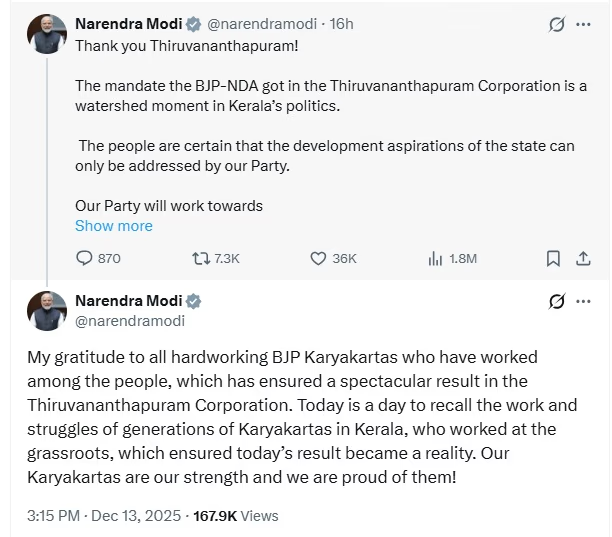
The biggest political shock for the Left came in the state capital, Thiruvananthapuram. In the 45-year-old CPI(M) bastion, the BJP-led NDA surged ahead. Winning 50 out of 101 divisions, the NDA secured a clear majority in the Thiruvananthapuram municipal corporation. The LDF managed only 29 seats, while the UDF got 19 seats. Prime Minister Narendra Modi termed this as a 'watershed moment' for BJP in Kerala.
BJP's Presence in Other Urban Areas
In Palakkad municipality, BJP posed a strong challenge to the UDF by gaining a slight lead. Even though CPI(M) led in Kozhikode, BJP fortified its position by winning at least 14 seats. In traditional Left stronghold Kollam, BJP also marked a notable advance.
Election Issues and Dominance of Anti-Incumbency
While local issues and ward-level campaigning played their roles, this election became largely a referendum on the state government. Analysts highlight a widespread, unprecedented anti-incumbency sentiment across Kerala.
Before the elections, the LDF government tried to woo the public. They increased social security pensions, raised allowances for ASHA workers, and announced women's safety plans, but after nearly a decade of governance, voter fatigue outweighed these promises.
Allegations, Counter-Allegations, and Political Narratives
The UDF raised issues such as the alleged gold theft at Sabarimala. Meanwhile, the Left accused expelled Congress legislator Rahul Mamakootathil of sexual harassment and claimed the UDF was aligning with communal forces. According to political analyst Joseph C. Mathew, the presence of such a uniform anti-incumbency is rare in Kerala elections. It indicated that the CPI(M)'s traditional strength at the panchayat level is now shaking.
What CPI(M) Said...
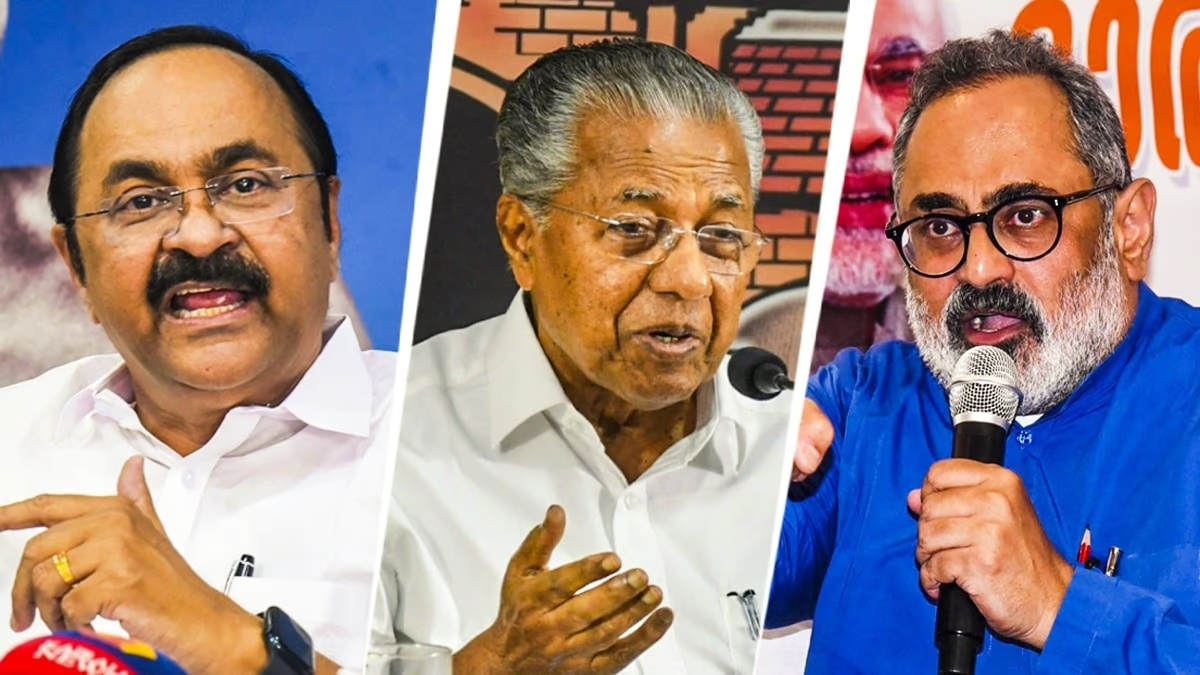
CPI(M) State Secretary M.V. Govindan dismissed anti-incumbency claims, pointing out that seven out of 14 district panchayats proved the party still has a solid base. Govindan termed the results as an 'unexpected jolt' and mentioned that the party had experienced even more significant setbacks in 2010 before making a comeback. He stated that the party would introspect and try to reconnect with the public.
BJP's Gain and Changing Political Picture
Analysts suggest that BJP's advances are now coming by cutting into Left’s vote bank, not Congress’s. The strengthening of NDA in places like Thiruvananthapuram, Palakkad, and Kozhikode indicates this transition. However, CPI(M) leadership argues that except for Thiruvananthapuram, BJP's progress should not be considered a massive political surge.
Challenges Ahead for Congress
While Congress is undoubtedly encouraged by their victory in the local elections, translating this success into a win in the 2026 assembly elections will require organizational solidity and a clear strategy. The next six months will determine whether the UDF can maintain this momentum.
Although local body elections are typically driven by local issues, the scope and geographic spread of these results convey a significant political message. They are seen as putting pressure on the CPI(M)-led government while injecting fresh energy into Congress and boosting BJP's confidence to strengthen its base in Kerala.