Over the past two months, the U.S. military has intensified its operations in the Caribbean Sea, deploying warships, fighter jets, marine troops, drones, and reconnaissance planes—all to exert pressure on Venezuela. The U.S. has accused the Venezuelan president of leading a narco-terrorist organization named Cartel de los Soles. Venezuela, on the other hand, has rejected the existence of such a group.
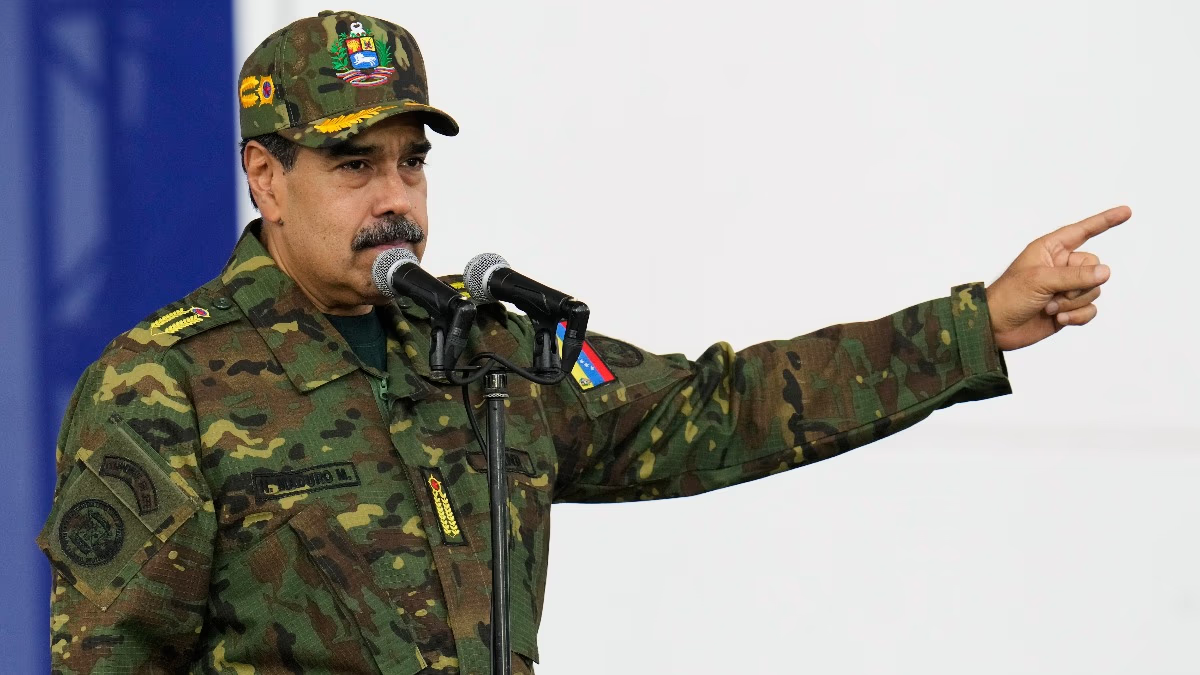
The United States has declared Cartel de los Soles (meaning the Cartel of the Suns in Spanish) a foreign terrorist organization, claiming it is led by Venezuelan President Nicolás Maduro and senior members of his government.
Such a declaration grants the U.S. law enforcement and military agencies extensive powers to target and dismantle the group.
Venezuela Labels It an Attempt to Control Oil Reserves
In recent months, the U.S. has increased pressure on Maduro, citing last year’s elections as illegal and accusing him of leading a drug cartel. Maduro denies these accusations, countering that the U.S. is attempting to incite war to control Venezuela's oil reserves.
Exploring Cartel de los Soles
Amid these developments, questions arise about the actual existence of Cartel de los Soles. Venezuela’s Foreign Ministry has vehemently rejected the notion, labeling the existence of such a group as outrageous lies.
According to a BBC report, Venezuela’s Minister of Interior and Justice, Diosdado Cabello, has long regarded Cartel de los Soles as an American fabrication. Allegations have been made against Cabello himself for being a high-ranking member of this cartel, although he has accused American officials of using the term to target individuals they dislike.
The Organization’s Existence Questioned
Even Colombian President Gustavo Petro has dismissed the cartel's existence, noting in August that right-wing factions use it as an excuse to topple unapproved governments. However, the U.S. Department of State stands by its assertion that Cartel de los Soles not only exists but has corrupted Venezuela’s military, intelligence, legislature, and judiciary.
First Named in the 1990s
The term Cartel de los Soles first emerged in the early 1990s. Venezuelan media used it to describe a general involved in drug trafficking allegedly commanding anti-narcotic forces. The nomenclature refers to the sun-shaped insignia on the general's epaulets, symbolizing his rank.
Mike LaSusa, an organized crime expert in the U.S., explained to BBC that the term soon identified Venezuelan officials accused of drug trafficking, regardless of their official membership in the organization.
The Story of Cartel de los Soles
Raúl Benítez-Manau from Mexico’s UNAM university suggests that the organization's activities began in response to late-1980s and early-1990s developments in adjacent Colombia, the world’s leading cocaine producer.
During this period, the powerful Medellín Cartel in Colombia was upended, and a vigorous anti-narcotics campaign was underway. As pressure on smuggling routes intensified, Cartel de los Soles started providing alternative routes for shipping cocaine from Colombia.
Benítez-Manau claims the organization gained strength during the initial years of leftist Venezuelan President Hugo Chávez's tenure. Chávez led Venezuela from 1999 to his death in 2013, relishing in challenging the U.S. and ending all military cooperation between Venezuela and the U.S.
Conspiracy with Colombian Left-Wing Guerrillas
Benítez-Manau observes that without DEA oversight, some Venezuelan military officers felt free to do business with criminals. Chávez also reportedly sympathized with Colombia's leftist FARC guerrillas, who heavily relied on cocaine trafficking, using Venezuela as a route to revive some drug trafficking activities.
Safe Haven in Venezuela for Colombian Drug Traffickers
Former DEA agent Wesley Tabor, who worked in Venezuela, stated that FARC found a safe haven in Venezuela. Numerous governmental figures, from street-level police to military aviation, soon allied with them in drug trafficking.
Corrupt System vs. Organization
Tabor argued that the collaboration led to hundreds of tons of cocaine flooding into the U.S. Unlike other drug networks, Cartel de los Soles lacks a formal structure—it is a corrupt system according to LaSusa.
LaSusa noted that the crisis emerged during Maduro’s leadership due to Venezuela’s economic collapse. Maduro’s regime cannot adequately pay security forces, and to maintain their allegiance, they permit bribes from drug traffickers.
Corruption Under Maduro’s Governance
Benítez-Manau suggests that mid-to-low level officers, who control Venezuela’s major entry and exit points, such as airports, form Cartel de los Soles. They hold key positions facilitating drug flow.
U.S. officials insist that Cartel de los Soles infiltrates the highest levels of the Maduro administration, involving the president himself. In 2020, the U.S. Department of Justice accused Maduro and 14 others of conspiring with armed Colombian groups to traffic cocaine into the U.S.
Minister’s Involvement Under Scrutiny
High-ranking officials, such as Defense Minister Vladimir Padrino and former Venezuelan Supreme Court head Maikel Moreno, were also implicated. The indictment pointed to long-standing leadership by Maduro’s internal minister Diosdado Cabello, former military intelligence chief Hugo Carvajal, and former general Clíver Alcalá since at least 1999.
Revelations from Former Allies
Allegations were corroborated by information from former high-ranking military officials of Venezuela—including Carvajal and Alcalá—offered to U.S. authorities. The late Hugo Chávez’s former security chief, Leamsy Salazar, provided insights into Cartel de los Soles early in 2014 to American officials.
Salazar, with DEA assistance, left Venezuela, asserting that Interior Minister Cabello led the cartel. Cabello countered, arguing it was part of an “international conspiracy.” In 2020, General Alcalá turned himself into DEA agents after disagreeing with Maduro’s government and admitted to supporting FARC and their cocaine-trafficking operations.
Earlier this year, former Venezuelan spy chief Carvajal, who left Venezuela due to disagreements with Maduro, was convicted in U.S. court on narco-terrorism and drug trafficking charges.
Using Cocaine as a Weapon
A federal prosecutor stated during Carvajal’s trial that he and other Cartel de los Soles officials used cocaine as a weapon, inundating New York and other American cities with poison.
Bounty Offers by the U.S.
Maduro and Interior Minister Cabello remain in Venezuela, though the U.S. recently raised their bounties to $50 million (£38 million) and $25 million, respectively, for information leading to their arrest.