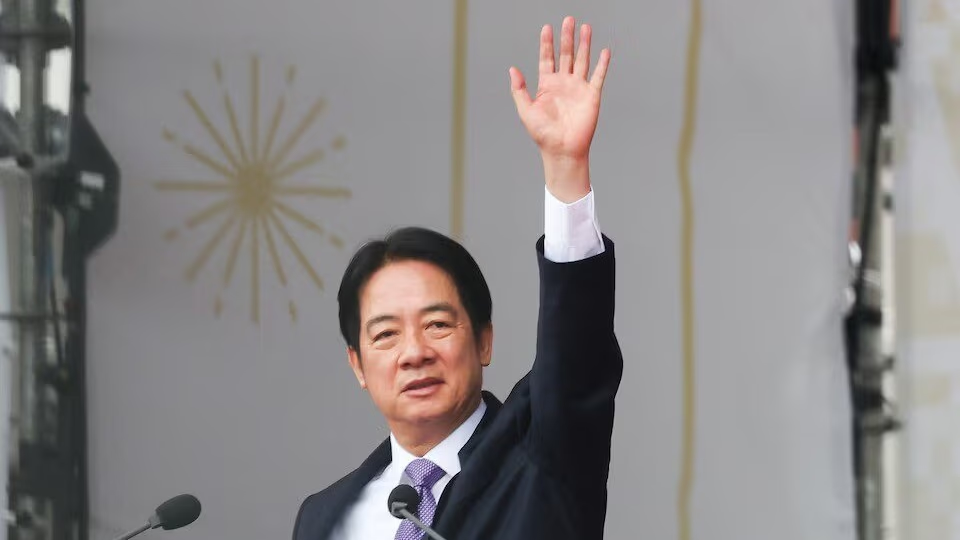
In an article for The Washington Post, Taiwan's President Lai Ching-te announced the country's intention to present a supplementary defense budget of $40 billion, aiming to bolster its defense posture by acquiring sizeable new weaponry from the United States.
This decision arises amidst increasing military and political pressures from China over the past five years, pressures Taipei resolutely dismisses. China, however, views the democratically governed Taiwan as its territory.
Moreover, Taiwan finds itself under pressure from Washington to increase its defense expenditures, echoing the United States’ influence in Europe. In August, Lai remarked on the expectation that defense spending will reach up to 5% of the Gross Domestic Product by 2030.
What Impact Will This Have?
In the Washington Post, Lai Ching-te emphasized, "This landmark package will not only fund the purchase of substantial new weaponry from the United States but also significantly enhance Taiwan's diverse capabilities."
He further stated, "By doing so, we aim to fortify deterrence by imposing higher costs and uncertainty on Beijing’s decision to use force."
Why Is There Dispute Between China and Taiwan?
The contentious and fraught relationship between China and Taiwan stems from the aftermath of the Chinese Civil War, concluding in 1949 with the defeat of the Nationalist government to the Communist Party of China (CPC). Led by Generalissimo Chiang Kai-shek, the Nationalist government retreated to Taiwan, establishing the Republic of China (ROC). Meanwhile, the CPC founded the People's Republic of China (PRC) on the mainland.
Since then, PRC and ROC have pursued entirely different political systems and paths for economic development. The PRC has emerged as a major global power with a communist one-party system and a rapidly expanding economy. Conversely, Taiwan has blossomed into a democratic, free-market society.
In recent years, tensions have reignited as Beijing intensifies its claims over the island, evidenced by increased military activities in the Taiwan Strait, diplomatic isolation efforts against Taiwan, and economic pressures on Taiwanese businesses.