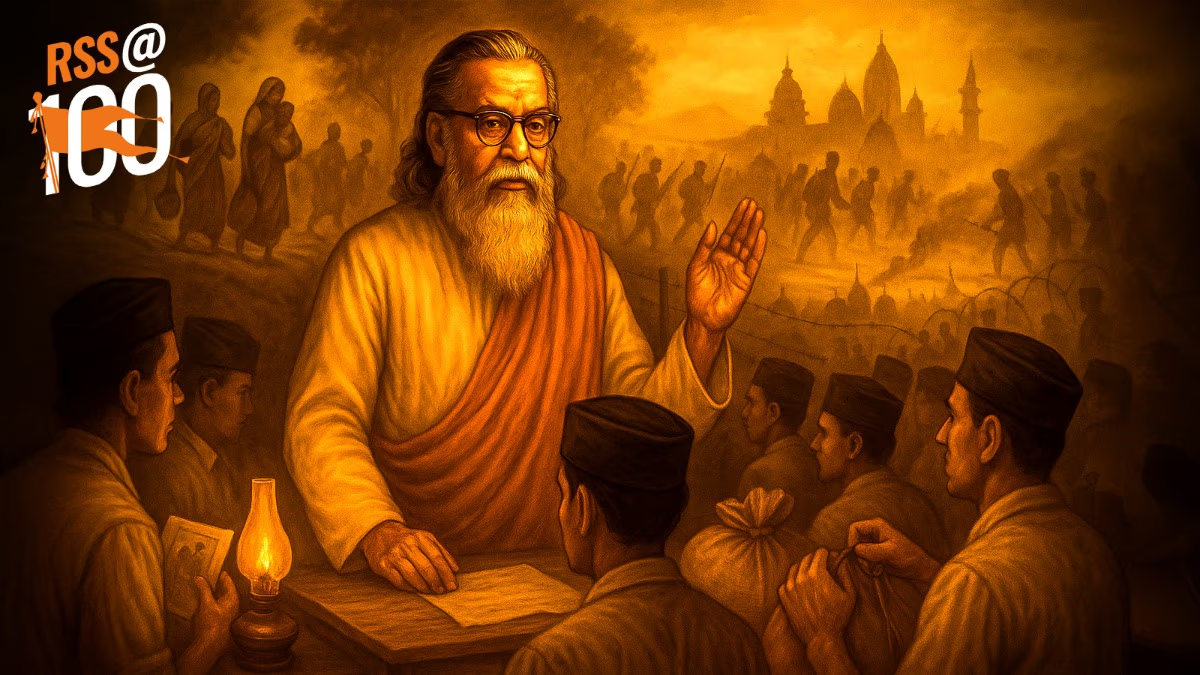
The scenes where Sheikh Hasina was forced to seek refuge in India, chants of 'Long Live Pakistan' echoed in Bangladesh, and a rise in atrocities against Hindus seem to validate Guru Golwalkar's earlier predictions. It wasn't that Golwalkar wasn't pleased with Bangladesh's formation; he was, but he anticipated that under the name of anti-Hindu sentiment, the two Islamic nations might eventually reunite. Drawing lessons from history, he cited the Bahmani Sultanate. While he declared full support for Indira Gandhi's government during the war, Golwalkar expressed discontent similar to the Tashkent Agreement over the Shimla Agreement.
Golwalkar Had Foreseen the War
From as early as the 1970 Vijaya Dashami, Guru Golwalkar issued stringent warnings concerning the ordeal and havoc wrought by Pakistani forces against the Bengali populace of East Pakistan. He foresaw India's inevitable involvement. This wasn't a one-off statement but was reiterated across various platforms: a rally of Delhi volunteers on 22 November, during Guru Purnima celebrations in Nagpur on 8 July 1971, a public meeting in Jammu on 24 October, and another in Jaipur on 26 November. His prescient predictions came true, and he consistently urged the RSS volunteers to stay alert for any call from the nation. By this time, refugees had begun arriving even before the war, with volunteers aiding them and an estimated 200,000 volunteers providing effective assistance to the military and protecting citizens from anti-social elements.
Throughout training camps in 1971, Golwalkar cautioned about the dangers emanating from explosive conditions in East Pakistan. By 28 June, he wrapped up his tour and returned to Nagpur as the crisis escalated. Hindu refugees numbered over 3 million by then. The Sangh had embarked on relief operations through the Vastuhaara Sahayata Samiti, launching nationwide campaigns to collect relief supplies, distributing food, clothing, and medicines in refugee camps.
The central executive meeting of the Sangh, held on 8, 9, and 10 July 1971, passed a resolution on the Bangladesh situation, urging the government to uphold the solemn promises made to Hindus in Pakistan at the time of Partition, assuring their security. Golwalkar called on volunteers to remain vigilant, offer necessary aid, and boost public morale. In October, when he toured Punjab, he learned that volunteers had heeded his call, and the army was fully prepared for war.
Spreading the Message of Unity
When the Pakistani army launched an attack on 3 December 1971, a training camp for young volunteers was ongoing in Nagpur. Guru Golwalkar promptly issued a statement concerning the invasion and citizen responsibility, which volunteers disseminated widely, delivering millions of copies to every household. In his 4 December 1971 address, he appealed to the nation to rise above political and other differences, unify, and thwart the Pakistani invasion. “It is unity inspired by true love for the motherland that can ensure our victory,” he stated.
The war, initiated on 3 December, culminated on 16 December with the Pakistani forces' surrender in Dhaka. Golwalkar lauded the army for its unmatched valor and brilliant strategy. The speed of Dhaka's surrender was indeed astonishing. His faith in the capabilities and expertise of our armed forces was unwavering. When asked about a possible intervention by America's Seventh Fleet, he confidently remarked, “Then the Americans too would experience the formidable striking power of Indian arms.”
Bangladesh's Comparison to the Bahmani Sultanate
Elsewhere, he remarked, “There is no reason to rejoice over Pakistan's division. History teaches us that although the Bahmani Empire split into five parts, when the opportunity arose, they all united against the Hindu kingdoms.” The profound changes in Bangladesh post-1971 underscored Golwalkar's insight. Military dictatorship had smothered democracy and secularism and refugee influx and Muslim infiltration into India persisted unfettered, almost visibly apprehensive for the first time.
Letters Between Golwalkar and Indira Gandhi
Upon the Bangladesh war's conclusion, Golwalkar sent a congratulatory letter on 22 December to Indira Gandhi, expressing, “May the unity in the country, the realistic assessment of the situation, and the determination to uphold the country's honor and prestige remain steadfast. This is essential not just during times of crisis, but for all endeavors toward national revival. The RSS stands with you and will always stand with you in the strength of unity infused with national pride. I trust you'll consider these factors in domestic and foreign policy deliberations. May India's pride continue to rise under your leadership.”
Indira Gandhi's reply arrived by mid-January. The RSS central executive also passed a resolution congratulating the victory. Riding the wave of victory, she secured a resounding majority in the 1972 Legislative Assembly elections.
Displeasure Over the Shimla Agreement
Following the war, Golwalkar expressed that open latitude hadn't been afforded to the army on the western front. The 1972 Shimla Agreement squandered military achievements. India had to relinquish territories captured by its armed forces. The Defense Minister had openly declared 'Azad' Kashmir was indeed Indian territory and assured that forces wouldn't retreat an inch from their present position. Yet, politics played its part, and the Shimla Agreement was signed. Diplomatically, the victory was more significant than the one in 1965. Had this leverage been utilized during negotiations, heroic military achievements wouldn't have gone wasted. But they were.
The Indian army had to surrender territory won and withdraw, and release around 90,000 POWs. Golwalkar strongly criticized the Shimla Agreement. Expectations kindled during the ceasefire weren't met. The Kashmir issue remained unresolved, and Pakistan's intransigence persisted. In this context, Golwalkar vehemently condemned the thoughtless policies of governmental leaders, articulating that India wasn't adhering to the battlefield principles dictating that not a shred of the enemy should survive. Consequently, victory turned into defeat, subjecting the nation to successive misfortunes.
'Integration of Bangladesh with India Should Be An Option'
Golwalkar also foresaw Bangladesh potentially veering towards becoming an extremist Islamic nation like Pakistan. While it claimed secularism, Golwalkar advised that, “If they adhere to a secular, yet not anti-religious, formation, that's commendable. They've assured no religious discrimination, hoping they'll uphold these promises.”
Each Story of This Special RSS Centenary Series
Golwalkar went further, suggesting that Bangladesh should have the option to join India if it desired. Golwalkar stated, “I believe currently, East Bengal should be given the choice to become part of our Indian states family or remain a sovereign neighbor.”
What RSS Volunteers Were Doing During the 1971 War
During the Bangladesh Liberation War, RSS wholeheartedly supported Prime Minister Indira Gandhi and the Indian government. Volunteers (RSS volunteers) actively aided the military by digging trenches, providing logistical support, and conducting relief work in border areas. The RSS was the first to organize massive blood donation camps for the Indian army, making significant contributions to medical assistance for wounded soldiers. Such efforts prompted Field Marshal Cariappa to state, “RSS is my heart's work...The country is standing in need of your services.”
By this time, Balasaheb Deoras had taken command over considerable relief efforts related to the war. RSS volunteers set up relief camps in West Bengal, Assam, and Tripura. These camps offered food, shelter, medical aid, and rehabilitation assistance to millions of Bengali Hindu refugees fleeing Pakistani atrocities in East Pakistan (now Bangladesh). RSS held a major provincial camp in Vidarbha-Nagpur during 1971, enlisting over 10,000 volunteers, bolstering morale, and coordinating war-related volunteer efforts.
Volunteer Sacrifice For BSF Assistance Remembered in Memorial
In Raiganj, West Bengal, an RSS volunteer named Madan Lal Verma played a crucial role by alerting BSF personnel about potential intrusions by the Pakistani army. Entrusted with delivering ammunition cartons to the front, he played a pivotal role in providing vital logistical support amidst intense crossfire, eventually sacrificing his life. A martyr memorial in Raiganj stands in his honor today. This episode depicts how RSS volunteers supported logistical assistance to border security efforts on the eastern front, including material transport and intelligence sharing during the war.
Previous story:
Golwalkar's Disappointment on Hearing of the 1965 Ceasefire
Next story: