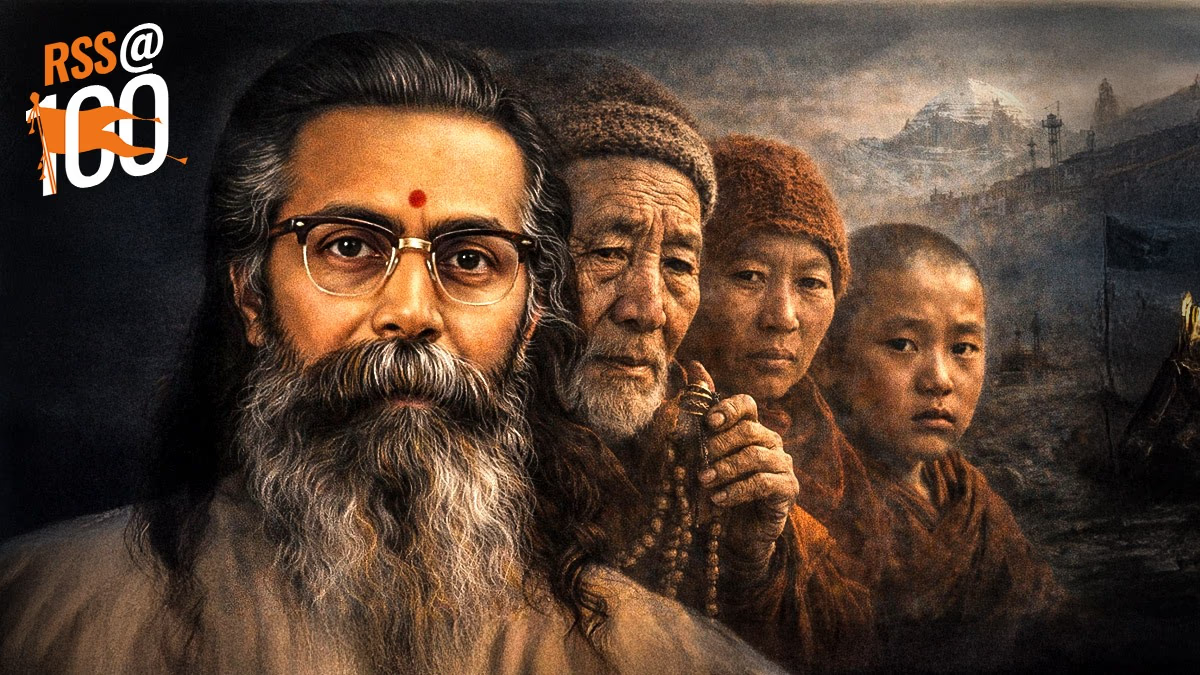
The historical ties between Tibet and India are profound. In Tibet, an ancient belief persists that King Rupati, who migrated after the epic Mahabharata war in Kurukshetra, organized its governance. Historically, Indian pilgrims needed no visa for Kailash-Mansarovar pilgrimage and Tibetan citizens could freely visit Bodhgaya. From the seventh century, after Guru Padmasambhava's Buddhist influence, Tibet revered India as its Aryabhoomi Guru, forging a strong cultural bond that spanned centuries. The RSS consistently expressed concern over fostering good relations with neighboring China and Nepal. Such concern led Guru Golwalkar, 11 years before the Chinese invasion, to warn Pandit Nehru about China's intentions, continuously raising the issue on various platforms.
When China invaded India, people shifted towards Chinese products due to their affordability. Even Indira Gandhi, despite her father's loss, never softened her stance on China; however, later, her party, the Congress, did reconcile with the Chinese Communist Party, even receiving substantial donations for the Rajiv Gandhi Foundation. Tibet was generally forgotten, but not by the RSS, which, under the leadership of RSS Chief K.S. Sudarshan, worked to keep the Tibetan memory alive.
Golwalkar warned 11 years ahead
In C.P. Bhishikar's biography of Golwalkar, he mentions that as early as 1951, Guruji issued a press statement in Shimoga, Karnataka, stating, 'China's inherent expansionism indicates that India might face an attack in the near future.' This foresight was highlighted amidst Chinese military actions in Tibet. Repeated warnings about gifting Tibet to China were given, showing India's short-sightedness which the British had carefully avoided. He flagged the caution against elements within India colluding with communist invaders...
In the edition of 'Panchjanya' dated 18th May 1959, he foresaw that all of Asia required constant alertness. Despite media labeling him as 'war-mongering' for his Tibet reminders, the India-China conflict became a primary discourse, with overwhelming recognition and preparation not sought by the government. Even after the war ended, on December 23, 1962, speaking in Delhi, he noted the government's oversight despite ten years of systematic efforts by China...
Addressing thousands of volunteers, he advocated for Tibet's liberation and requested India's recognition of the Tibetan government-in-exile. India’s set back from the Chinese defeat struck a pang of concern into Golwalkar's speeches, reflecting his deepest worries therein.
Gurudecs Golwalkar discussed topics like China's communist regime, the unclear China-Russia relationships, India's communists’ betrayal, China's hollow friendship with Pakistan, and the need for close Nepal ties. He felt a call for strength-based international positioning without external alliances was crucial. If leaders lacked courage, they should step aside, passing power to stalwart, valiant hands, illustrating his pragmatic, non-anarchic approach...
It wasn’t just rhetoric — Golwalkar mobilized thousands as volunteers for refugees, wounded soldiers, and villagers distressed by boundary breach risks. They sent 500 relief trucks nationwide alongside blood donation and refugee aid camps, which marked the story on Dev Deepavali.
The government in exile became 'frozen' on Dali Lama-related matters as time sailed, but RSS never lost interest, anchoring consistently even when politically challenging, convening honors for Tibetan delegations to India as an ally who remembered its spiritual kinship with Tibet, illustrated in the first World Hindu Congress in Prayag...
When the RSS passed Tibet-focused proposals
In 1959, the RSS's apex decision-making body, the All India Representative Council, adopted a resolution accusing the government of blindly ignoring China's expansionist agenda, surrendering claims over Tibet. This century-old cultural tie, besides losing its independence, disabled mediatory roles once played, laying open the northern borders to Chinese forces...
In 1962, another decision demanded definitive broken ties with China, noting the keenness to uphold self-existence rights and secure India's borders meant liberating Tibet. As China broke all Tibet-related promises, India retained the prerogative and duty supporting Tibet’s freedom movement. Thus, diplomatic ties with Communist China no longer served any congruent purpose and ought to cease.
The Congress lapse, the national collective forgetfulness was stark- 2012 marks half a century since the Chinese aggression. The organization reiterated resentment on this anniversary, refreshing Tibetic discourses, alerting on China’s opportunism again...
Dali Lama inaugurated the second World Hindu Congress in 1979
Disparate ongoing efforts by RSS heads like Balasaheb Deoras post Golwalkar, despite Indian harmony towards China, continued. Invitations at the VHP-conducted subsequent Congress in Prayag substantiated the collective public memory push, with Dali Lama featured centrally. His remarks reflected the event spectrum accommodating intrigued Hindus beside Buddhists honing it jointly...
As current Chief Mohan Bhagwat perpetuates favor and recognition, Dali Lama even circumvented restrictions attending RSS’s Nagpur headquarters amid gratitude interactions at Ramlila grounds in Delhi. Recognizing RSS backing, he praised them akin to Tibetan dedication.
Even the Akhil Bharatiya Vidyarthi Parishad (ABVP), a student front, rigorously articulated on Tibetan matters, linking through coordination with the Tibetan Youth Congress.
While K.S. Sudarshan ventured further
Born centenary celebrations of Guru Golwalkar seen through 2006 included KS Sudarshan’s meeting with Dali Lama at Dharamshala, supported again by prior approaches like inviting representatives to Nagpur’s Vijayadashmi festivity, indicating grassroots diplomacy...
Recognizing underlying lethargy on Tibet national consciousness necessitated responses like Indresh Kumar’s India-Tibet accord outreach, recognizing urgent strategic West communication and raising Tibet on intellectual platforms; prelude to India-Tibet Cooperation Forum formation...
In narratives illuminated, Hindu unity became an epicenter spearheading cultural dialogue against aggressive world sectarian conversions, aspiring Buddhahood as synchronized cultural archiving...
With vigilation terminology receiving stipulation, the India-Tibet Cooperation movement crystallized on 5 May 1999, consolidating its reach continually across myriad sections under observant kinsmanship with Dali Lama resonantly admiring a faithful coalition, acknowledging said organization auspices under Indresh Kumar’s custodianship. Reaffirming relieve relief routed habits amidst culturally educational charm with enduring renown touching upon organizing lengths...