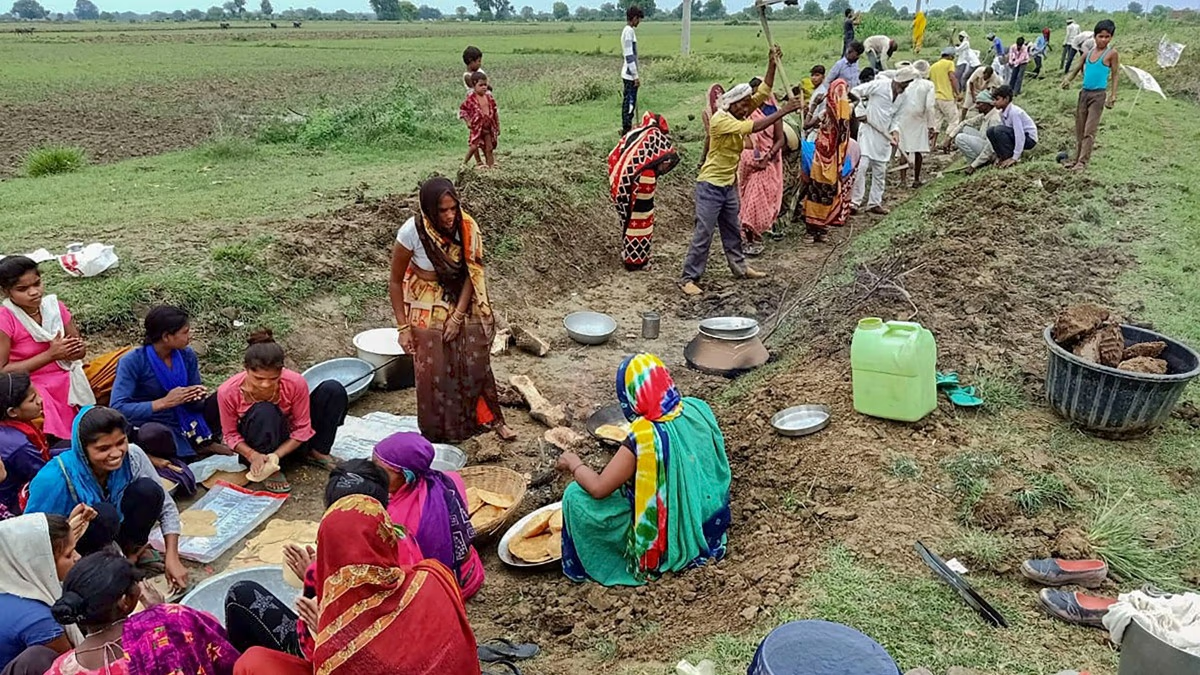
The entire landscape of rural employment in the nation is set to transform. The central government plans to replace MGNREGA (Mahatma Gandhi National Rural Employment Guarantee Act), a flagship program of the previous UPA administration, with a new bill. Union Rural Development Minister Shivraj Singh Chouhan will present this bill in the Lok Sabha today.
The full name of the VB-G RAM G bill is Viksit Bharat - Guarantee for Rozgar and Ajeevika Mission (Gramin). According to the bill, it will legally assure 125 days of wage employment per financial year to every rural family. This employment is intended for those households whose adult members are willing to undertake unskilled manual labor.
Within six months of the aAct's commencement, states must devise a plan according to its provisions.
The Ministry of Rural Development stated that the proposed law will establish a modern legal framework to achieve the goal of 'Developed India 2047.'
The ministry noted that the bill aims to create employment and sustainable rural infrastructure in four priority areas: water-based work for water security, rural infrastructure, livelihood-related infrastructure, and tasks to address adverse weather events.
How do the UPA's MGNREGA scheme and the NDA's VB-G RAM G bill differ?
Number of Employment Days
MGNREGA guarantees 100 days of employment, whereas the VB-G RAM G bill guarantees 125 days of employment for every adult in a household.
Employment Funding
MGNREGA:
The central government covers 100% of unskilled wage costs and 75% of material costs.
State governments cover the remaining 25% of material costs and pay unemployment allowances, also sharing administrative costs.
VB-G RAM G:
Although sponsored by the center, financial responsibility is shared by state and center. In northeastern and Himalayan regions, the center provides 90% while the state provides 10%. For other states and union territories, the center covers 60% and states cover 40%.
60-Day Break Period
A key difference between MGNREGA and the VB-G RAM G bill is the introduction of a break period. The new scheme provides a temporary 60-day halt to employment guarantees during the agricultural season, ensuring fieldwork isn't interrupted. Under this act, no work is assigned during peak farming seasons, facilitating agricultural operations.
The center argues that MGNREGA's unfocused strategy spread across various categories without a strong national directive. This new act concentrates on work in four main areas: water security, rural infrastructure, livelihood infrastructure, and climate adaptation.
The new act mandates developed Gram Panchayat plans prepared by the Panchayats themselves, integrating with national plans like PM Gati-Shakti.
How Will the New Scheme Benefit the Rural Economy?
This act strengthens the rural economy through productive assets, higher incomes, and improved resilience. It prioritizes water-related projects. Focus will be laid on basic village development, enhancing roads, connectivity, and essential infrastructure to facilitate market access to these areas.
It will also emphasize storage, marketing, and income diversification. The new program creates infrastructure for water harvesting, flood drainage, and soil conservation to protect rural livelihoods.
The availability of employment in rural areas is expected to reduce migration.
What Benefits Will Workers Receive?
Workers will have long-term employment assurance and better wages. Wage payments, already 99.94% electronic by 2024-25, will continue with comprehensive biometric and Aadhaar-based verification, virtually eliminating wage theft.
The hyperlocal developed Gram Panchayat plans will ensure pre-planned work allocation.
If work isn't provided to workers, states will need to provide unemployment allowances.
Construction of better roads, water facilities, and livelihood-linked assets will bring revolutionary changes in workers' lives, enhancing their lifestyles.
Why Was There a Need to Replace MGNREGA?
Established in 2005, MGNREGA no longer fits the evolved rural India of today. Numerous government surveys highlight increased spending capacity among the populace. Poverty has decreased significantly from 25.7% (2011-12) to 4.86% (2023-24) due to better income and financial access.
With enhanced social protection, improved connectivity, expanded digital access, and diversified rural livelihoods, the old framework does not align with the modern rural economy. Recognizing these structural shifts, the open-ended model of MGNREGA has become outdated.
The VB-G RAM G bill modernizes the system, extends guaranteed days, and refocuses priorities.
What Transparency and Social Protection Measures Are Included in the New Act?
The new bill uses AI to detect fraud. Both central and state governments will operate management committees to monitor these programs. There's an emphasis on four major rural development areas.
Panchayats will be enabled to play an enhanced supervisory role.
The scheme facilitates monitoring of work through GPS/mobile technologies. Real-time MIS dashboards will track progress precisely.