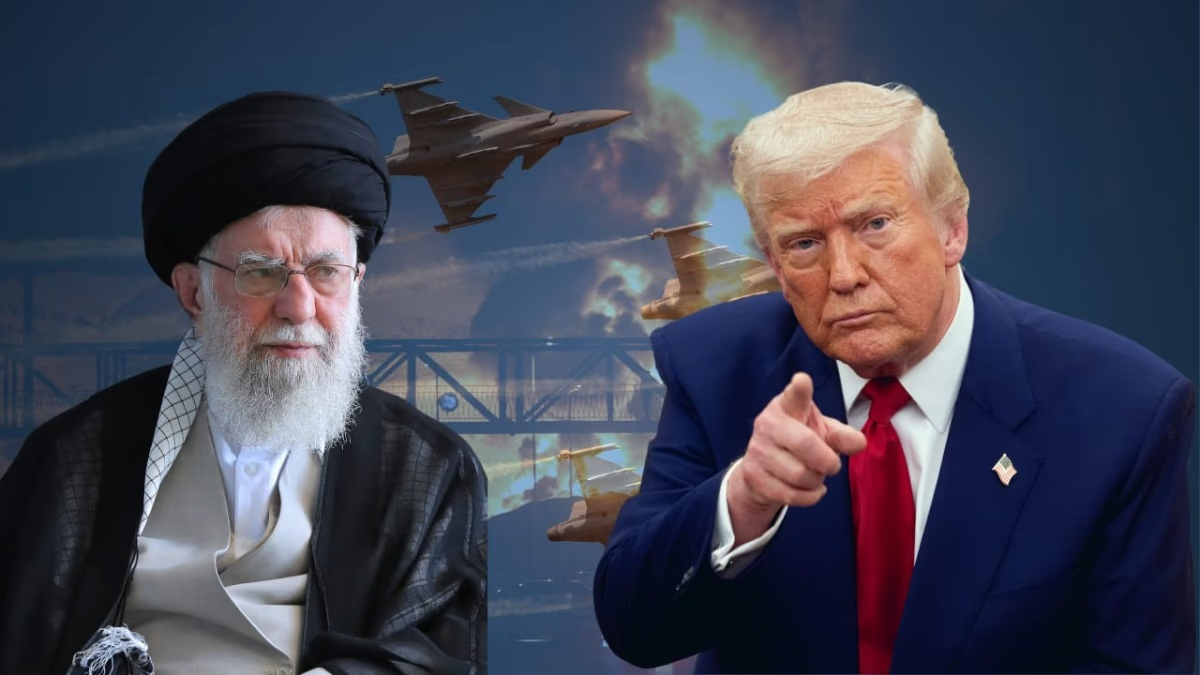
The global focus has centered around Iran's nuclear program for over 25 years. The U.S. and its allies claim Tehran is aiming to develop nuclear weapons, whereas Iran asserts its intentions are peaceful. On Tuesday, critical talks will occur in Geneva, Switzerland, between the two nations. The U.S. will demand that Iran cease uranium enrichment and limit missile range, offering potential economic sanction relief in return. Failure in this negotiation might trigger a significant military conflict in the Middle East.
The U.S. fears that if Iran develops a nuclear bomb, it could pose a widespread threat across the Middle East. Iran's longstanding animosity with Israel and tensions with Saudi Arabia, both U.S. allies, heighten concerns. These allies do not wish for Iran to grow too powerful and become a security threat to them.
According to Reuters, during the Geneva talks, the U.S. will insist on a drastic reduction or end to Tehran's uranium enrichment in exchange for easing sanctions. Additionally, the U.S. will press Iran to halt its missile program or restrict missile range.
The IAEA notes that Iran has escalated its uranium enrichment to 60%, far beyond the 4.5% needed for energy and close to 90%, required for nuclear armament. With missiles capable of reaching all of Israel, Iran can strike anywhere within it. The U.S. remains determined to pressure Iran to curtail its nuclear ambitions and limit missile reach.
U.S. Military Build-Up Near Iran
Prior to the talks, the U.S. stationed the aircraft carrier USS Abraham Lincoln in the Middle East, with military exercises targeting Iran conducted on Sunday. U.S. officials informed Reuters that military action could commence upon President Trump's orders. Additionally, the USS Gerald R. Ford, another massive aircraft carrier, is heading to the region, carrying thousands of troops, fighter planes, guided missiles, and more. If Iran doesn't concede to halt its nuclear and missile activities, President Trump might order a strike on Iranian nuclear and military sites.
Previously Bombing Iranian Nuclear Sites
Last year, during a 12-day conflict between Israel and Iran, the U.S. launched aerial strikes on Iran's nuclear grounds, particularly targeting Fordow, Natanz, and Isfahan. Following these B-2 Stealth Bomber operations, President Trump claimed significant damage to Iran. However, many experts believed the impact fell short of crippling Iran's nuclear capabilities.
Experts highlight that, even now, Iran operates three major nuclear facilities, including the Natanz and Fordow uranium enrichment centers and the Isfahan nuclear research center. Moreover, nuclear power plants are active in Bushehr, Darkhovin, and Sirik. Meanwhile, the Arak facility is a heavy water plant with more limited uses.
Israel's Reaction
Israel has responded to the looming U.S.-Iran talks, with Prime Minister Benjamin Netanyahu expressively voicing that any deal should completely dismantle Tehran's nuclear infrastructure, not just cease uranium enrichment processes.
During a conference for American Jewish organizations, Netanyahu expressed skepticism about any agreement with Iran, emphasizing Israel's national security needs, which align with global safety concerns. Any agreement should focus on halting uranium enrichment and dismantling infrastructure capable of developing nuclear arms.
Following preliminary talks in Muscat, Oman, Israeli Prime Minister Netanyahu visited the U.S. last week to relay concerns to President Trump.
Iran's Nuclear History and Perspectives
In 2003, the IAEA revealed that Iran had secretly run a nuclear program for 18 years, possibly aiming for nuclear weapons. This disclosure led to widespread condemnation, including from Russia and China, long-term Iranian allies. Consequently, the U.S. intensified sanctions, supported by European and UN restrictions. Amidst this scenario, Iran forged a deal in 2015 under President Barack Obama, easing some global sanctions. However, in his first term, President Trump withdrew from the agreement, imposing harsher penalties on Iran.
Early U.S. Assistance
In 1957, the U.S. and Iran signed a nuclear cooperation agreement under Shah Mohammad Reza Pahlavi, America's supported leader. This agreement laid the groundwork for Iran’s peaceful nuclear program. During the Cold War, Iran was a crucial U.S. ally, receiving a 5-megawatt nuclear reactor in 1967, alongside the necessary uranium.
In 1970, Iran signed the Nuclear Non-Proliferation Treaty, pledging against nuclear weapon endeavors. Post-1979 Islamic Revolution, with threats from Israel escalating, Iran, under Ayatollah Ruhollah Khomeini, accelerated its military capabilities. Consequently, Iran allegedly pursued nuclear weapons and now possesses the means to fabricate such arms independently, potentially joining the nuclear weapon nations' club. While Israel is believed to have nuclear capabilities, they have not officially confirmed it.