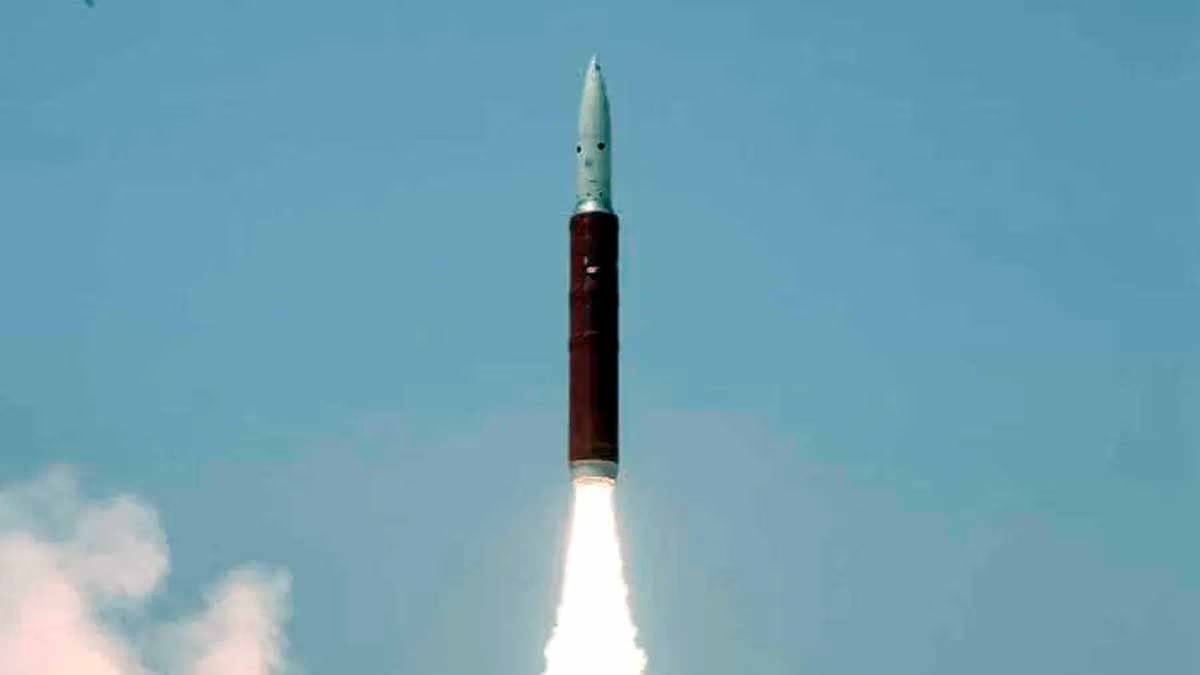
The Indian government has issued a notification declaring an expanded danger zone in the Bay of Bengal for a potential missile test. The Notice to Airmen (NOTAM) now extends to about 3550 kilometers, significantly more than the previous 2520 kilometers. This test will occur from December 17-20, 2025, running daily from 6 AM to 6 PM.
The test, launching near the Visakhapatnam coast, will impose temporary restrictions on marine and air traffic. The Defense Research and Development Organization (DRDO) and the Indian Navy are rigorously preparing for this undertaking.
NOTAM is an international alert notifying aircraft and vessels to steer clear of the danger zone, critical to avoiding debris, explosions, or missile paths during testing. This notification dated December 11, 2025, outlines a 3550 km corridor in the eastern Bay of Bengal, stretching from Odisha's APJ Abdul Kalam Island towards the Indian Ocean.
Comparatively, this represents a considerable expansion from past notices; zones from November-October 2025 spanned 1480 km to 3545 km, with some tests canceled. Initially, a zone from December 1-4 up to 3485 km was also canceled. The new December dates indicate testing of longer-range missiles. Satellite imagery analyst Damien Symon shared this information, derived from open-source intelligence on X.
Though there is no official confirmation, experts speculate a submarine-launched ballistic missile (SLBM) could be under test. Potential candidates include the K-4 SLBM, Agni-series ICBM, or the BrahMos-II.
K-4 SLBM: With a range of 3500 km, it is nuclear-capable, launched from nuclear submarines such as INS Arihant, enhancing India's nuclear triad (land, air, sea).
Agni-5 or Agni-Prime: MIRV (Multiple Independently Targetable Reentry Vehicle) capable ICBM with over 5,000 km range; could see SLBM version testing.
BrahMos-II: A supersonic cruise missile with a potential hypersonic version; however, SLBM more likely due to the range.
The testing will be from DRDO's Integrated Test Range (ITR) Chandipur or naval ships/submarines, coupled with constant surveillance by the Navy and Air Force, necessitating diversions for civilian flights and ships.
This strategic development unfolds amid growing activity by China. In November 2025, four Chinese survey ships (Yuan Wang series) entered the Indian Ocean for potential missile tracking. China often seeks telemetry (data leaks) during Indian tests. An attempt in 2022 was canceled due to the presence of the Yuan Wang 6 ship.
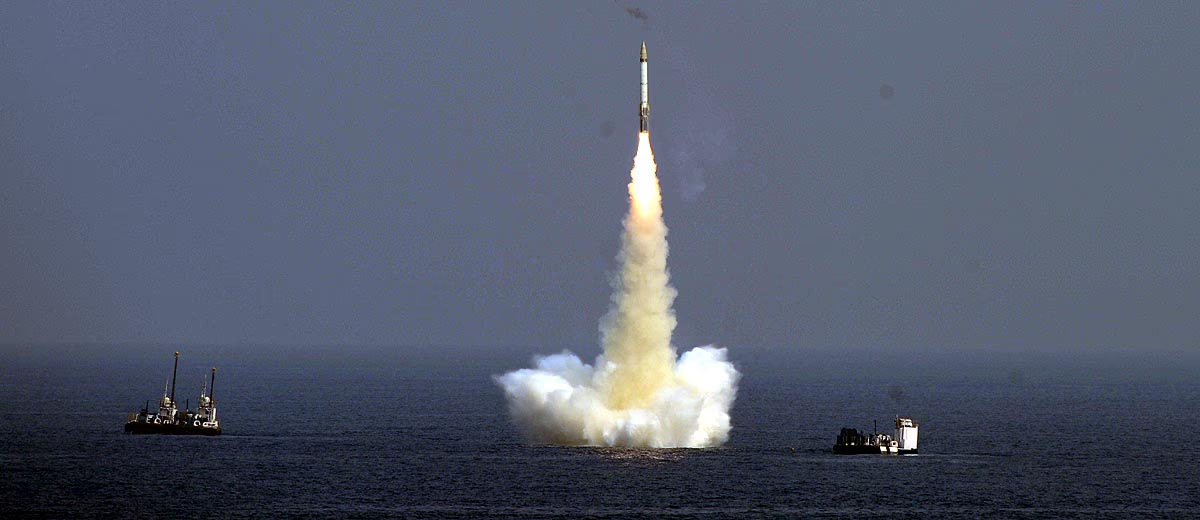
Source: aajtak
India is adopting a 'Bastion Strategy' — creating a secure zone in the Bay of Bengal for deploying submarines. A long-range SLBM like the K-4 could target major Chinese locations (such as Beijing) directly from the Bay of Bengal, bolstering nuclear deterrence amid tensions in the South China Sea and the Indo-Pacific.
Aviation: Commercial flights (e.g., Delhi-Bangkok route) will reroute, with restrictions from 6 AM to 6 PM.
Maritime: Fishermen and vessels must maintain distance. Naval patrols will escalate.
International: Neighboring nations (Sri Lanka, Bangladesh) have been informed.
Such scenarios have unfolded in past tests — in July 2025, a drone-missile intrusion was thwarted during an IAF exercise in Rajasthan.
This notification indicates India's intent to elevate its defense capabilities. With successful tests by DRDO and the Navy, deployment of missiles like Agni-5 or K-4 is imminent. Vigilance against Chinese espionage remains imperative. Successful tests could lead to further launches in 2026.