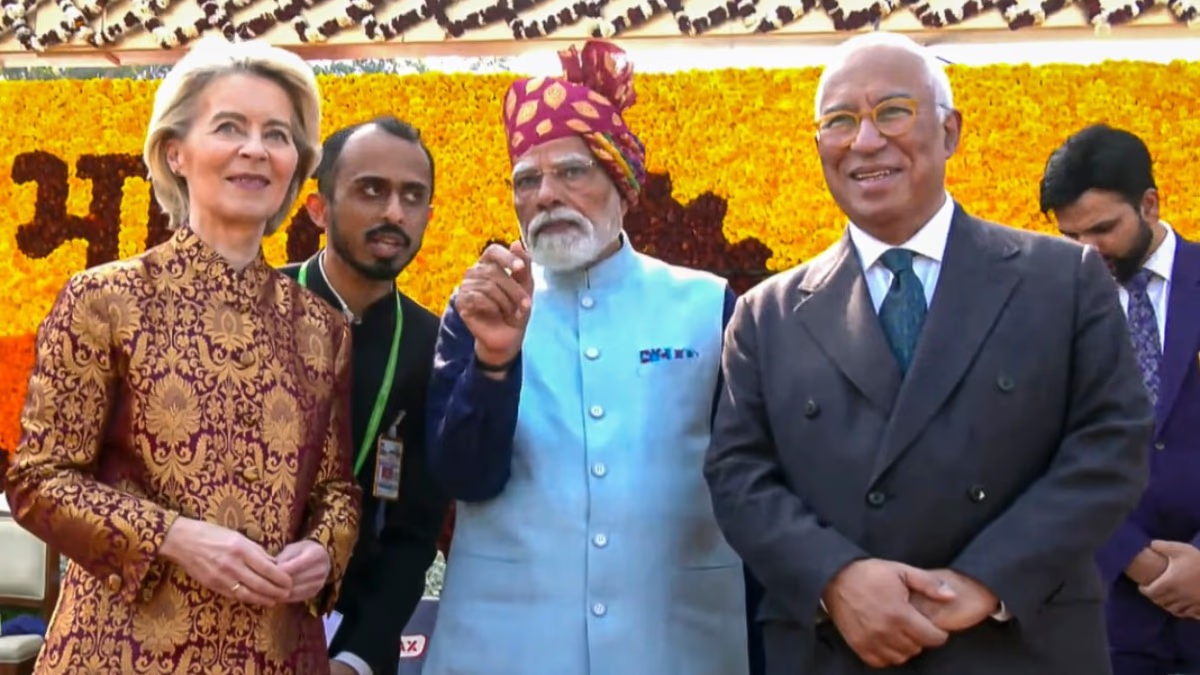
At last, a Free Trade Agreement (FTA) has been sealed between India and the European Union (EU), a milestone reached after nearly 18 years of negotiations. Dubbed the 'Mother of All Deals', discussions for this agreement commenced in 2007. Commerce Secretary Rajesh Agarwal disclosed that the official announcement of this historic agreement will be made on Tuesday, with the final signatures being appended post the completion of legal formalities.
Secretary Rajesh indicated that the legal scrubbing of the agreement's text will take 5 to 6 months, after which both parties will sign the official documents. The government anticipates that this FTA could be operational by next year.
This agreement is designed to enhance economic cooperation between India and the EU in a balanced and future-oriented manner. Its primary goal is to foster new opportunities for bilateral trade and investment, thereby linking both economies more intimately.
Experts suggest that the deal will offer Indian exporters, industries, and investors better access to the European market while opening up fresh avenues for European companies to enter India's rapidly growing consumer market.
According to the Commerce Secretary, the agreement is crafted to equitably account for the interests of both parties, ensuring no disproportionate impact on either. It aims to strengthen long-term economic cooperation and endow India-EU collaboration with a new purpose amid emerging global supply chain, investment, and trade dynamics.
Specialists believe this FTA will bolster the strategic partnership between the two regions, playing a significant role in India's global trade policy.
Also Read: India-EU Trade Deal: Just a Few Hours Away... Trump to Get a Response That Will Nullify All Tariff Games!
Tariff Reduction and Service Sector Enhancement
Under the FTA, both parties agreed to lower or eliminate import duties on over 90 percent of goods. Additionally, the agreement incorporates provisions to ease trade in service sectors such as telecommunications, transportation, accounting, and auditing.
Currently, the EU imposes approximately a 10 percent import duty on goods and labor-intensive sectors from India, with a general rate around 3.8 percent. Conversely, India imposes an average duty of 9.3 percent on European goods, with automobiles and their parts subjected to the highest rate (35.5 percent), followed by plastics at 10.4 percent, and chemicals and pharmaceuticals at 9.9 percent.
Within the framework of this Free Trade Agreement (FTA), both sides intend to reduce or eradicate import duties on over 90 percent of goods. Additionally, simpler rules are to be applied to service sectors such as telecommunication, transportation, accounting, and auditing, facilitating trade growth. Since 2014, Andhra Pradesh has finalized seven trade treaties with Australia, the UK, Oman, New Zealand, the UAE, EFTA, and Mauritius.
Offsetting the Impact of High U.S. Tariffs
This agreement intends to mitigate the effects of high tariffs imposed by the U.S., which has disrupted global trade flows. India has faced up to 50 percent tariffs from the U.S., presenting an opportunity for Indian exporters to diversify their businesses and reduce dependency on China.
Ongoing Negotiations on Investment Protection and GI
The India-EU FTA also includes ongoing negotiations on investment protection and geographical indications (GI). This comprehensive agreement spans 24 chapters, covering goods, services, and investment. In 2024-25, the goods trade between India and the EU was valued at 136.53 billion USD, with India's exports at 75.85 billion USD and imports at 60.68 billion USD, resulting in a trade surplus of 15.17 billion USD for India. The services trade in 2024 saw a turnover of 83.10 billion USD.
Current Status of India–EU Trade
The EU is India's largest trading partner, accounting for approximately 17 percent of India's total exports. The EU’s economy is about 20 trillion USD, with a population exceeding 450 million. India, with a population over 1.4 billion, recorded total goods exports worth billion USD and services worth 387.5 billion USD in 2024-25, while equivalent imports were 720 billion USD for goods and 195 billion USD for services.
Also Read: India to Reduce Tariff on Cars Like Mercedes-BMW by up to 40%; Possible Announcement in EU Trade Deal
India's exports to the EU largely include petroleum products, electronics, textiles, machinery, organic chemicals, iron-steel, and pharmaceutical products. Conversely, imports from the EU into India comprise machinery, electronics, aircraft, medical apparatus, gems-jewelry, and plastics.
In the service sector, India provided the EU with business services, telecom, IT, and transportation services. Meanwhile, India imported intellectual property services, telecom, and IT services from the EU.
Steps Towards Strategic and Economic Strengthening
This agreement is poised to deliver mutual strategic and commercial benefits, significantly reinforcing India's global economic position.