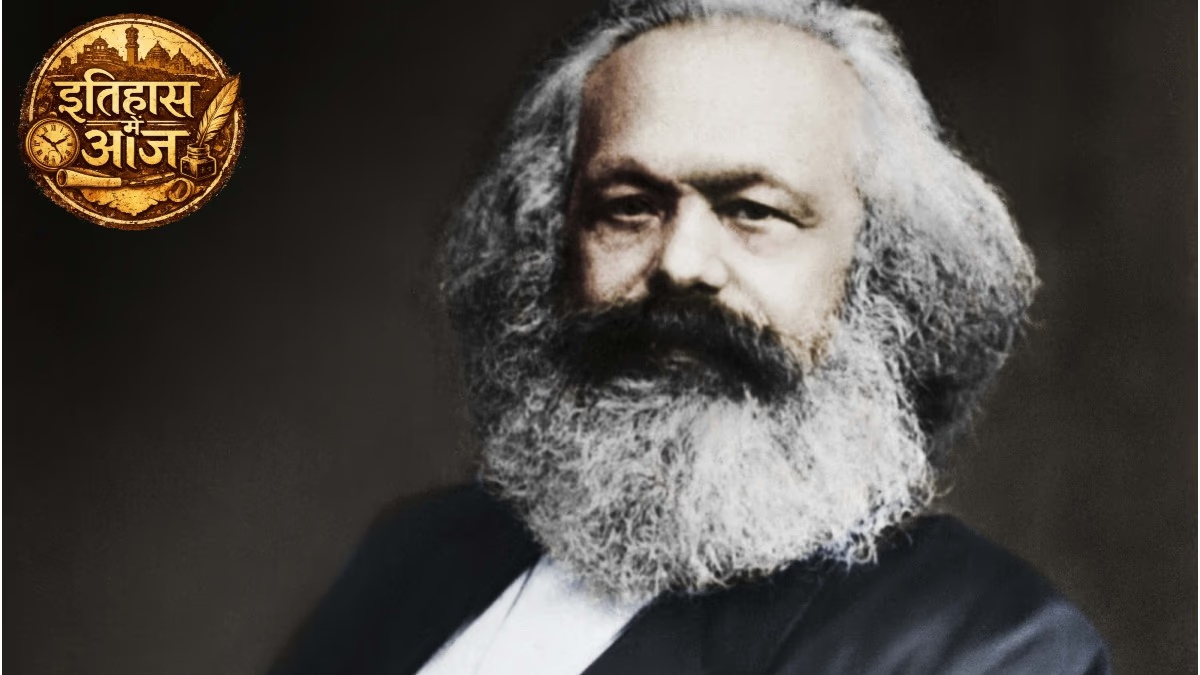
On February 21, 1848, modern communism was ideologically born when Karl Marx published the Communist Manifesto. Originally written in German, it was titled 'Manifesto of the Communist Party.' Although initially it did not make a significant impact, its ideas would go on to influence nearly half the world's population.
Karl Marx, with the assistance of Friedrich Engels, had the Communist Manifesto published by the Communist League in London, a group of German revolutionary socialists. This political pamphlet—a document considered one of the most influential in history—declares that the history of all hitherto existing societies is the history of class struggles, and the victory of the proletariat, or working class, would put an end to the class society forever.
The echo of the Communist Manifesto's ideas grew stronger through the 20th century, and by 1950, approximately half of the world's population lived under Marxist governments. Karl Marx was born in 1818 in Trier, Prussia. His father was a Jewish lawyer who converted to Lutheranism.
Marx studied law and philosophy at the universities of Berlin and Jena, initially following the German philosopher G.W.F. Hegel of the 19th century, who sought a dialectical and universal philosophical system. In 1842, Marx became editor of the liberal democratic newspaper, Rheinische Zeitung, in Cologne. Under his guidance, the newspaper grew considerably but was shut down in 1843 by the Prussian authorities for being too outspoken.
That year, Marx co-edited a new political journal in Paris, the center of socialist thought, and embraced the extreme form of socialism known as communism. This called for a revolution by the working class to overthrow the capitalist system. In Paris, Marx befriended Friedrich Engels, who shared his views and remained his collaborator throughout his life.
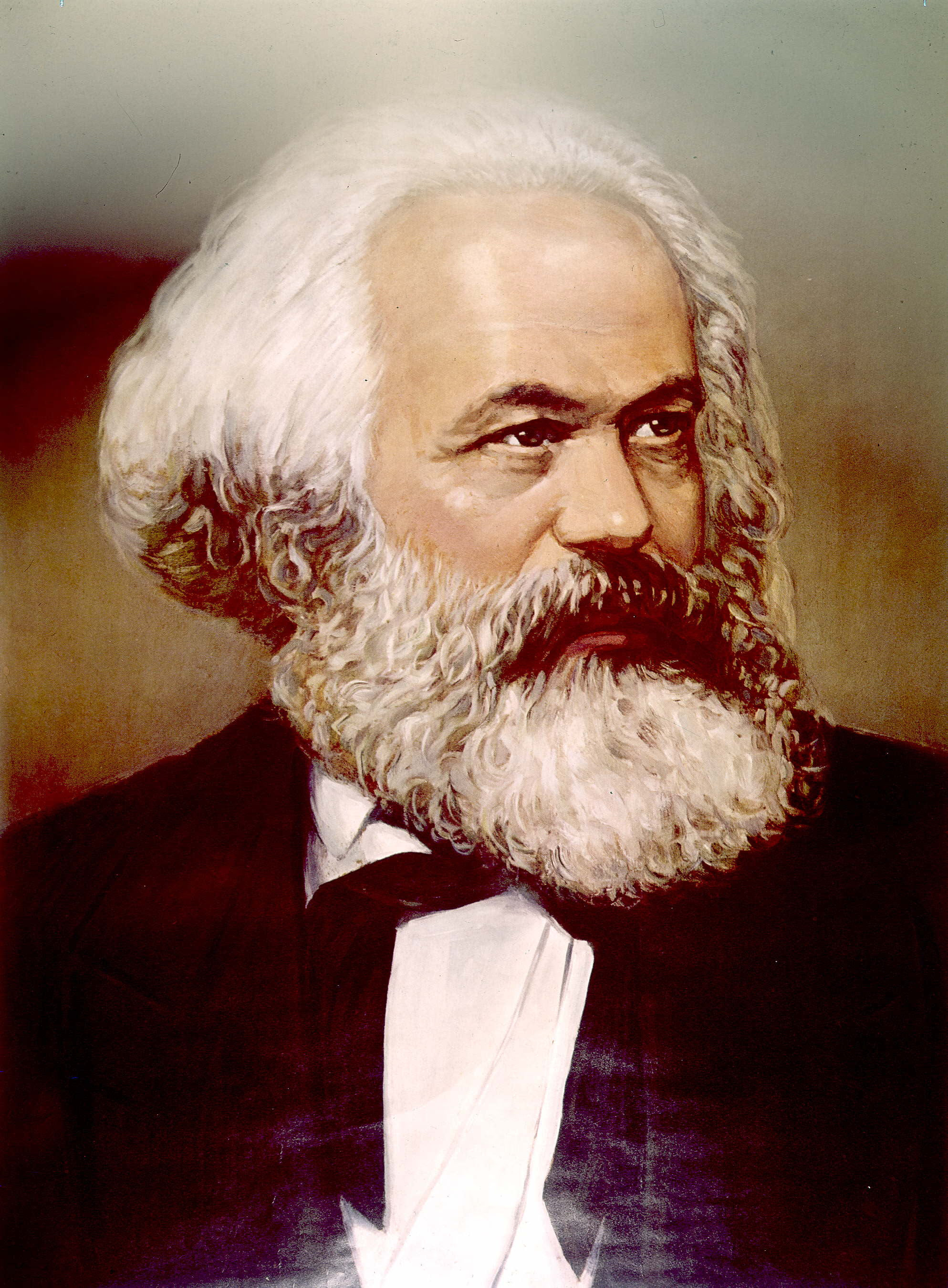
Source: aajtak
In 1845, Marx was expelled from France and settled in Brussels, renouncing his Prussian citizenship. Engels joined him in Brussels, and together they developed their philosophy of communism, becoming the intellectual leaders of the working-class movement. In 1847, a secret association of revolutionary German workers in London, the League of the Just, invited Marx to join their organization.
Marx accepted and collaborated with Engels to rename the group the Communist League and planned to unite it with other German workers' committees across Europe. They were tasked with drafting a manifesto to summarize the League's principles.
Upon returning to Brussels, Marx wrote the Communist Manifesto in January 1848, based on an article Engels had written for the League in 1847. In early February, Marx sent it to London, where the League quickly adopted it as their manifesto. Although many ideas in the manifesto were not new, Marx had synthesized various concepts with his materialist conception of history, producing a powerful synthesis.
The manifesto concludes with the statement, "The proletarians have nothing to lose but their chains. They have a world to win. Workers of the world, unite!"
Marx predicted the revolution sweeping across Europe that indeed began shortly after the manifesto's publication. On February 22, revolution erupted in France, sparked by socialist and opposition groups protesting bans on political meetings. Riots escalated into a popular uprising, and by February 24, King Louis-Philippe was forced to abdicate.
The revolutionary fire quickly spread throughout Europe. Marx was in Paris at the invitation of the provisional government when the Belgian authorities, fearing the revolutionary wave would reach their borders, expelled him. Later that year, he moved to the Rhineland to agitate for armed rebellion. The European bourgeoisie swiftly crushed the revolutions of 1848, and Marx had to wait for another opportunity to incite change. He relocated to London, where he continued writing with Engels, organizing the international communist movement.
In 1864, Marx helped establish the International Workingmen's Association (known as the First International) and published the first volume of his seminal work 'Das Kapital,' a cornerstone of communist theory. By his death in 1883, communism had become a significant political movement in Europe. Thirty-four years later, in 1917, Marxist Vladimir Lenin led the world's first successful communist revolution in Russia.