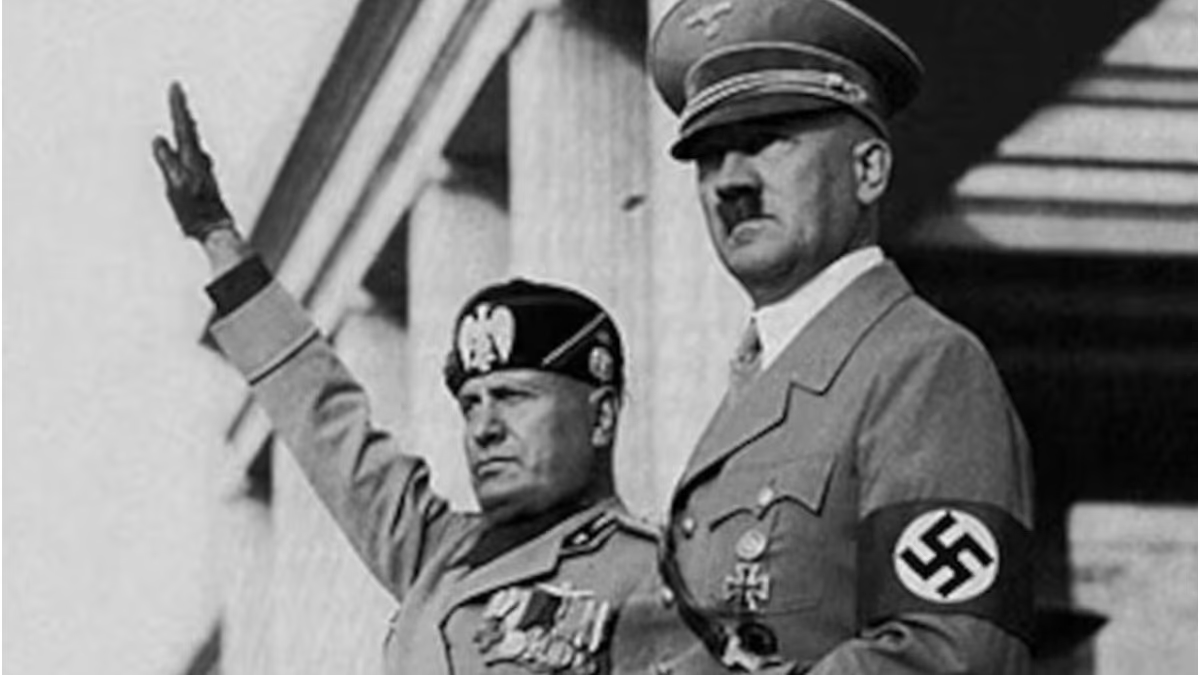
On January 30, 1933, the world saw one of history's most notorious leaders, Adolf Hitler, assume the position of Chancellor in Germany. President Paul von Hindenburg appointed the leader of the National Socialist German Workers' Party (Nazi Party), Adolf Hitler, as Chancellor. With this, Hitler swiftly rose to influence, sowing the seeds for World War II.
The rapid ascent of Hitler in 1932 Germany was driven by the dire economic situation of the German people, the sting of defeat in World War I, and the harsh terms of the Treaty of Versailles, which left deep wounds. Hitler's dynamic oratory skills were a powerful asset that propelled him to the position of Chancellor.
He capitalized on public dissatisfaction with the post-war Weimar government, transforming it into backing for his nascent Nazi Party. In the July 1932 elections, the Nazis claimed 230 governmental seats, securing more than half of the Reichstag seats alongside the communists, emerging as the second-largest party.
Hitler's Popularity Rises in Germany
Despite being alarmed by the growing popularity of Hitler and his aggressive supports (the SA or Brownshirts), Hindenburg initially refused to appoint him Chancellor. Instead, he chose General Kurt von Schleicher, who tried negotiating with the dissenting Nazi faction led by Gregor Strasser to undermine Hitler's rising influence.
In subsequent elections in November, the Nazis suffered losses while the Communists gained momentum. Schleicher's efforts indirectly bolstered right-wing forces in Germany, strengthening their resolve to bring Hitler to power. In a complex web of negotiations orchestrated by former Chancellor Franz von Papen, supported by leading German businessmen and the conservative German National People's Party (DNVP), Hindenburg was persuaded to appoint Hitler as Chancellor.
Also Explore: The Day Antarctica Caught the World's Eye — Who Discovered It?
This decision was made with the understanding that von Papen would become Vice-Chancellor and other non-Nazis would fill key government roles, hoping to curb Hitler's harsh tendencies. However, January 30, 1933, marked a terrifying turn for Germany and, ultimately, the entire world.
Read More: The Day Thomas Edison Revolutionized Night with the Electric Bulb
Backed by a large section of the German populace, Hitler's vision was to abolish politics and transform Germany into a powerful, unified single-party state. He immediately ordered the rapid expansion of the state police, Gestapo, appointing Hermann Göring as the head of a new security force entirely composed of Nazis, dedicated to quashing any opposition to his party. At that moment, Nazi Germany began its ominous rise, and neither Hindenburg nor von Papen, nor anyone else, could halt it.