The president of the world's most powerful nation has elevated himself above international laws. He claims to protect democracy and speaks the language of human rights. Yet, under the guise of safeguarding democracy, he kidnaps other nations' presidents without approval or bombs foreign lands. Even when election results are unfavorable, he refuses to accept them, leading his supporters to storm government buildings.
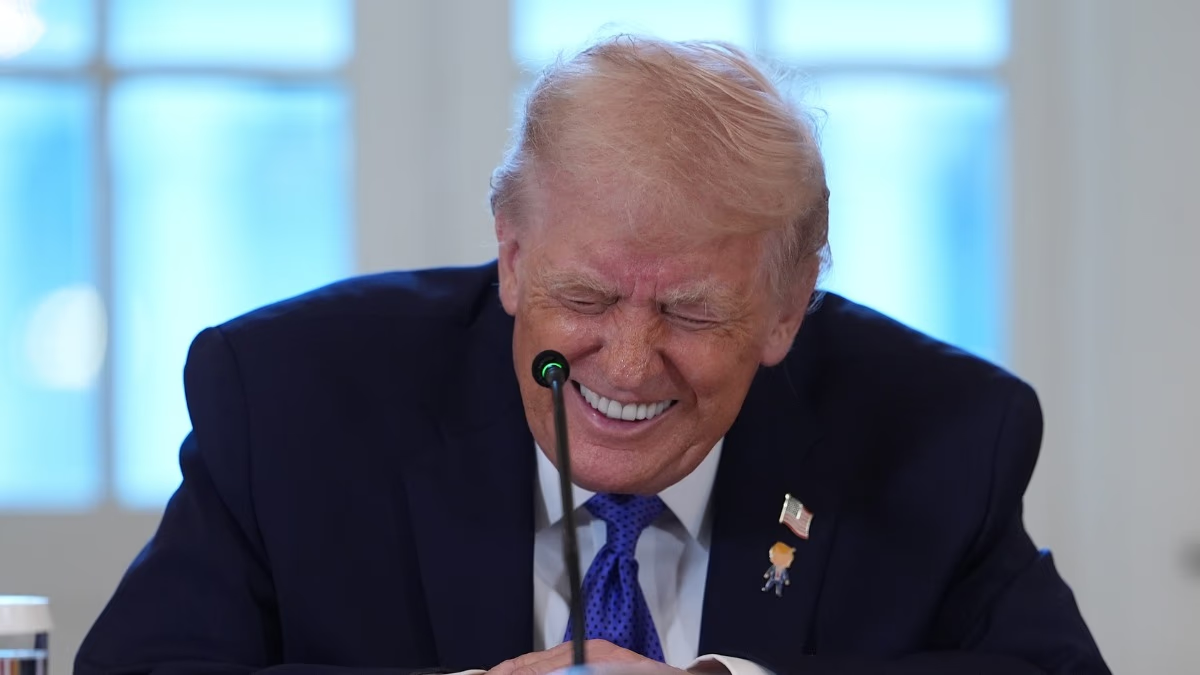
This analysis revolves around Donald Trump. How would you describe such a leader? A strong authoritarian or a fearful guardian of democracy? Trump has long declared himself a critic of dictators. Yet, recent decisions paint a picture where he speaks democracy but acts with authoritarian intent.
Consider Trump's actions in Venezuela that shocked both the world and Americans. No one anticipated that the American military would invade Venezuela and forcibly abduct President Nicolás Maduro. Is this not a blatant violation of international laws? Remarkably, Trump's decision even caught their own leaders off guard, with no approval sought from the United Nations.
A single individual in America decides the fate of a sovereign nation. If we assume Maduro was a tyrant, did the U.S. have the right to depose him? The power rightly belonged to the Venezuelan people, yet the world's most powerful president made that decision instead.
Democracy or Oil: The True Question Lies Here
Behind Trump's Venezuelan game is a clear objective: oil. America's interest in Venezuelan oil isn't new. Venezuela possesses the largest oil reserves worldwide, surpassing even the Middle East. With 303 billion barrels, this wealth attracts global power's gaze.
After Maduro's forced removal to America, Trump announced that U.S. companies would manage Venezuelan oil. So, why does oil appear in discussions if democracy was the intent?
Historically, whenever democracy is used as a pretext for invasion, resources lie at the core of motivations.
Iran: The Same Language, The Same Pattern
Turning from Venezuela to Iran, massive protests erupt against the Khamenei regime. Iran's Supreme Leader Khamenei suspects American and Israeli involvement.
With eyes now set on Iran, Trump repeatedly speaks of regime change, publicly threatening the Khamenei rule with severe consequences for violence against protesters.
What else might Iran have to provoke such continuous threats from Trump? Iran boasts significant oil reserves and controls the Strait of Hormuz, further fueling the geopolitical intrigue.
Read More: Is Aspirin Overdose Affecting Donald Trump's Behavior?
Having exited the nuclear deal, America already imposed economic sanctions on Iran. During Trump's tenure, American forces bombed Iran multiple times, causing substantial damage to nuclear facilities.
This raises questions: Is Iran on a path similar to Venezuela?
History: The Unchanging Narrative
Across the globe, America has used the pretext of establishing democracy for action. Iraq, Libya, Afghanistan; each time, promises to uproot terrorism accompanied the rhetoric of democracy, yet chaos spread instead, dismantling economies and shattering societies.
Within America: When Defeat Was Unbearable
Trump's authoritarian mindset isn't confined to foreign policy. After losing the 2020 election to Joe Biden, Trump rejected the results. Without evidence, he alleged fraud, spurring supporters to attack the Capitol, resulting in unprecedented vandalism.
Clearly, this was an attempt to disrupt the democratic process, and disturbingly, attackers were labelled patriots.
This underscores that such acts aren't democratic responses but reflect a fear of losing power.
Media, Courts, and Opposition: All Seen as Enemies
Every dictator starts by labeling the media and opposition as enemies, as Trump does. He disparages judges and courts when unfavorable verdicts arise.
If anyone disagrees, they're branded seditious. This repeating pattern traces back to countless authoritarian beginnings worldwide.
Friendship's Criterion: Not Democracy, But Advantage
The U.S. claims the oldest democracy. Ostensibly, America appears a champion of democracy, yet reality speaks otherwise.
Without scrutinizing elections in places like UAE, North Korea, and Saudi Arabia, Trump forms strategic alliances. It's not about democracy but strategic interests.
Such selective morality exposes Trump's authoritarian mindset.
Laws and the UN: Power Overrules Everything
How can one country kidnap another's leader in the 21st century? Yet this implausible scenario manifested under Trump.
According to UN Charter, attacking another country without permission is illegal. Had any other nation acted similarly, it would face heavy sanctions, but not Trump.
Without provocation, America attacked Venezuela, evading consequences, showcasing how power subdues the world.
Final Question: If Maduro Is a Tyrant, What About Trump?
A leader eager to overthrow foreign governments, who refuses electoral defeat, silences dissent, and flouts international laws—who is he?
This isn't just about Donald Trump. It's a query for a world silent before power. History reminds us that tyrants wage wars externally before turning inward.
Trump's Vision: Not Strengthened Systems, But a Weaker World
Understanding Trump's politics involves examining his rapport with Russia's President Vladimir Putin. The U.S. and Russia lack ideological ties; to America, Russia is merely a tool for global instability. Why? America employs Russia to maintain world unrest.
Trump isn't engaging in ideological combat or targeting one nation. His struggle lies with global rules and institutions like NATO, the UN, and international law.
These entities strive for global stability, but Trump's politics thrives not on stability, but pressure. Russia becomes a critical asset in this pressure game, as it challenges international norms directly.
Due to Russia, Trump has Europe at his feet. It's a landscape where leaders like Trump excel. As international laws weaken and institutions falter, decisions are dictated by sheer power.