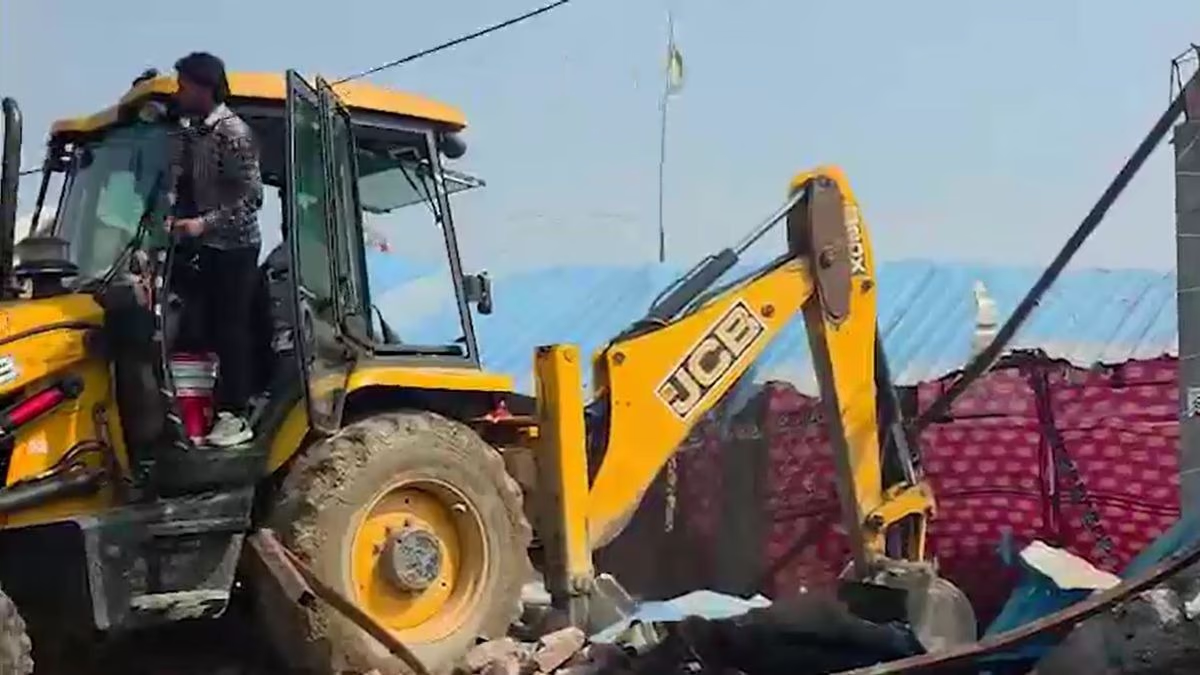
The United States has made a striking revelation, publicly alleging for the first time that China conducted a secret nuclear test in 2020. This test, reportedly executed clandestinely, took place amidst the violent clash in the Galwan Valley between India and China, and as the world grappled with the COVID-19 pandemic.
US Undersecretary of State, Thomas DiNanno, made this statement during a disarmament conference in Geneva. This claim is particularly notable as it emerges during a period marked by the expiration of the last nuclear weapons treaty between the US and Russia on February 5. President Donald Trump seeks to include China in any future nuclear agreements.
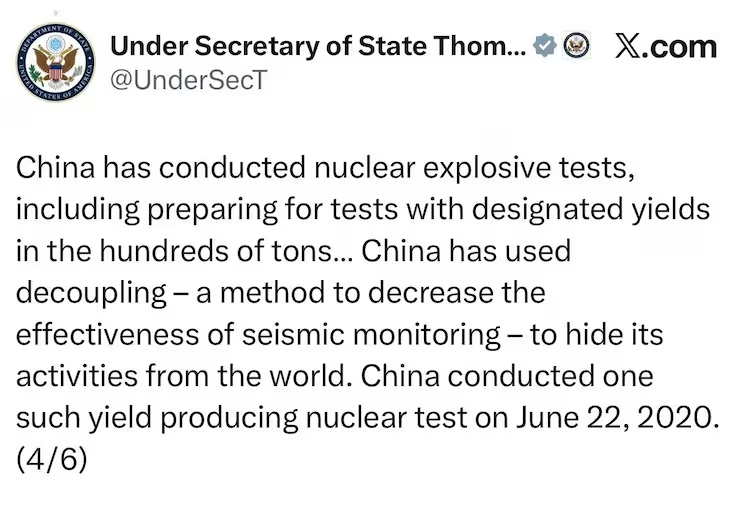
DiNanno shared via social media that the US possesses intelligence indicating China's conduct of nuclear tests, carefully avoiding global surveillance agencies. According to US officials, China executed such a test on June 22, 2020.
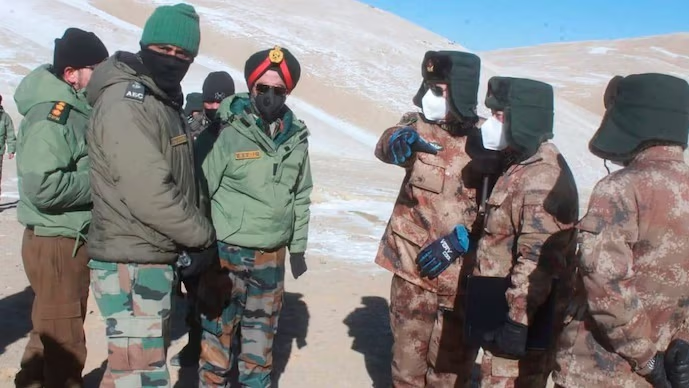
This date holds significance, occurring a mere seven days post the violent skirmish in Galwan Valley. In this confrontation in Eastern Ladakh, 20 Indian soldiers lost their lives. Per an agreement, deadly weapons were banned in this region, rendering the clash a hand-to-hand combat. China has never officially disclosed the extent of its losses, but global reports suggest that China suffered more casualties than India. The military standoff eventually concluded with an agreement in 2024.
Source: aajtak
It has now come to light that the alleged Chinese nuclear test may have been conducted at the Lop Nur site in the Xinjiang region, near India's border. According to US authorities, China employed a technique known as decoupling.
In layman's terms, the explosion is carried out in a large underground cavity, minimizing seismic waves and making the test hard to detect. This method has long been recognized for concealing nuclear tests.
Simply put, it's a classic technique where an explosive is detonated in a sizable underground cavity for the seismic waves to dissipate and conceal the explosion. This traditional method is effectively used to cloak such explosive tests.
DiNanno remarked that the US government is aware of China's nuclear tests, preparations for which involve tests with a capacity of hundreds of tons. China utilized decoupling to hide its activities from the world. On June 22, 2020, China conducted another nuclear test.
Why is this timing significant?
Although the US has not directly linked this nuclear test to the India-China border dispute, the timing is considered profoundly sensitive. During that period, there was substantial military deployment and aggressive activities along the Line of Actual Control (LAC). The face-off between two nuclear-armed nations raised serious concerns about regional stability.
Some geopolitical experts believe that if China indeed executed such a test, its planning must have been ongoing months earlier. In such a scenario, the Galwan incident, which captivated global attention, served as a 'shield' for China to conduct the nuclear test discreetly.
China needed to perform such actions in secrecy, as it is a signatory to the Comprehensive Nuclear-Test-Ban Treaty (CTBT), which prohibits nuclear explosive tests. However, neither China nor the US has ratified the treaty to date.
Why is the US worried about China?
The US has long been concerned about China's rapidly expanding nuclear arsenal. China is believed to possess approximately 600 nuclear weapons. Last November, President Trump claimed that China and Pakistan were conducting nuclear tests, prompting US military preparations for a resumption of testing.
In an interview, Trump stated that Russia was testing and so was China, yet they remain tight-lipped about it. Consequently, Trump aims to include China in any future nuclear agreement with Russia. The expiration of an arms control treaty from the Cold War era sparks fears of a global arms race.
Chinese ambassador for nuclear disarmament, Shen Jian, neither confirmed nor denied DiNanno's accusations. He asserted that China has consistently adopted a responsible approach on nuclear matters. Shen Jian noted China's awareness of the US's continuous exaggeration of the so-called Chinese nuclear threat and expressed strong opposition to such false narratives. He also pointed out that the real culprit for promoting an arms race is the US.
Meanwhile, the Comprehensive Nuclear-Test-Ban Treaty Organization (CTBTO), an international surveillance body, reported that its monitoring system detected no nuclear activity in China during that period.