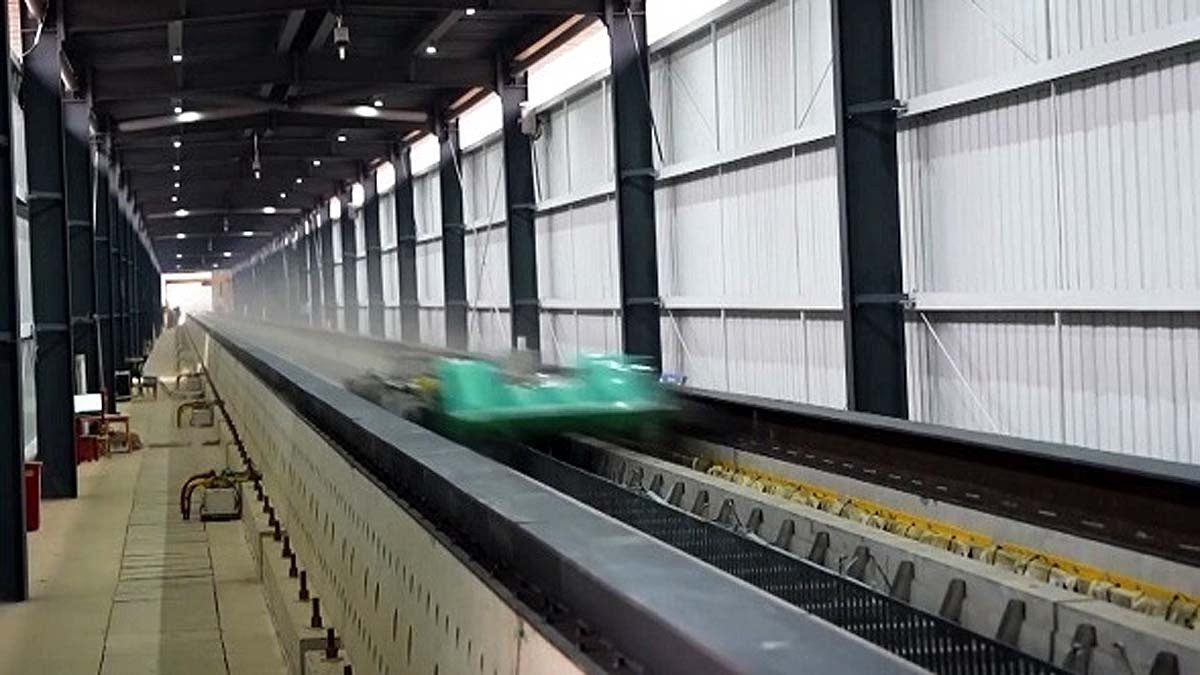
China has set a new world record in magnetic levitation (maglev) technology. Scientists at the National University of Defense Technology (NUDT) accelerated a 1-ton test vehicle to a speed of 700 kilometers per hour in just 2 seconds. This test took place on a 400-meter-long track. The vehicle was safely brought to a halt.
State channel CCTV aired a video showing the vehicle resembling a mere chassis. It sped along the track like a blur, leaving a trail of smoke behind. This is the superconducting electric maglev system, setting the record for the world's fastest acceleration and speed. The test also successfully demonstrated extremely rapid braking.
This achievement resolves several major challenges...
Ultra-high-speed electromagnetic propulsion.
Electric suspension and guidance.
High-power energy storage.
High-field superconducting magnets.
Professor Li Ji stated that this success will accelerate the development of ultra-high-speed maglev transport in China.
The full name of the maglev train is Magnetic Levitation Train. It's a special high-speed train that doesn't run on wheels on regular tracks; instead, it floats a few centimeters above the tracks with magnetic force.
The train and the tracks are equipped with powerful electromagnets. Similar magnets repel each other, causing the train to lift off the track (about 1-10 cm). To propel it forward, the magnetic field is alternately applied to push and pull, eliminating friction and enabling high speeds.
Incredible Speed:
400-600 km/h or more, which is double that of regular trains. Quieter and smoother travel, and minimal maintenance as there're no wheels or track wear. Environmentally friendly as it runs on electricity, reducing pollution.
This technology isn't just limited to trains...
Hyperloop-style transport in vacuum tubes (up to 1000 km/h possible).
Initial boosts and fuel savings for rocket and aircraft launches.
Facilitating ground simulation for aerospace testing.
Thirty years ago, the same university developed China's first manned maglev. After 10 years of research, it achieved a record of 648 km/h in January 2025. Shanghai maglev provides the world's only commercial service (430 km/h). A 2 km vacuum tube line in Datong aims for 1000 km/h.
This breakthrough could revolutionize global transport and space technology. China has now joined the ranks of the world's top countries in this field. More significant tests are anticipated in the coming years.