The year was 1964 when RSS Chief Guru Golwalkar attended a meeting with activists in Bhopal. It was in this gathering that Guruji introduced two individuals, one being Pandit Deendayal Upadhyay. As he introduced the other, he mentioned, 'This thin young man fixing the mic is not just a mic man, he's a telecommunications engineer and your new regional promoter.' This was KS Sudarshan, previously the promoter from Mahakoshal province. Who knew that one day this telecommunications engineer would succeed in connecting where no telecom tower could be allowed.
KS Sudarshan hailed from the village of Kuppahalli in Mandya district of what was then the Mysore state. He always included his village's name in his name, although he was born in Raipur. He later became the fifth chief of the RSS and took on tasks originally laid by Guru Golwalkar, the second chief, and Balasaheb Deoras, the third chief: expanding the reach of the RSS among Muslim and Christian communities.
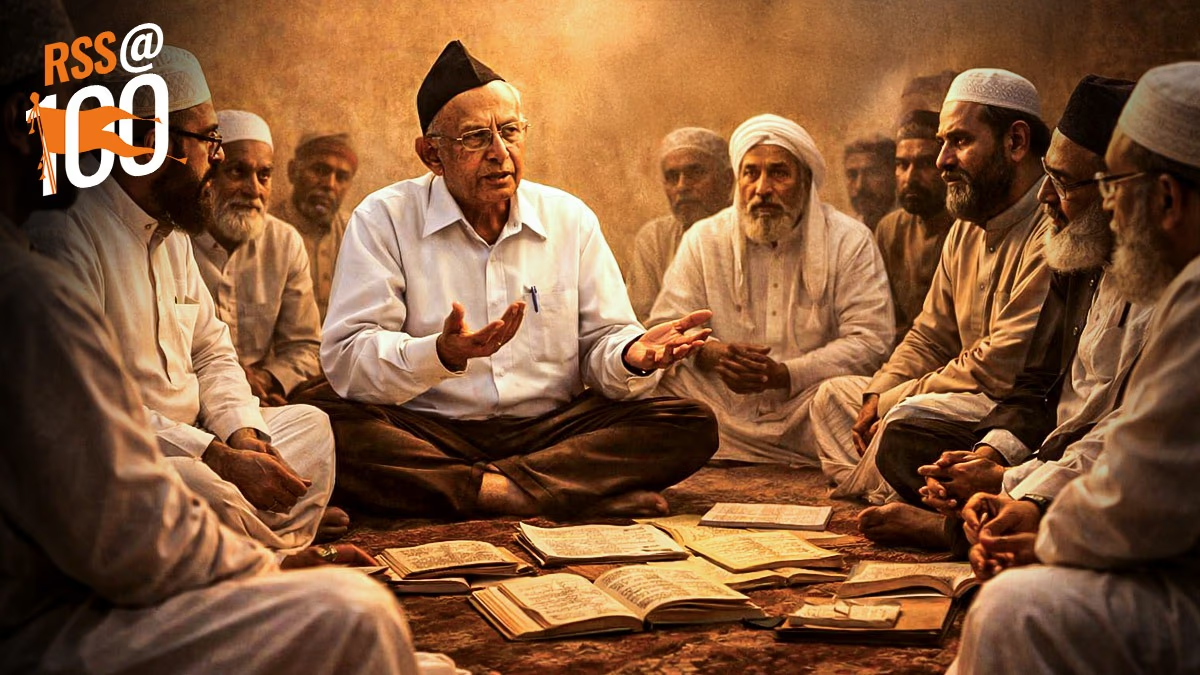
On October 2, 2002, ambassadors from seven West Asian countries arrived at the RSS headquarters, Keshav Kunj, for a dialogue with KS Sudarshan. For two hours, the ambassadors, led by Iraq's ambassador Saleh Mukhtar, sat cross-legged on the floor, keen to hear Sudarshan's thoughts on global events and Arab issues. Ambassadors from Syria, Libya, Sudan, Iran, and the UAE, along with a First Secretary from Saudi Arabia, were present. Sudarshan shared the principle of 'Vasudhaiva Kutumbakam' - the world as one family - and shared how for thousands of years diverse beliefs coexisted peacefully in India because Hindus are inherently secular. Here, even atheists like Charvaka could be considered Hindus.
His straightforward message was to respect certain traditions, ways, and beliefs of the land. He cited Hindu scriptures and shared how those who respected local traditions were never harmed. Jews and Parsis have lived for millennia here. But coming as invaders and maintaining belligerence harms India's soul. He urged that everyone must recognize this and highlighted examples of Indian Muslims who truly embraced India. He also critiqued the Indian government's 'secular' policies and global leadership, which disrupt natural and economic balances. In response, Syria's ambassador humorously remarked, 'Sudarshanji, how do you regularly serve such delicious (intellectual) feasts to so many people?' a comment met with smiles.
Following the discussion, Saleh Mukhtar returned to Keshav Kunj in February, about a month before the US invasion of Iraq. He and Sudarshan held a private 45-minute conversation. While the details were never disclosed, it was assumed that the looming war was discussed. After the meeting, while escorting Mukhtar to his car, Shyam Parande mentioned Mukhtar's admiration for Sudarshan as an incredibly wise and holy man. After Iraq's defeat, Mukhtar sought refuge in another country, a story Shyam Parande penned in 'Our Sudarshan'.
Establishment of the Muslim National Forum
Whenever the Muslim National Forum is discussed, the name of Indresh Kumar, a senior RSS promoter, surfaces. Ordinary RSS volunteers who question the organization sometimes express their frustrations with Indresh Kumar when they are upset about issues related to Pakistan or Muslims. While others on TV praise national-minded figures like Faiz for strengthening the RSS ideology. Yet, Indresh Kumar credits his efforts to former RSS chief KS Sudarshan.
Indresh Kumar began addressing these challenges while working as an RSS promoter in Jammu and Kashmir and Himachal, during a time of unrest. Thousands of Kashmiri Pandits had left the valley, yet Indresh Kumar frequently met with families living in refugee camps or under duress in the valley. KS Sudarshan regularly consulted him, curious whether all Muslims in Jammu-Kashmir resented India. Indresh replied, 'No, that's not the case. I continue to visit and speak with Muslim communities in these turbulent areas. I believe most desire peace and brotherhood. However, they feel helpless without government or media support. Even authorities and media sometimes align with extremists. But there are Muslims within governance and media opposed to nurturing extremism.'
In 1997, KS Sudarshan, then Assistant Secretary-General, visited Jammu and Kashmir for two days, hosting meetings with Muslims at both locations. It revealed that many Muslims were weary of terrorist attacks and wished to remain in India. Sudarshan searched for possibilities to engage such Muslims in national causes through a new organization. He had ongoing dialogues with Muslim scholars nationwide.
At crucial decision points, unforeseen events like terrorist attacks or riots would derail progress. February 2002 saw the Gujarat riots further deepening communal divides. Despite heightened mistrust, KS Sudarshan, Indresh Kumar, and others persisted in their mission. On December 24, 2002, at an 'Eid Milan' event in Bapudham, Chanakyapuri, Muslim and Hindu leaders gathered. Prominent figures like Maulana Jameel Elias, Maulana Wahiduddin, Peerzada Hasan Nizami, and others mingled with political leaders like LK Advani and Sushma Swaraj.
Every Story from RSS's 100-Year-Old Journey
In 'Our Sudarshan', Indresh Kumar shares insights about Sudarshan's speeches, where he emphasized that 'Islam' literally means 'peace and security'. Yet, the face of Islam is often portrayed as extremist and foreign. 'Can we strip away fanaticism to reveal its peaceful nature?' Maulana Wahiduddin concurred. The event concluded with everyone savoring delicious delicacies. From thereon, many Muslims pledged to partake in this challenging yet vital mission. Over time, this movement assumed various names, such as 'My Hindustan' and 'National Muslim Movement', before settling on 'Muslim National Forum, A New Path'. This name was chosen in Sudarshan's presence. Given Indresh Kumar's consistent efforts in rallying national consciousness among Muslims, he was tasked to support the organization in its growth and initiatives.
Gradually, the work of the Muslim National Forum spread across other states, thanks to Indresh Kumar's dedication. By August 30-31, 2003, the first National Worker Conference in Delhi drew over 250 representatives from 14-15 provinces. The conference passed two proposals: first, terrorism has no religion; second, equating jihad with terrorism is utterly wrong. Terrorism has no connection to Islam. Maulana Chhote Miya from Clear Sharif (Roorkee) was among the representatives.
The Inauguration of Muslim Women's Conventions
In April 2004, the first National Convention of Muslim Women took place at the World Youth Center, New Delhi. KS Sudarshan and Indresh Kumar supported and attended the two-day convention, listening and learning from Muslim women's perspectives and their current circumstances. They emphasized that educated, safe, and cultured daughters, sisters, and mothers are the foundation of any progressive society. Thus, communities must prioritize educating and nurturing their daughters. Approximately 300 women from 13 provinces, including lawyers, professors, teachers, students, and social-workers, participated.
Commemorating 'Saluting 1857' Nationwide
When the 150th anniversary of the 1857 revolution approached, RSS chief Sudarshan addressed the Muslim National Forum, expressing deep concern over the removal of martyr stories from educational curricula. 'Let's remember our freedom fighters; they belong to us,' he urged. Hence, forum members decided to commemorate the 150th anniversary of the 1857 revolt as 'Saluting 1857'. On May 10, 2007, at Mavlankar Hall, Delhi, a program transcending caste, religion, and language kicked off the tribute. The auditorium was packed.
Sudarshan addressed the inaugural event, reminding, 'Our country achieved freedom after sacrificing over 27 million lives. These sacrifices epitomize national duty. A community that forgets its martyrs faces existential danger. Martyrs are the song and glory of the nation.' Over 100 nationwide events spread the message. In Nagpur, on July 2, 2007, many Muslim organizations under the Muslim Forum banner organized 'An Evening in Honor of Our Martyrs'. Thousands of Muslims participated, and Nagpur University Vice-Chancellor Dr. S.N. Pathan was the chief guest. The notable fact was that RSS Chief Sudarshan attended the event early, seated among the audience.
'Salam 1857' culminated with an All India Conference in Meerut. Inspired, the forum initiated a new annual event on 'Shab-e-Raat', encouraging prayers for martyrs at shrines, a tradition now firmly embedded in the Muslim community.
From Red Fort to Lal Chowk
Both Red Fort and Lal Chowk have sparked discussions among Muslims. Yet, no one anticipated the Muslim National Forum linking the two with a campaign. Amidst political tensions in Jammu and Kashmir over Amarnath pilgrims' hardships, the forum launched a 'From Red Fort (Delhi) to Lal Chowk (Srinagar)' journey on August 7, 2009, from 'Hazrat Nizamuddin to Hazratbal'. Carrying messages of peace and patriotism, KS Sudarshan flagged off the event, having already passed on the leadership baton to Mohan Bhagwat in March. On August 10, 172 pilgrims approached the Lakhanpur border. Despite government halts and separatist threats, twenty participants, including Mohammad Afzal, Arund, and Siraj Qureshi, reached Srinagar. Jammu and Kashmir officials noted, 'If Indian Muslims' voices rise like this, Hindustan will soar to new heights.' Daily, KS Sudarshan received comprehensive updates on the journey, praising its success.
Dialogue on the Ram Temple with Muslim Society
KS Sudarshan sought dialogue on Ayodhya with Muslim scholars and imams. In 2009, Maulana Jameel Ilyasi, Vishnu Hari Dalmiya, and Sudarshan convened in Delhi with 200 maulanas and imams nationwide, including Indresh Kumar. They agreed that Ayodhya's rightful claims should be recognized. Dialogue commenced while awaiting a judicial verdict, though further discussions in Sudarshan's era were limited.
Indresh Kumar shares, “In Lucknow, alongside Maulana Hamid Ul Hasan and Maulana Kalbe Sadiq, Sudarshan passionately advocated election process reform in presence of the media.” Once, during prayer time, Sudarshan made arrangements for Muslim leaders visiting Nagpur to conduct prayers in his office, earning immense respect and admiration.
Tiranga Yatra Post 26/11 Mumbai Attacks
In response to the attacks, the Muslim National Forum, inspired by KS Sudarshan, organized the 'Tiranga Yatra', rallying Muslims nationwide with the call, 'Let's go to Mumbai'. With slogans like 'No more innocent Indian deaths by terrorists, no shelter for foreign murderers', thousands of Muslims gathered at Chowpatty in Mumbai, holding the tricolor flag and demanding justice. KS Sudarshan may no longer be here, but in his memory, Indresh Kumar launched a nationalist program echoing Sudarshan's thoughts, 'We are Indians, Kashmir belongs to India.'
‘Kashmir’s Voice’, a nationalist initiative, began in 2010. Hundreds of Muslims, including those from the Kashmir Valley, flocked to Delhi, proclaiming, 'Kashmir seeks peace and is intrinsically Indian'. Indresh tells, “At the RSS National Council's all-India meeting on July 26-27, 2012, Sudarshan emphasized that our birth in India is a privilege. We must reclaim territories under foreign control, and never let the nation divide on religious grounds again.” At the conclusion in Pushkar, Ajmer Sharif's Gaddinashin Peerzada attended, marking their last event with KS Sudarshan since he passed away on September 15, 2013.
Revelations from Jamia Ulema's Maulana on Meetings with KS Sudarshan
Maulana Abdul Hameed Nomani of Jamia Ulema shares insights from exchanges at the Intercontinental, attended by RSS Chief KS Sudarshan, Vishnu Hari Dalmiya, Ram Madhav, along with Jamia Ulema-e-Hind's representatives Maulana Mahmood Madani, Maulana Niazah Farooqi, and Abdul Hameed Nomani. After Sudarshan's death, Maulana Abdul Hameed Nomani wrote an article on November 1, 2012, acknowledging Sudarshan's deep understanding of Islam and Muslim history. Sudarshan initiated dialogues on Hindu-Muslim unity, questioning how Muslims classify Hindus within Islamic law. Citing books like 'Arab and India Relations' and 'Seerat-un-Nabi', he noted, “Islamic law categorizes humans into four: believers, non-believers, people of the book, and quasi people of the book.”
Further encounters reveal Sudarshan addressing Islam as a spiritual and moral code, free from direct political ties. While empire-building clouded its image, Sudarshan articulated the need for Muslims to acknowledge India's indigenous roots and embrace figures like Rama and Krishna as their ancestors, fostering Hindu-Muslim closeness.
Maulana Nomani recounted a rare personal meeting with Sudarshan: In August 2012, news emerged of Sudarshan walking to Bhopal’s Tajul Masajid, eager to convey Eid greetings. However, due to logistical constraints, he was rerouted to a Muslim acquaintance’s home by former Madhya Pradesh Chief Minister Babulal Gaur, where Sudarshan savored sweet vermicelli and warmly greeted his Muslim friends.
While Sudarshan suggested freeing Indian Christians from Vatican influence and establishing a national church, sparking controversy, his vision for the Muslim National Forum resonates to this day, inspiring Muslims to join. Had life permitted, he might have accomplished similar feats among Christians. Unfortunately, his life's chord snapped, leaving the mission unfinished.