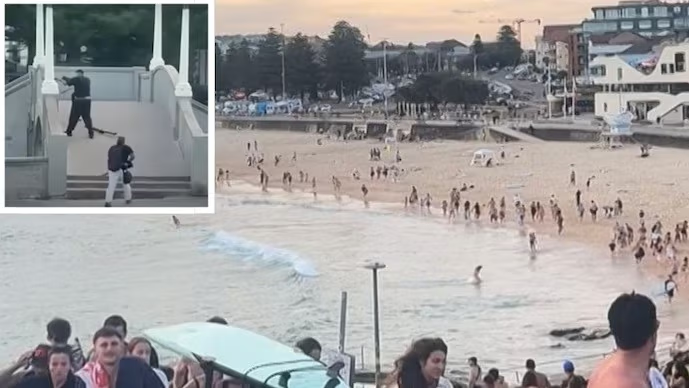
The tragic shooting at Bondi Beach claimed 15 lives, shedding light on the systemic failures within Australia's intelligence and police agencies. Granting clearance to an alleged Pakistani attacker linked to the Islamic State (IS), dismissing anti-Semitic threats, and the police's initial inaction during the attack are critical issues pointing to the systemic problems behind this massacre in Australia.
In police custody, 24-year-old Naveed Akram was first on Australian intelligence's radar in October 2019. Australian Prime Minister Anthony Albanese stated on Monday, 'He was assessed based on certain links, but it was concluded that there were no indications he posed a threat or that he might resort to violence.'
This Bondi Beach shooting occurred amidst a surge of anti-Semitic incidents (threats, vandalism, arson, graffiti, and violence) in Australia following the Israel-Gaza war's onset in October 2023. American broadcaster CNN reported in January 2025 that the Jewish communities of Sydney and Melbourne were most at risk due to recent anti-Semitic attacks.
Senior police officials, under anonymity, informed ABC News that two IS flags were found in the car of a father-son duo involved in the Bondi Beach attack.
The Bondi Beach shooting during the Jewish festival of Hanukkah exposed critical lapses in Australia's intelligence system. Among the attackers, the surviving 24-year-old Naveed Akram was investigated by the Australian Security Intelligence Organisation (ASIO) back in 2019. ASIO, the leading body in Australia's intelligence community, conducted a six-month investigation owing to Akram's close ties with a Sydney-based Islamic State cell.
Despite these connections, authorities ended surveillance, no longer viewing him as a threat. This decision now haunts officials, with Naveed Akram and his 50-year-old father Sajid Akram claiming 15 lives in the Bondi Beach attack.
Sajid Akram, who died in a shootout with police, possessed a valid firearms license for a decade, with six guns under his name. No severe warning signals were previously issued against him.
New South Wales Police Commissioner Mal Lanyon confirmed the license was appropriately regulated, yet the discovery of two IS flags in their car raises questions about how they evaded close scrutiny.
Retired Indian Army Major Manik M. Jolly accused, 'The Bondi Beach attackers were father and son from Pakistan. Another day, another terrorist attack, and another group of immigrants from Pakistan. Nothing ever changes. Never…'
This assault is Australia's deadliest mass shooting in the past 30 years, claiming at least 15 lives, including a little girl, and injuring over 40 others.
Critics argue that circumstances have worsened since the onset of the Israel-Gaza war. Experts cite resource limitations and focus on high-priority threats as significant concerns. The Albanese government now faces accusations of negligence. Opposition leaders claim that the unchecked protests in Australia are escalating anti-Semitism.
US Democratic Senator John Fetterman commented, 'Following years of Israel-opposition protests in Australia, at least 11 Jews were shot during a Hanukkah event… From Tree of Life to 7/10, from Bondi Beach, anti-Semitism is a growing, lethal global crisis.'
Eyewitness reports present a disturbing picture of the immediate aftermath of the Sydney shooting. The attack commenced just before 7 PM local time. For about 20 minutes, the shooters fired from a bridge, reloading weapons multiple times.
Witness Shmuelik Skuri told the New Zealand Herald, 'Twenty minutes later, four policemen came. No one returned fire. Nothing. It seemed like they were frozen. I couldn't understand why.' The Bondi Beach massacre raises serious concerns about the police's response, as witnesses say officers appeared 'stuck' on the spot.
Grace Matthews, hiding in a church, shared that a friend observed police being 'poorly prepared.' A nearby police station also failed to respond promptly.
Matthews said, 'There's a police station less than a block from where the shooting occurred… It's beyond my comprehension why it took so long to manage the situation.'