The darkness will fade, the sun will rise, and the lotus will bloom... These were the words spoken 46 years ago along the Arabian Sea in Mumbai at the first convention of the Bharatiya Janata Party by former Prime Minister Atal Bihari Vajpayee. Today, this prophecy finds its fulfillment in Maharashtra's political landscape. With a third consecutive term for the Modi government at the center and a resounding victory for the BJP in Maharashtra, the party's political fortitude has been solidified.
The results are a clear signal of the burgeoning support for the BJP across the nation. Following a historic win in Thiruvananthapuram in Kerala, the BJP has scripted a new chapter in Maharashtra. Prime Minister Narendra Modi expresses confidence that people trust the BJP from the grassroots to parliament, a trust now affirmed by Maharashtra's overwhelming response.
The late Vajpayee once said, standing by the majestic seas of India’s Western Ghats, “The darkness will fade, the sun will rise, and the lotus will bloom...” At that moment, the possibility of such a future seemed distant, yet today, it is a realized vision.
Wave of Saffron from Mumbai to Nagpur
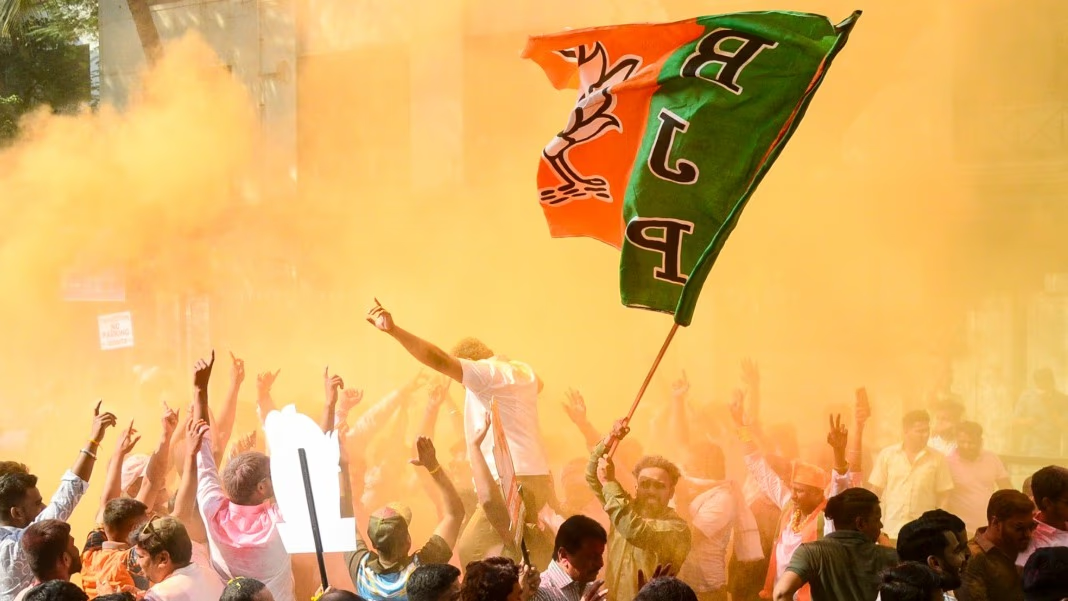
The BJP alliance is making headway in 25 out of the 29 municipal corporations statewide. The most consequential win is in the BMC, once the unassailable fortress of the Thackeray family, now a stronghold of the BJP. The rise of BJP as the leading party signifies a shift in power, with a BJP mayor set to lead Mumbai. The BJP alliance has claimed victories from Nagpur to Pune and Nashik to Solapur.
Chief Minister Devendra Fadnavis has declared this a record-breaking mandate, attributing the win to the public trust in Prime Minister Modi that has shaped a new narrative of development not just in Maharashtra, but across India.
Thackeray and Pawar Strongholds Fall
From rural to urban local elections, BJP has emerged as a central force within Maharashtra. It is clear that BJP has managed to dismantle the bastions of powerful political families in one sweep. Despite efforts, the Pawar family, known for their cooperative to government model, could not sustain their strongholds, highlighting BJP's influence. Moreover, the Thackeray family, tied intimately with Mumbai’s identity and the BMC, for the first time, failed to defend their citadel.
Even a united front of Uddhav and Raj Thackeray could not thwart BJP's momentum. Similarly, despite the reunion of Sharad and Ajit Pawar, the BJP alliance was unstoppable in strongholds like Pune and Pimpri-Chinchwad. The Congress, too, faltered, unable to replicate past successes even with diverse alliances, conceding ground in previously held corporations.
Risk-Taking Politics and Its Response
Prime Minister Modi advocates taking risks, steps which previous governments hesitated to take due to electoral concerns. In Maharashtra, BJP translated this daring political style into reality. After a setback in the 2024 Lok Sabha elections due to the Congress-Sharad Pawar-Uddhav Thackeray alliance, BJP accepted the challenge in the assembly polls and decisively responded in municipal elections.
Post 2024 Lok Sabha elections, BJP shifted strategies, emphasizing hyper-local issues. Their manifesto, with 29 focus points like sanitation, health, education, and women’s security, catered to specific electorate needs. Meanwhile, the Thackeray family’s campaign of Maratha pride couldn’t resonate effectively this time.
Impact on Future Politics
This Maharashtra victory will reverberate beyond the state's borders. Celebrations erupted outside the BJP office in Ranchi, 1600 kilometers from Mumbai. The question arises whether this psychological effect will impact impending elections in states like West Bengal and Assam. For now, BJP has issued a clear message that coalitions or ideological compromises against it, no matter how robust, will find it challenging to succeed. Through the prism of Hindutva, development, and steadfast leadership, BJP has penned a new chapter in urban politics in Maharashtra.