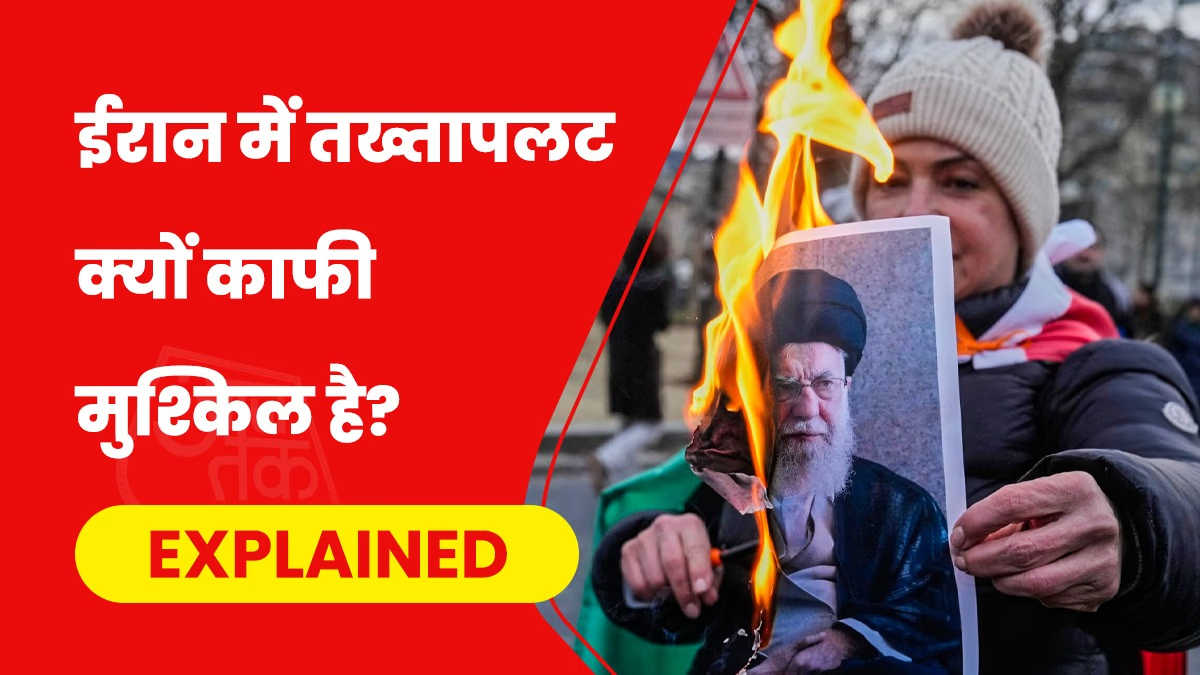
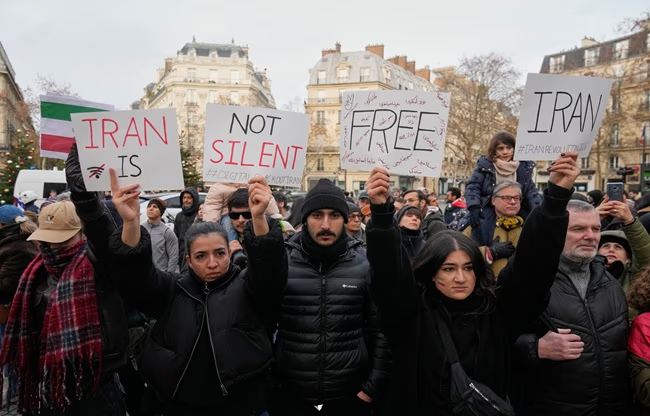
The predominantly Muslim nation of Iran has seen protests raging for two weeks. Ordinary citizens are clashing with police, and young women are burning both hijabs and portraits of Supreme Leader Ali Khamenei. Amid chants of 'Death to the Dictator,' over six hundred lives have been lost. The situation feels volatile, yet Iran has a history of extinguishing such public anger. The country’s extremists have an entire system dedicated to this purpose.
Past Instances of Unrest in Tehran
- After the Islamic Revolution, several political groups and secular parties staged protests against the new regime; a conflict for control. - During the 1980s, minority groups, along with the Kurdish population, rebelled, resisting the Islamic way of governance.- Late 1990s witnessed student protests as university students in Tehran opposed the government's harsh policies.- Massive protests erupted in 2009 over presidential election fraud, drawing many to the streets.- Sporadic protests due to inflation occurred before COVID-19, though they were swiftly suppressed.- About two and a half years ago, Mahsa Amini, a young woman, died in police custody over hijab regulations, sparking open rebellion among the youth.

Source: aajtak
Since the Islamic Revolution, Iran has seen the establishment of religion-based systems. Not idealistic, but rather extremist in nature. Ruhollah Khomeini, the country's first Supreme Leader, held absolute power. His successor since 1989, Ali Khamenei, remains the unchallenged voice of Iran.
Given the theocratic underpinnings, there's always fear of rebellion. To manage this, Iran has developed an extensive system that can quash dissent before it starts.
Mechanisms of Quashing Rebellion
Their greatest strength lies in the Islamic Revolutionary Guard Corps and Basij forces—a paramilitary entity whose members blend unnoticed among ordinary citizens, like small-scale entrepreneurs or delivery people. Due to their close mingling with the populace, they can detect dissenters. They undergo weapons training to eliminate threats when needed.
Internet blackouts are not new in Iran. This tactic has been tried before to quell uprisings. In Iran, much like China, there's rigorous monitoring of internet activities. Any anti-Khamenei or pro-American sentiments expressed online are promptly flagged by cyber spies, leading to swift action to suppress the activity.
Source: aajtak
Iran has gained notoriety for harsh reprisals against protesters. Mahsa Amini's death in custody is a glaring instance, where she was accused of not wearing her hijab properly at the age of 22. Many protesters vanished during subsequent demonstrations, later found dead. Police sometimes release tortured individuals to send a warning message to others.
How Iran's Power Can Shift
This isn't a simple math problem solvable with a formula. To change the status quo would require dismantling the entire system that supports Islamic authority from top to bottom. Iran first needs strong leadership to unify the populace under one umbrella, a leader who commands both national and international confidence. Such support could bring external assistance to internal rebellions, even if only diplomatically.
Weakening the Revolutionary Guards and Basij is also critical. These forces are fiercely loyal to Khamenei because the regime fulfills their every need. To dismantle this security fortress, one must identify individuals willing to discreetly oppose Khamenei or refuse to fire on unarmed demonstrators.

Source: aajtak
Since the Islamic Revolution of 1979, factors for a potential Revolution 2.0 are present: economic crises and a young, angry population. Most crucially, the opposition seems unified. However, even if change were to occur, it might lead to instability for some time or even a prolonged period.
Potential Leaders for a Government Change
In case of a regime shift, Reza Pahlavi is a potential contender. He is the son of Mohammad Reza Pahlavi, who ruled Iran for nearly four decades. At 65, Reza resides in the United States, rallying protesters from abroad and has spoken about managing the transition, suggesting a potential return.
Former President Hassan Rouhani is another key player. He has the skill to communicate, particularly with the US. In 2013, he was the first Iranian leader to engage in direct talks with the then US President.
There's also a possibility that the military might take control, given the absence of strong leadership to seize the opportunity.