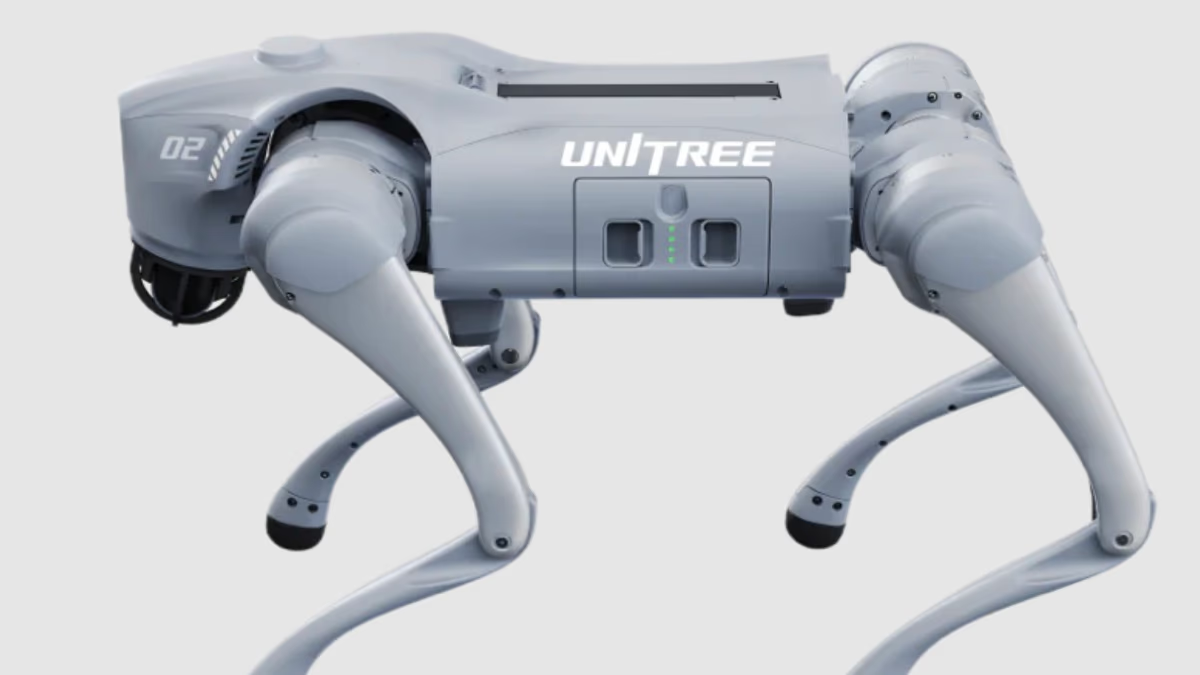
At the India AI Impact Summit 2026, a robot dog captured more attention than the tech itself. This four-legged marvel seen in the summit pavilion went viral on social media.
Spectators halted to watch, filmed, and shared videos. Within hours, the robot dog became an internet sensation. It was later revealed as a model from the Chinese company Unitree Robotics, known as Unitree Go2.
What is Unitree Go2 Robot Dog?
The Unitree Go2 is an AI-powered robot dog capable of understanding its surroundings and walking autonomously. Equipped with cameras and sensors, it navigates paths while avoiding obstacles.
Read more about Galgotias University's role and the governmental steps in the AI Impact Summit controversy.
On Unitree's website, the robot's price ranges from $1,600 to $2,800. In India, including shipping, it costs approximately INR 600,000.
Features LiDAR Sensors
This robot can walk smoothly, turn, and handle slight inclines, making it suitable for research, security demos, and tech showcases. It features LiDAR sensors to create three-dimensional maps of its surroundings.
Complemented by a camera and motion sensors, it processes data in real-time. Some versions are operable via remote control or mobile app. The robot has a battery life lasting hours, depending on usage.
The Unitree Go2's cost varies by model. The base version in the international market starts at around INR 150,000, with advanced versions priced higher.
Import taxes and shipping further inflate the cost in India, making it ideal for colleges, labs, startups, and research teams, rather than the general public.
Going Viral at the AI Impact Summit
The robot went viral at the summit because people were captivated by seeing it up close for the first time. Crowds gathered to witness the live-moving machine. Students and visitors were seen snapping photos and videos with it.
As clips circulated on social media, public curiosity surged. Users even compared it to robots featured in movies. Its virality partly hinges on its origin as a product from a Chinese company rather than an Indian lab.
The presentation of foreign tech at the summit sparked discussions. Some questioned whether Indian innovations should be spotlighted more prominently at such events.