While a student refines English homework using ChatGPT, a shopkeeper drafts product listings with AI. Coders fix app glitches with chatbots. Even in cities like Mumbai, Bangalore, and lesser-known towns, AI is gaining ground.
AI isn't confined to tech offices anymore; it's integrated into daily life. By 2025, India witnessed a pivotal change with 16% of its workforce utilizing AI tools, a rise from 14% just six months earlier.
At first glance, it seems promising. Yet, the larger issue is that developed countries are implementing AI at a far greater speed.
Widening Gap, Growing Concerns
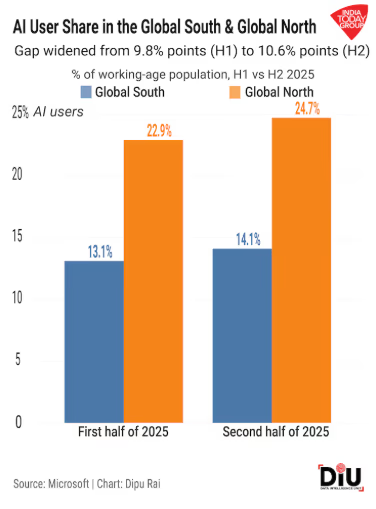
Early 2025 data showed a 9.8 percentage point gap in AI usage between rich and poorer countries, rising to 10.6 points by December, and it continues to grow.
Why Should You Care?
AI is not merely a trend; it’s becoming a critical tool in education and the workplace. Imagine the smartphone’s evolution—from a rarity to an essential competitive asset. AI is on a similar path, only faster. If developed nations adopt AI first, they stand to gain more with productive workers, rapid learning students, and fast-growing enterprises, leaving other countries trailing behind.
Numbers Tell the Full Story
Source: aajtak
India:
By late 2025, 15.7% of workers used AI (up from 14.2%)
Globally:
AI use rose from 15.1% to 16.3%
Developed Nations:
Increased by 1.8 percentage points in just six months
Poorer Nations:
Only a 1 percentage point rise
Leading Nations:
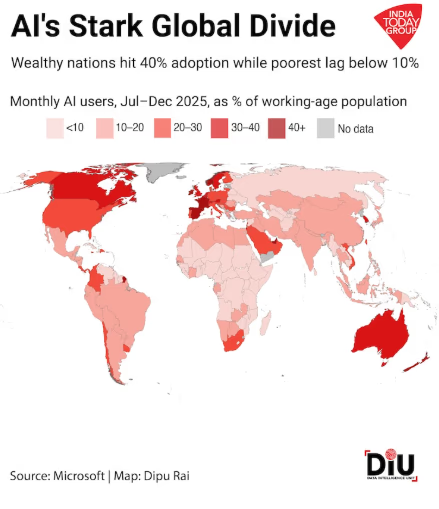
UAE- 64%, Singapore- 61%, Norway, Ireland, and France- above 44%
India's Situation:
Ahead of most poorer nations but trailing every wealthy nation.
Growth Speed:
Top 10 fastest adopters of AI are all wealthy economies.
Why the Disparity?
Wealthier countries have advantages not yet widespread in India, like fast internet, affordable data, ubiquitous smartphones, and universal digital payment systems.
Furthermore, most AI tools work better in English, leaving millions who speak Hindi, Tamil, Bengali, and Marathi behind. Credit cards are often required for many AI tools, but most Indians don't have one.
Moreover, many effective AI tools are costly. ChatGPT costs about $20 a month, approximately 1700 rupees. Additionally, AI performs better on expensive phones, which not everyone can afford. These obstacles collectively slow AI adoption, widening the gap.
What Might Change?
India has transformed itself twice before. Remember when mobile data cost 250 rupees per GB? Then Jio emerged, prices dropped, and usage surged. Recall the difficulty with digital payments? Then UPI arrived, and now even vegetable vendors use it. It could be the same with AI but some vital steps are required.
What's Necessary
Low Cost:
Free AI tools are emerging. DeepSeek is an example—open-source and subscription-free.
Local Languages:
AI needs to perform equally well in Hindi, Tamil, Telugu, and Bengali.
Easy Access:
No credit cards, no complex sign-ups, just download and use.
Functional Tools:
AI for invoicing, document translation, homework help, customer service... These can significantly boost AI use.
What's at Stake?
Source: aajtak
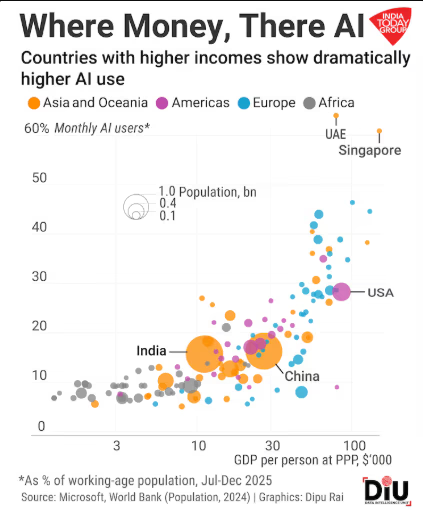
This isn't just a tech story; it's an economic tale. If developed countries fully leverage AI benefits, their productivity and economies will soar, their people will earn more, and other countries will lag—not because they didn't try, but because they started late.
Simply put, today’s digital divide might become tomorrow’s income divide.
Source: aajtak
Lessons from South Korea
In South Korea, AI usage jumped from 26% to 31% in just six months, thanks to the government’s emphasis. People quickly adopted better AI tools.
Clearly, India isn't out of the AI race. The 15.7% adoption suggests there's significant usage already. Yet, data also shows that wealthy nations are rapidly advancing. The gap is expanding, and the opportunity to accelerate may not last forever. India pressed ahead in mobile internet. Excelled in digital payments. Now the question is, will India showcase the same speed in AI? The clock is ticking.
Methodology:
These figures are sourced from Microsoft's AI for Good Lab. This study tracked AI chatbot usage, like ChatGPT, Cloud, Gemini, and DeepSeek, across 147 countries. It estimates AI adoption considering device usage, internet access, and market shares of various platforms. While not perfectly accurate, it’s considered the most dependable data for inter-country comparison. Working-age refers to individuals aged 15 to 64. GDP data are based on World Bank figures from 2024.)