
History of Gujiya:
As the festival of Holi approaches, the aroma of Gujiya delights many, making mouths water with anticipation. This golden, ghee-drenched crispy flour layer crumbles delightfully as you bite into it, revealing the flavorful cardamom-infused filling of dense khoya and subtly sweet sugar intertwined with finely chopped nuts—it feels like you could keep devouring it. This crescent-shaped treat is a cherished part of Northern Indian tradition, but did you know its roots are also claimed to be linked to Turkey?
Many theories suggest that Gujiya is a modern adaptation of the famous Turkish dessert Baklava. Let's explore how Gujiya has transformed over time and how it was first crafted.
History suggests that a dish similar to Gujiya had become a part of Indian cuisine by the 13th century. Documented in ancient texts around this time, a dish called 'Gunjha' is believed to be an early form of today's Gujiya, boasting a history spanning approximately 700-800 years.
Indian food historian
elaborates in 'A Historical Dictionary of Indian Food' on the evolution of Indian cuisine, including stuffed pastries and festival dishes, deeply rooted in centuries-old traditions across regions. References to dishes akin to 'Gunjha' and 'Puri' appear in 13th and 14th-century texts as precursors to modern-day Gujiya.
According to a
, the earliest mentions of sweets resembling Gujiya date back to the 13th century. During this era, descriptions exist of mixtures of jaggery and honey encased in wheat flour and sun-dried. Some food historians associate Gujiya's conception with Baklava, a flaky, sweet pastry popular among Turkish elites and sultans.
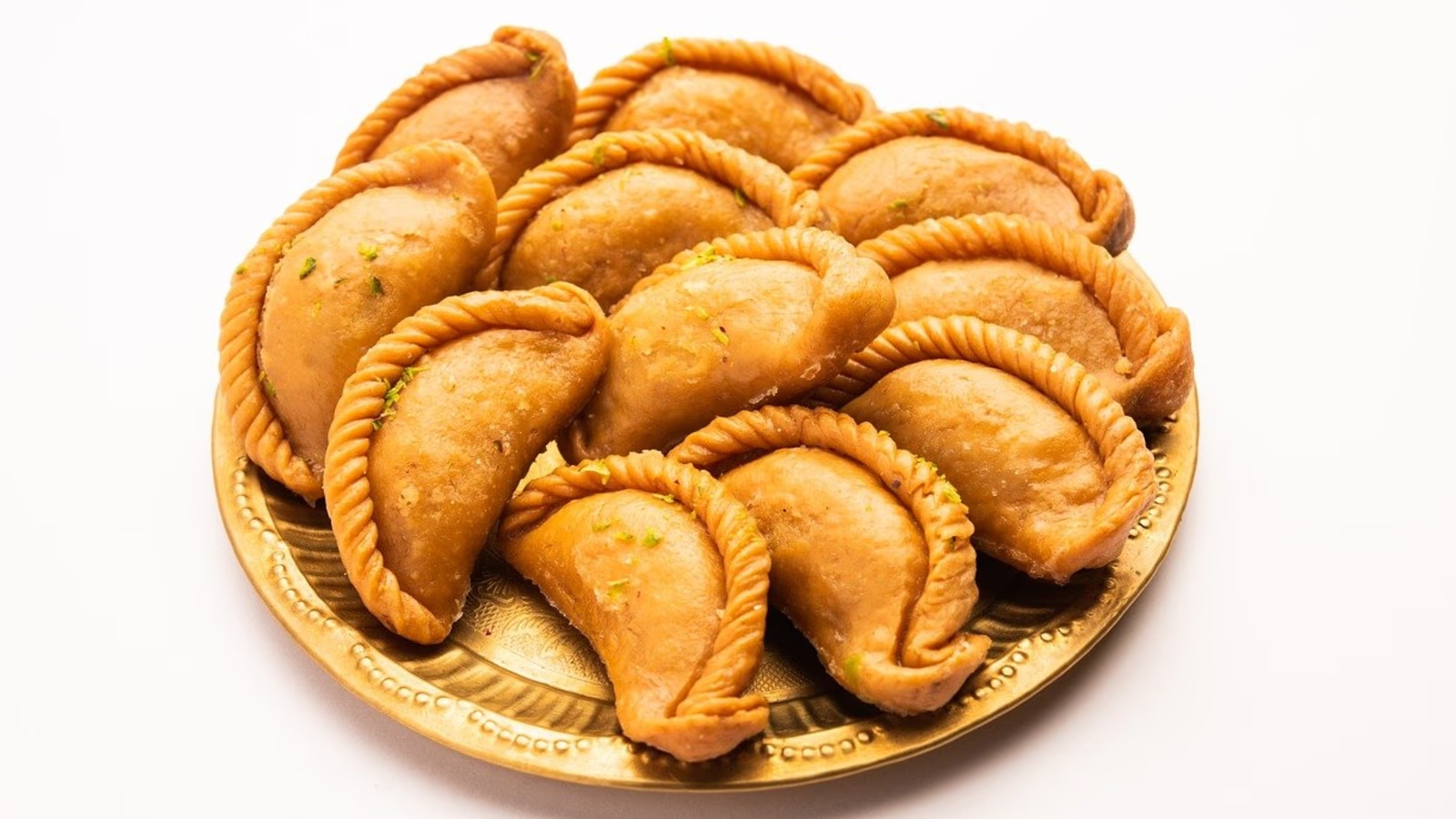
Source: aajtak
It's believed that traders from Central Asia introduced dishes like samosas and Baklava to India. Over time, while samosas became savory, Baklava took on an Indian twist, becoming Gujiya. This was due to the tradition of layering dry fruits between dough sheets in Turkey, adapted in India with khoya (milk solids), creating an entirely new and beloved dish.
Historians credit Bundelkhand as the 'fortress' of Gujiya. During the medieval period, as culinary practices in North India evolved, the royal kitchens of Bundelkhand introduced 'Chandrakala' (round Gujiya). From there, the dish spread across Braj, Uttar Pradesh, Madhya Pradesh, and Bihar.
A
asserts that Gujiya was a royal dish in the kitchens of Bundelkhand's kings. According to historian Sanjesh Tripathi, traders brought the idea of pastries, adapting them locally with wheat or millet flour, khoya, and dry fruits to suit Indian tastes.
The report also mentions that in Braj (Mathura–Vrindavan) during the 16th century, Gujiya was offered to Lord Krishna as a blessed food, especially during the era of devotional worship when a tradition of '56 bhog' (feasts) was customary. Records from temple kitchens in Braj and folklore suggest this delicacy has been crafted for some 500 years.
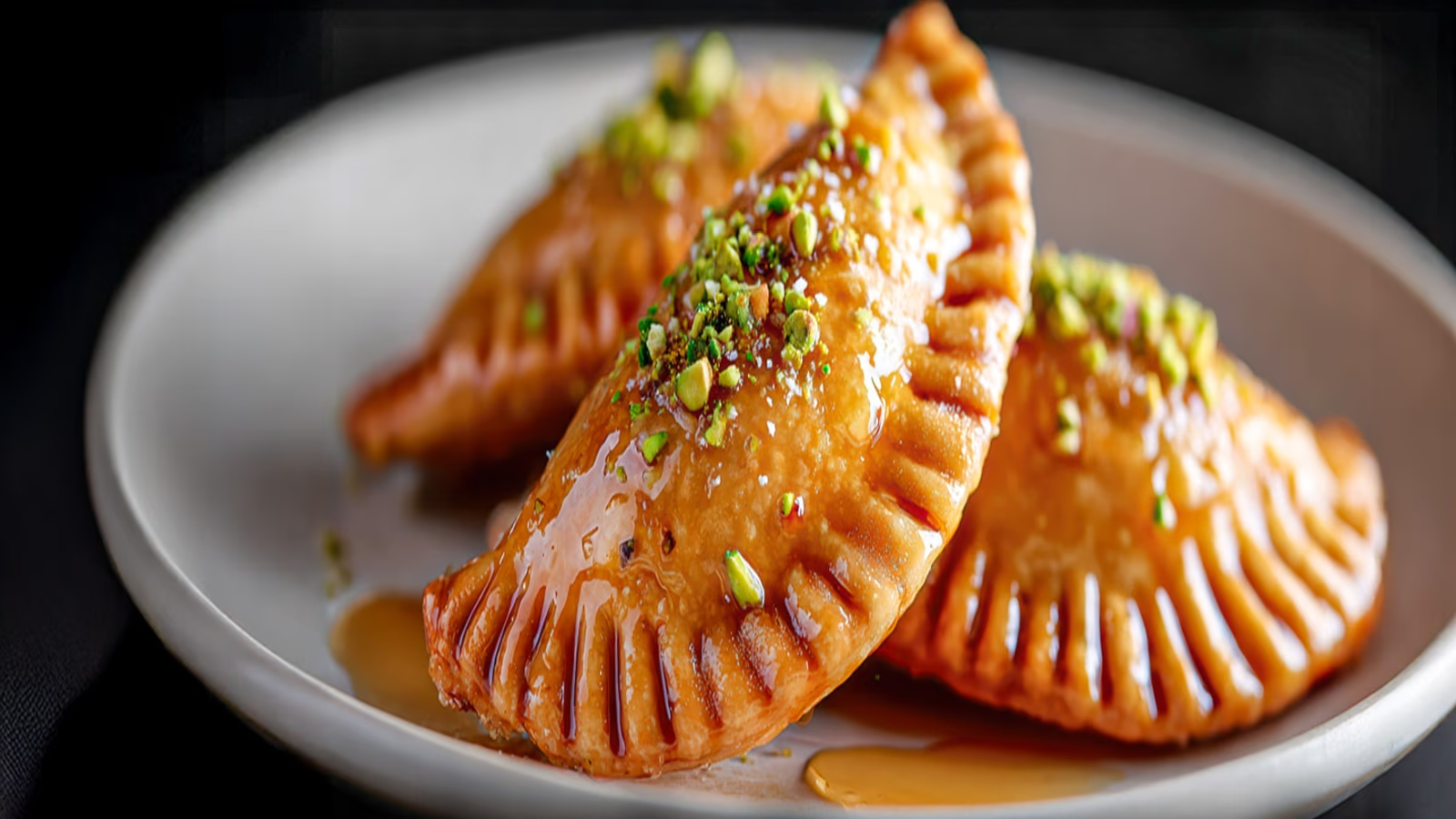
Source: aajtak
As time and place changed, the preparation and filling of Gujiya adapted local nuances. The syrup-drenched Gujiya we enjoy today emerged around 700-800 years ago in this form.
13th Century:
Emergence as 'Gunjha' (simple sweet fritter or bread)
15th-16th Century:
Influences from Central Asia (techniques from Baklava introduce khoya and fine nuts)
Mughal Era:
Enhanced as a royal treat with the use of saffron and expensive nuts.
Present:
Evolved beyond traditional khoya into variations like chocolate, saffron, and sugar-free.
Wherever Gujiya traveled, it assumed unique characteristics and names:
Maharashtra and Gujarat:
Known as 'Karanji' with fresh coconut and jaggery.
Bihar and Jharkhand:
Referred to as 'Pidakia,' filled with semolina and khoya mixtures.
Southern India:
Called 'Karjikai' in Karnataka, using poppy seeds and coconut filling.
Regardless of its history or adaptations, Gujiya's true identity remains its taste and aroma, enlivening every festive occasion.