The Under-19 World Cup is underway, a tournament that has consistently been a reliable stage for discovering talent in India. From this very platform, Indian cricket has unearthed names like Virat Kohli, Rohit Sharma, Ravindra Jadeja, and Shubman Gill, who have carved out their niches in world cricket. It's like a 'talent factory' for Indian cricket, where the next generation steps into the limelight.
… But this time, the name grabbing the most headlines is
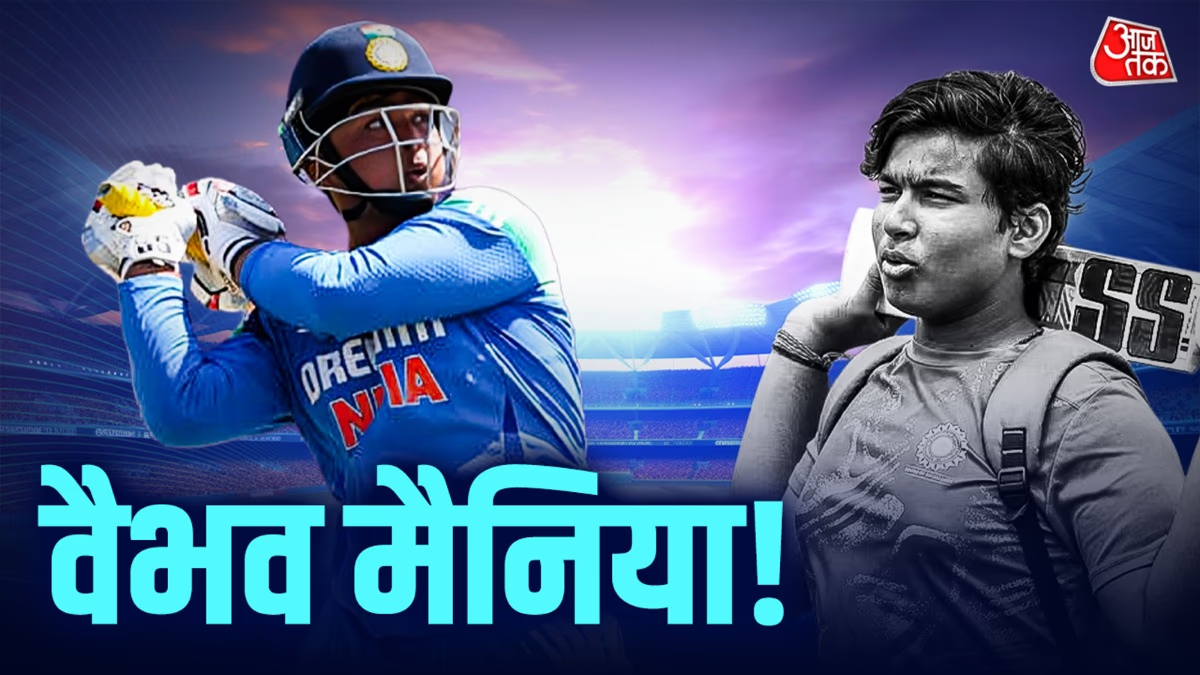
Vaibhav Suryawanshi.
His story stands out from the rest. The reason isn't just his gameplay, but also his age, the buzz surrounding him, and a fanbase that's grown rapidly in this digital era. Vaibhav's case clearly demonstrates that Indian cricket is no longer confined within traditional structures. A new model is emerging where players gain recognition through digital mediums even before stepping onto the field.
This time around, fans are following the Under-19 World Cup solely to catch a glimpse of Vaibhav Suryawanshi.
1.
Only 14 Years Old – A Story of Youth on the Big Stage
Vaibhav Suryawanshi's most striking attribute is his young age. Being merely 14 years and 294 days old while playing in the Under-19 World Cup is noteworthy, as typically, Indian players reach this tournament at 17-18 years of age, advancing by 18-19. Could Vaibhav possibly play in another U-19 World Cup?
… Yet an important fact arises here - since 2016, the BCCI has stipulated that any player who participates in the U-19 World Cup for India cannot play again, even if they remain under the age limit. This rule was passed in a 2016 working committee meeting following recommendations from the BCCI's junior committee.
Prior to this, several players represented India in two U-19 World Cups, including:
Ravindra Jadeja - 2006 and 2008
Vijay Zol - 2012 and 2014
Avesh Khan, Sarfaraz Khan, and Ricky Bhui - 2014 and 2016
...But post-2016, this is no longer possible, making it clear in Vaibhav's case that, despite eligibility due to age, he won't get a second shot because BCCI's rules do not allow it.
2. Famous Even Before U-19 – The New Social Media Trend
An essential aspect of Vaibhav’s story is his recognition. Most Indian players become household names after performing well in the U-19, but Vaibhav has taken the reverse path—famous first, then entry into the U-19.
Clips of his batting have gone viral on social media, earning him nicknames like 'Baby Boss,' with fans noticing him without seeing international TV broadcasts.
This became possible because the way we consume cricket has evolved—
YouTube Highlights
Instagram Reels
Data and Stats Posts
Digital Scouting
This new ecosystem had already propelled Vaibhav as a 'digital star.'
3. Fearless Game – The Essence of Modern Cricket
What sets Vaibhav’s batting apart is his fearless play. Bold strokes without hesitation, high strike rates, and the ability to seize opportunities—these are the demands of contemporary T20 cricket. As a result, people are following not just his name, but his 'style.'
The fan sentiment is -
'This U-19 World Cup is being watched for Vaibhav's batting.'
Though it may seem exaggerated, it signifies that cricket is now not just about team versus team but also about player versus fan interest dynamics.
4. Comparisons and Expectations - But the System is Different Now
In India, every new talent is often compared to peers—Jadeja, Gill, Kohli, and Rohit rose to fame post U-19. However, Vaibhav already has recognition. The distinction lies there.
Old Model -
Performance → Then Recognition
New Model -
Recognition + Performance → Move hand in hand
5. The Question Now – Will the Hype Sustain?
To understand this, three factors need to be examined—
A.
Technical Game
At the U-19 level, fast bowling, bounce, wrist spin, and match pressure are the real tests. Here, it will become clear whether Vaibhav is merely a highlights star or a fully developed, dependable batsman.
B.
Fitness and Body
Between ages 15 to 20, a body undergoes significant change. Many players shine at the U-19 level but find progression halted due to fitness or strength limitations.
C.
Proper Timeline
Typically, Indian players reach the senior level between 20-23 years. If Vaibhav reaches even at 18-19, it would be considered rapid advancement.
6. Conclusion – Why Vaibhav's Story is Significant?
Because Vaibhav isn't just a young player but the face of a new cricketing era. An era characterized by—
Young age,
Fast-paced play,
Digital recognition first,
... and where people follow players by watching on-screen.
Whether they will become a great player… cannot be predicted yet. But clearly, Vaibhav Suryawanshi is the new page of Indian cricket, where talent, hype, and digital identity march together.
That's why his story is not just about a player but a tale of the evolving Indian cricket system.
History shows - U-19 Stardom isn’t a Destination, It's the First Step
It’s essential to realize that early recognition ≠ Senior level guarantee.
Several players shone in U-19 but did not make it further, such as - Unmukt Chand – who led the team to win the World Cup in 2012, gaining fame… but later, career consistency and opportunity scarcity resulted in stagnation in India.
Prithvi Shaw – U-19 World Cup-winning captain, hit a century on Test debut; but fitness, selection, and disciplinary issues hindered career pace.
Why is Vaibhav called a 'Digital Cricket Star'? Facts revealed by Google search results supported this.
The 14-year-old 'Google Star'
In 2025, India's Google search trends made it clear which direction new-age stardom is heading… Vaibhav Suryawanshi topped this list at just 14. After making a mark in the IPL and proving his talent in Under-19 Cricket, he stole the limelight at the Rising Asia Cup to become a new youth icon. Interestingly, globally in the 'People' category, Vaibhav Suryawanshi ranked number-6 worldwide—Indian Google trends announced a new teenage superstar this year.