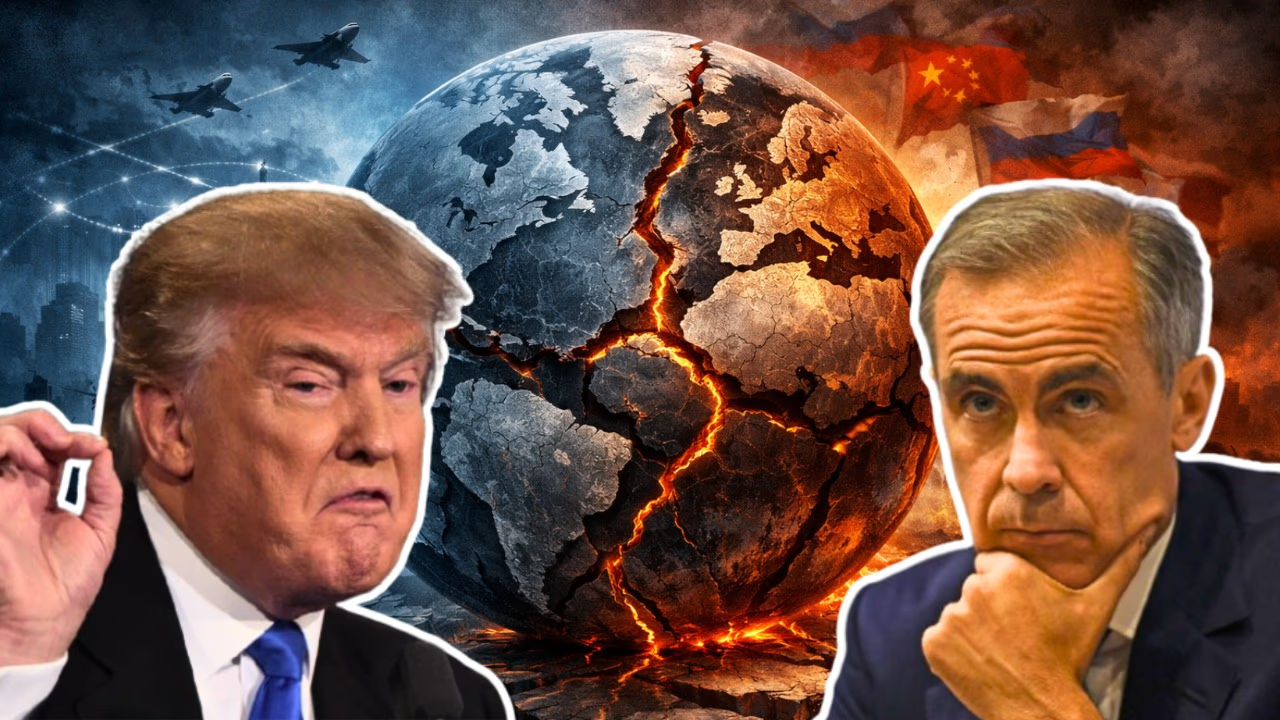
The Davos meeting of the World Economic Forum has long symbolized the Western-led multilateral global framework. However, this time, a clear message has emerged. Due to the erratic threats and actions of former U.S. President Donald Trump, voices for change have intensified within Western countries. Canadian Prime Minister Mark Carney and European Commission President Ursula von der Leyen have voiced cooperation with America while criticizing its actions, delivering a very clear message.
Both leaders stated that the old global order has ended, and there is no desire to bring it back. We know that the old global order won't return, and instead of mourning, we need to focus on forward strategies.
In his stern speech, Mark Carney said that the Russia-Ukraine war has ended a pleasant illusion and started a harsh reality. Ursula von der Leyen agreed, saying efforts to bring back past systems won't correct the structural dependencies we live with today.
Both leaders affirmed that we are energy superpowers. We have the most educated populations, and we have capital. We are capable of attracting investments. Von der Leyen asserted that the European Union has infinite potential, efficiency, skills, and innovation. This was indirectly a warning to the U.S. that if we distance ourselves from America, its global dominance might reach an end.
Regarding Greenland, both leaders opposed Trump's actions. Carney affirmed Canada's support for Greenland, Denmark, and NATO. Von der Leyen stated the EU stands united with Greenland and Denmark.
Has the New World Order Already Begun?
Assuming from the Davos 2026 speeches by Canadian Prime Minister Mark Carney and European Commission President Ursula von der Leyen, it would be premature to say a new world order has commenced. While both leaders spoke of the old order's end, they focused on division as opposed to nostalgia as a strategy.
Carney rightly states that U.S.-led rule-based order is not coming back, and middle powers need to unite. Von der Leyen describes this as a permanent change, urging Europe to emphasize its decision-making independence. As these speeches came in the context of Trump’s Greenland threats and tariff-related crises, where Western allies felt distanced from America, it cannot be called Canada and the EU's permanent stance.
In reality, a new order often begins similarly. When the old order faces a crisis, a new one germinates. Trump’s policies are breaking down the global order, yet no clear new framework is emerging. Carney and von der Leyen talked of various alliances and strategic partnerships, signaling a new attempt at multilateralism, not a new order.
In fact, before a new order is born, there is a transitional period. The world is currently in that transition.
Trump’s policies, the rise of China-Russia, and the Ukraine war have weakened the old order, but a new order—whether multilateral or multipolar—remains to be seen.
Davos speeches are political messages aiming to unite middle powers, yet they remain reactions rather than the foundation of a new order. However, it can be said that change is on the horizon, and it has begun. It might be that this is a crisis phase for the global order rather than a new start.
Signs of Declining American Global Dominance
1-Trump's 'America First' Policies and Military Intrusions
The Trump administration attacked Venezuela and arrested its president, threatened military action in Colombia, Mexico, and Greenland. No organizations like the United Nations appear capable of controlling the capriciousness of the U.S. president.
2- Trump's Policies Are Isolating America
America is becoming isolated from its close allies like Europe and Canada. That's why allies (EU, Canada) are forging new partnerships (Mercosur, India, UAE). The WEF Global Risks Report 2026 mentions that American policies are increasing fragmentation.
3-The Rise of China and a Multipolar World
China is expanding its influence through the BRI and technology, while America is embroiled in tariff wars. The India-Russia-China 'troika' is advancing towards the creation of a new order. The decline of the dollar has started, with prices of gold and silver rising.
4-The Emergence of Middle Powers
Canada and the EU are emerging as 'middle powers', distancing themselves from America. At Davos, Carney and von der Leyen proclaimed the end of the "old order" and stressed new alliances (variable geometry).
5- Economic and Military Balance No Longer Favors America
America's influence in Eurasia is waning, as challenges in the Middle East and Indo-Pacific rise. The TRENDS report 2026 identifies shifting alliances as a key trend. Power is not concentrated in a single country anymore (US), with China, Russia, India, Brazil, and middle powers like Canada, the EU, Indonesia, and Saudi Arabia playing independent roles.