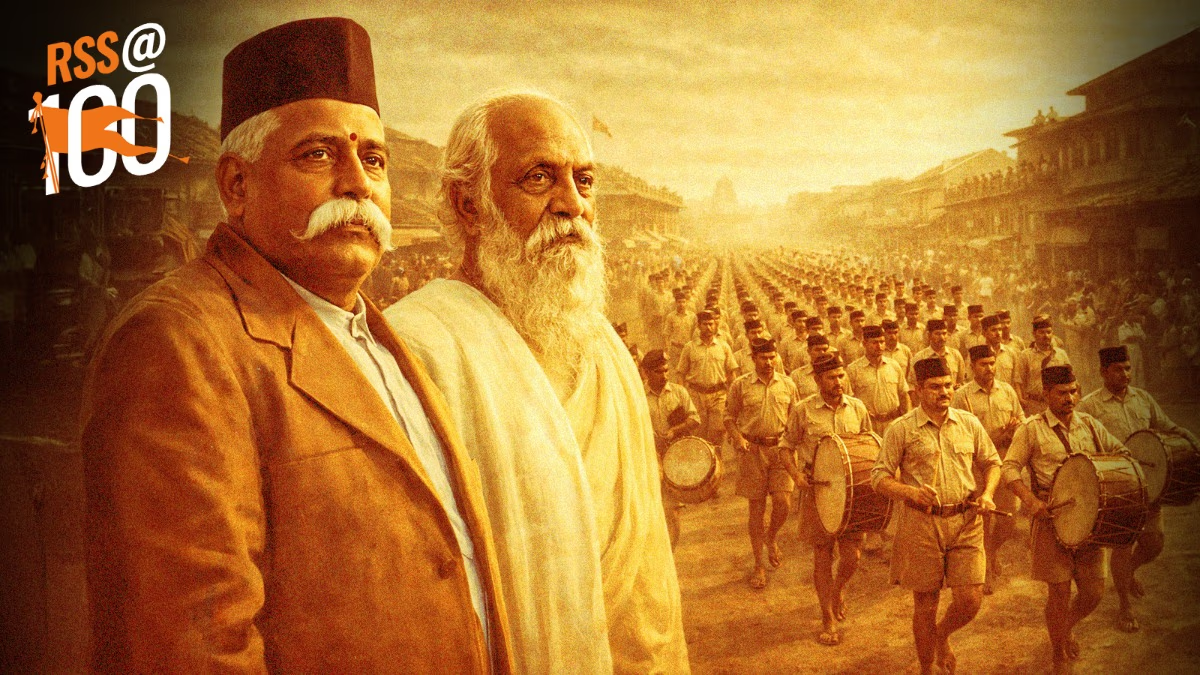
On 23rd October 1928, the festival of Vijaya Dashami was celebrated. Dr. Keshav Baliram Hedgewar envisioned the RSS route march in Nagpur to mirror a military parade. However, the challenge was in organizing it without a band. Author Nana Palekar, in his biography of Dr. Hedgewar, 'Man of the Millennium,' noted, 'Dr. Hedgewar founded the RSS band, 'Ghosh', to accompany the disciplined steps of the volunteers. Nearly 600 volunteers locally practiced drumming. As preparations were underway, the esteemed leader Vithalbhai Patel, brother of Vallabhbhai Patel, visited Nagpur at Dr. Hedgewar's invitation on 16th August 1928. After witnessing the disciplined march, Vithalbhai expressed his admiration.'
Addressing the volunteers, Vithalbhai stated, 'Although this movement is new to me, it has piqued my interest. I might not yet fully comprehend RSS's role in national life, but one should fear no one except God. Work with dedication toward your goal, and trust in your mission.' A revered leader, Vithalbhai Patel had worked with Dr. Hedgewar during his Congress days and was pleasantly surprised at the disciplined organization Hedgewar had built on his own.
The parade that year was unique in more ways than one. Alongside volunteers, many local citizens who admired RSS's efforts joined the procession. A Maharashtra newspaper remarked, 'RSS has helped in mass unification of Hindus, a fact we can't deny.' Within a few years post its foundation, Dr. Hedgewar had organized an effort to gather hidden arms in Nagpur, seamlessly integrating it into the celebrations of the day known as 'weapon worship', indicative of the RSS dedication. 600 disciplined volunteers marched through Nagpur to the rhythmic beats of the 'Ghosh' band, astonishing the city with their peaceful display.
Author Nana Palekar recounts another intriguing tale in his book: As the 'Ghosh' band evolved with better quality instruments and skilled training for the volunteers, public interest grew. People began approaching Dr. Hedgewar, sometimes out of acquaintance, sometimes through connections to the RSS, hoping to hire the band for their events, offering to pay any fee for such service.
This put Dr. Hedgewar in a perplexing situation. While he aimed to promote the 'Ghosh', the intent was not for private hire which could send a contradictory message. It became challenging to deny requests without causing offense, thus leaving him unable to say yes or no. Even volunteers began suggesting renting it out for funds that could further the RSS's work, avoiding the need to request money from donors. However, the idea didn’t sit well with Doctorji. Matters escalated when a close friend, whose son was getting married, approached him with such a request, offering any payment.
Dr. Hedgewar politely declined, stating, 'If your son had achieved a great victory for India, I'd be honored to play the Ghosh in celebration freely, proudly announcing our joy. Unfortunately, regardless of the payment, the RSS band isn't for private use. If I offer it to one, I'll have to offer it to all, and that won't be feasible.' Thereafter, Doctorji made it clear that the RSS band would only perform at national events or RSS functions, strictly not for personal purposes.
In the biography of Guru Golwalkar, writer C.P. Bhishikar mentions, 'Guruji was immensely sharp, with surprisingly updated knowledge across various subjects. His expertise in classical music allowed him to provide insightful suggestions to the RSS band on adopting new compositions based on ragas. His letters resembled scholarly essays, revealing his deep insight and grasp over diverse subjects like astronomy, astrology, ecology, cybernetics, nuclear science, Ayurveda, homeopathy, and allopathy.'
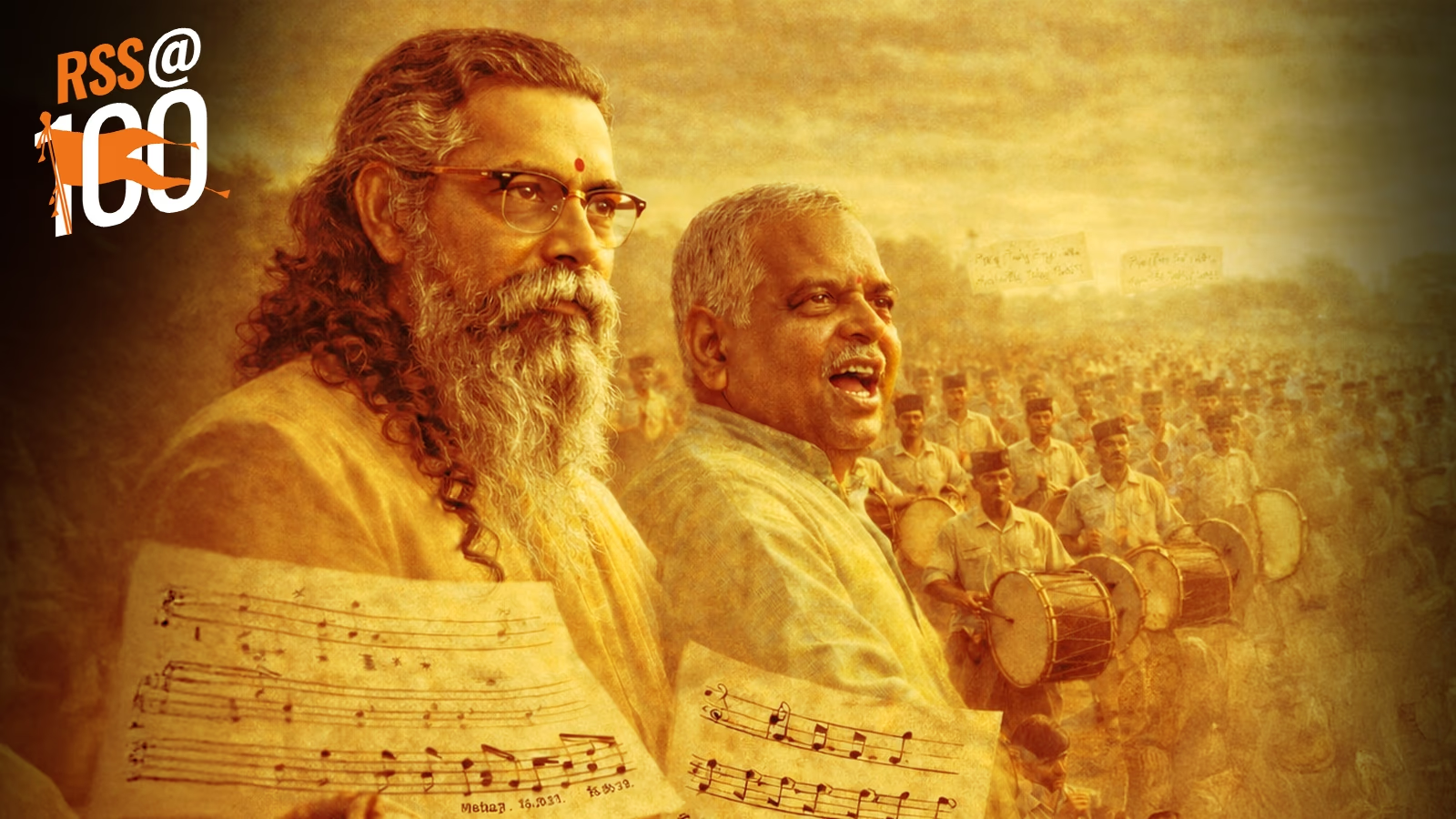
As RSS crosses into its centenary year, the mention of its promoter Subbu Srinivasan becomes significant. Testament to an enduring legacy includes contributions from Dr. Hedgewar, Guru Golwalkar, and numerous volunteers and band leaders. Subbu Srinivasan’s role is deemed most impactful.
Born on April 10, 1940, in Mysore (Karnataka), Subbu was the youngest among seven siblings in the family of a modest shopkeeper, B.G. Subrahmanyam. In 1952, he, along with his elder brother Anant, started attending RSS shakhas. Academics never fascinated him, and he barely completed matriculation. A brilliant student, Shripati Shastri, who later became a central officer of RSS, was in his shakha then and played a pivotal role in Subbu’s examination success.
In Karnataka, Yadava Joshi served as the provincial pracharak, having given voice to the RSS prayer under Doctorji Hedgewar himself. Inspired by Joshi, Subbu Srinivasan decided to become a pracharak in 1962. His elder brother Anant assured to manage their family business. In Pune, a dedicated ‘Ghosh’ shakha ran since 1932. Developing a keen interest in the band, Subbu spent six months deeply immersed in learning, later becoming the ‘Ghosh Pramukh’ for Karnataka, fundamentally altering the Ghosh band with Guru Golwalkar’s guidance and assistance, making its tunes distinctly Indian.
Source: aajtak
Subbu Srinivasan travelled nationwide, meeting subject matter experts to Indianize the tunes of the 'Ghosh'. In a few years, the band evolved drastically. Meanwhile, volunteer Hari Vinayak contributed significantly to the Indianization of the band. Pune’s senior volunteer Hari Vinayak Datye meticulously restructured the band scripts, integrating them into Indian ragas, rhythmically triggered by beats like Keharwa, Dadra, Khemta. Numerous harmonious pieces composed today stem from volunteers’ devotion, like Ganesh, Bhoop, Kedar, Shivranjani, Chetak, Tilak Kamod, amassing over 90 compositions.
At inception, finding instructors was a challenge. Military officials were too restricted to train external bands; thus, Doctor Hedgewar explored other options. Help came from lawyer Govind Rao Deshmukh, securing retired bandmaster training for volunteers. Martand Rao and Hari Vinayak Datye contributed to initial training, forming the earliest cadre of RSS musicians.
Western tunes offered little joy playing foreign compositions, convincing the volunteers to create Indian-flavored music. In this mission, late Vapurav and his team set to work, birthing melodies rooted in ragas like Kedar, Bhoop, and Aashavari.
Under Dr. Mohan Bhagwat’s leadership as the RSS chief, the RSS band saw a resurgence with thriving training programs. The number of musically inclined volunteers soared. The grand music camp ‘Swar Govindam 2017’ in Jaipur hosted over 2000 adept participants. Similarly, an extensive ‘Swar Sangam Ghosh Camp’ in Kanpur in 2022 saw 1500 skilled participants from across 2100 districts. In November 2021, Gwalior hosted the ‘Swar Sadhak Sangam’ with over 500 instrumentalists from 27 districts. In all camps, the RSS Chief Dr. Mohan Bhagwat made personal appearances to booster morale.
'Swara Naad Sangam', the annual event by Bhopal's Pratap district showcased 29 compositions by students as young as those in grade 4. District and State level Ghosh programs are now commonplace. Eminent singer Shankar Mahadevan's dedication to embellishing RSS songs with his music brings optimism for vibrant enthusiasm within Ghosh divisions.