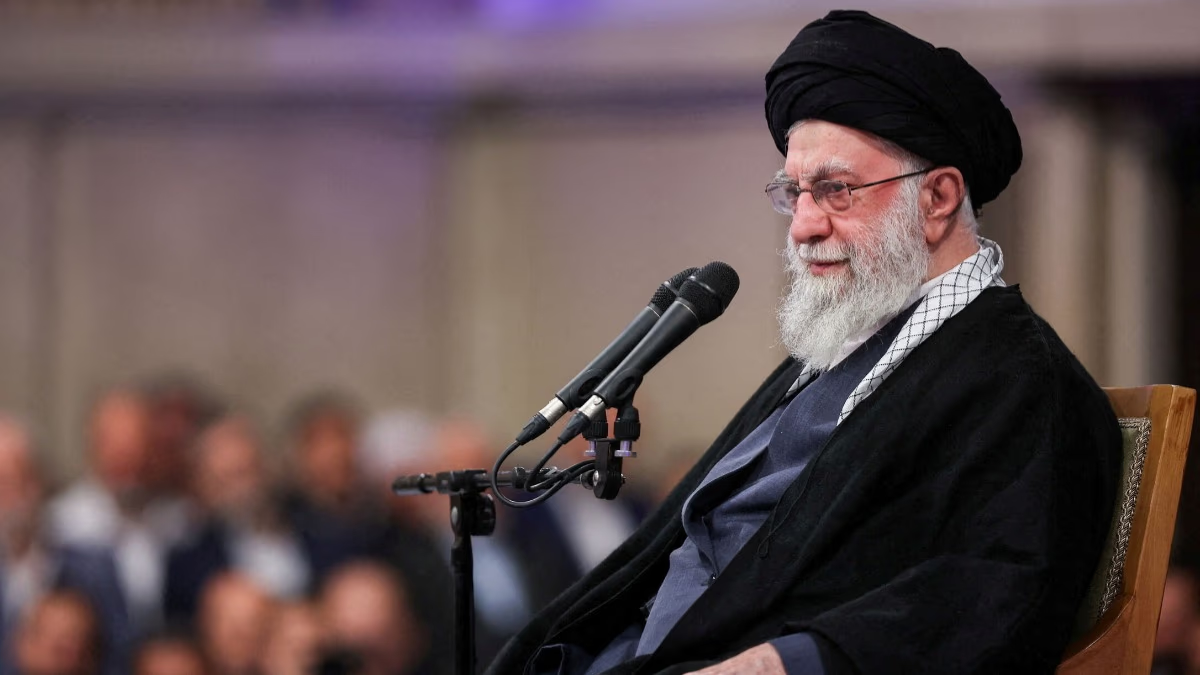
Iran is currently navigating one of its most volatile periods. Anti-government protests ignited against the leadership of Ayatollah Ali Khamenei have entered the 14th day, becoming increasingly violent. The internal security command has been entrusted directly to the Islamic Revolutionary Guard Corps (IRGC) due to the regular army’s and police’s inability to control the escalating situation. This reflects the magnitude of the crisis.
What is IRGC and Why is it So Powerful?
Formed immediately after the 1979 Islamic Revolution, the IRGC's mission was beyond border defense; it aimed to protect the Islamic regime and the supreme leader's authority. Reporting directly to the Supreme Leader rather than the government or parliament, the IRGC emerged as a formidable force, overshadowing Iran's regular military over time.
The IRGC today boasts its own land, naval, and air forces, with specialized units operating abroad. Whenever major military decisions are required, whether concerning Israel or regional conflicts, the responsibility often falls on the IRGC, not the regular army.
Journey from Revolution to Power
The roots of Iran's stern military structure trace back to the mid-20th century. After ascending to power in 1941, Mohammad Reza Shah Pahlavi sought to modernize the nation. However, his close relations with the U.S., oil policies, and strictness in religious matters fueled opposition. During this period, religious leader Ayatollah Ruhollah Khomeini emerged, stepping into the power center post-1979 Islamic Revolution.
Post-revolution, the IRGC was tasked with three core responsibilities: safeguarding the revolution, defending national sovereignty, and foiling coup attempts. The 1980 initiation of the Iran-Iraq War by Iraq's Saddam Hussein provided the IRGC an opportunity to prove itself, cementing its growing influence.
Grip on Politics and Economy
The IRGC is far from just a military body. Its pervasive influence extends deeply into Iran’s politics and economy. Its roots have often served as starting points for many of Iran’s presidents and prominent leaders. According to the International Institute for Strategic Studies, the IRGC consists of approximately 250,000 trained soldiers. However, its impact far surpasses mere numbers, dominating Iran's economy across construction, defense, and infrastructure sectors.
Why is the Basij Force in the Spotlight?
The Basij Force, part of the IRGC, is notably considered its most ground-level and controversial unit. Derived from the Persian term for mobilization, ‘Basij’ was formed post-1979 Islamic Revolution to rally ordinary citizens in support of the government during urgent times.
Mainly, the Basij Force operates within Iran, playing a frontline role in quelling anti-government protests, student movements, and riots. Hence, reports from human rights organizations often accuse it of severe repression and violence.
While not a traditional army, the Basij is a paramilitary volunteer framework capable of mobilizing up to six hundred thousand fighters during crises. Its name frequently appears in allegations of intimidation, manipulation, and electoral fraud. In essence, the Basij Force is seen as the 'street power' behind Iranian authorities, and reports indicate its activation to suppress current protests.