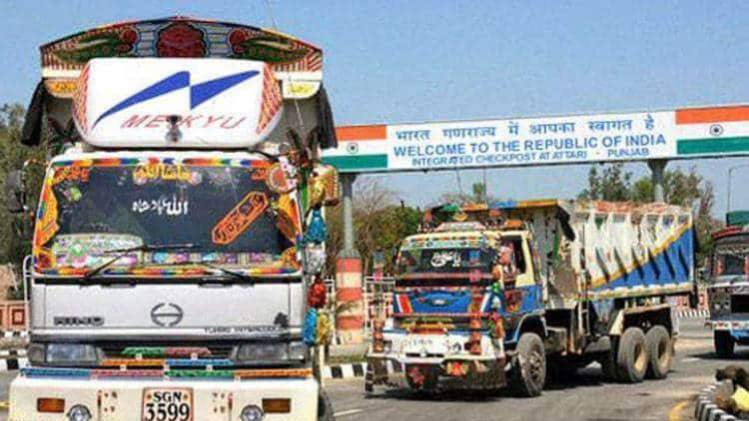
Pakistan has voiced its disapproval of India's unilateral decision to suspend trade across the Line of Control. Alongside this, it has expressed hope for the future resumption of trade. Mohammad Faisal, spokesperson for Pakistan's Foreign Ministry, stated, "We hope the trade will resume soon as it is an initiative to foster trust between the two countries."
Reasons Behind India's Decision
Recently, reports suggested that the trade route was being exploited for smuggling weapons, narcotics, and counterfeit currency across the border. Following these revelations, the Indian government suspended trade across the LoC between the two nations starting April 19, 2019. The trade across this LoC was based on a zero-duty policy.
In providing information on this decision, the Central Home Ministry revealed, "The National Investigation Agency (NIA) disclosed in its investigation that individuals who joined terrorist organizations based in Pakistan had established companies there. These companies, under terrorist control, were sneakily engaging in cross-border trade." According to the ministry, to prevent this, a stringent regulatory and enforcement mechanism is being developed, which will be implemented in consultation with various agencies.
Trade Initiated in 2008
In 2008, trade across the Line of Control between India and Pakistan was launched as a confidence-building measure. Indian traders predominantly exported cumin, chili peppers, textiles, cardamom, bananas, pomegranates, grapes, and almonds. In return, Pakistan exported prayer mats, carpets, textiles, oranges, mangoes, and herbs. This trade primarily took place in the Kashmir region's Baramulla’s Salamabad and Jammu region’s Chakkan-da-Bagh in the Poonch district. The commerce operated four days a week.