“Слава труду” (Glory to Labor), “Пролетарии всех стран, соединяйтесь!” (Workers of the world, unite!)... These slogans echo through the streets, a testament to Russia's communist past. Known globally as a center of communism during the Soviet era, this is common knowledge today. Following the Russian Revolution in 1917, Lenin and the Bolsheviks established a communist regime, rendering Russia the first constitutionally socialist state.
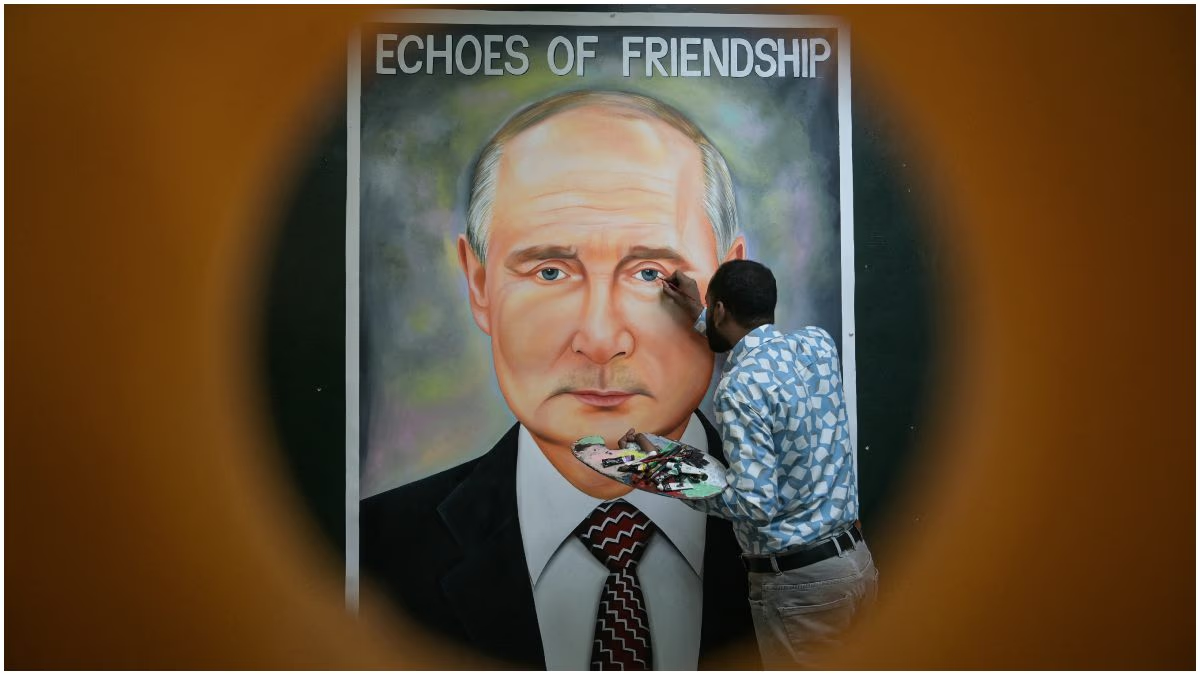
But times have changed, and with them, ideologies, societies, and politics. As Russian President Vladimir Putin visits India, we ponder if communism still holds sway in its stronghold. What ideologies dominate Russia today?
Is Russia Still Communist?
Though Russia was synonymous with communism for nearly a century, the 21st-century Russia presents a different picture. Although democratic roots remain tenuous, viewing Russia as a communist country is no longer accurate. Instead, it has forged an identity as a burgeoning capitalist state. While the Communist Soviet Union ceased on December 26, 1991, the ideology is not entirely extinguished—a faction in Russia still supports it.
Before 1991, communism reigned supreme in the USSR. Post-1991 dissolution saw Russia adopting fresh political and administrative frameworks. In 1991 itself, President Boris Yeltsin banned the Communist Party of the Soviet Union, leading to the rise of the CPRF. Today, two primary parties exist—the United Russia and the CPRF (Communist Party of the Russian Federation).
United Russia, the ruling party for a long time, holds a parliamentary majority, bolstered by regional governments. Putin hails from this party. The CPRF remains the foremost opposition, upholding traditional communist heritage. United Russia commands over a 60% majority, while CPRF stands as the second-largest political party, denoting that opposition is alive and many Russians still hold communist beliefs.
Thus, while communism is not fully eradicated in Russia, the populace increasingly favors market/capitalist governance. Russia no longer claims the mantle of a “communist stronghold.” Though communism exists as an ideology, it no longer governs.
Source: aajtak
Is Putin a Communist?
Putin is frequently heard criticizing communism, positioning his party as a rival to the Russian Communist Party. He often articulates anti-communist sentiments, underscoring his disdain for the ideology. In 2021, asked about Lenin, he labeled Lenin a disruptive force over a thousand years, fixated on revolution and destruction. Putin opined Lenin's foundations were inherently weak, built on violence rather than law.
Though Putin's administration promotes a market-driven economy, accusations of suppressing opposition, controlling media, and centralizing power around a select group evoke the Soviet state's controlled ethos. Elections have long been scrutinized for transparency.
Critics argue elections are a façade. Genuine elections might have seen poorer outcomes for United Russia. Critics are often targeted pre-election, as seen in 2021 when Alexei Navalny's organization was labeled extremist, curbing his associates' campaigns.
Come 2024, Navalny's death in prison sparked further controversy, fueling the notion of non-existent opposition. Those in power seemingly stifle dissent, securing their dominance. Even Putin altered the constitution to extend his tenure.
How Are Elections Conducted?
Russia's electoral processes often garner attention for the wrong reasons. Despite election traditions, results remain predictably unchanged. Let's explore how elections unfold. In 2024, Putin secured 87% of votes.
Elections employ ballot papers, yet results rapidly favor Putin. Public trust in electoral integrity wanes. If no candidate gains a clear majority, a second voting round ensues, a rare requirement. Only once in the past six presidential elections was it needed—in 1996, with Boris Yeltsin against Gennady Zyuganov. In a second round of voting, Yeltsin emerged victorious.
For a period, Putin served as Prime Minister, albeit with actual power vested in him. By 2012, he resumed presidency, appointing Medvedev as Prime Minister. Previously, presidential terms lasted four years. A 2012 constitutional amendment expanded it to six years.
What Was Lenin's Era Like?
Under Lenin, Russia (later the USSR) permitted only one party, the Bolsheviks (later the Communist Party). Political pluralism was abolished. Industries fell under government control. This era marked the initial implementation of Marxist ideology in a major nation, establishing the world's first “socialist state.”
How Many Times Has Putin Visited India?
Putin has visited India ten times. His first visit occurred in October 2000, marking a strategic partnership between the nations. Subsequent visits include December 2002, December 2004, January 2007, March 2010, December 2012, December 2014, October 2018, and December 2021.